Six of Cups and Page of Swords Reversed in Tarot

- Arcana
- Six of Cups — Minor Arcana, Cups; Page of Swords — Minor Arcana, Swords
- Elements
- Six of Cups — Water; Page of Swords — Air
- Elemental interaction
- Neutral elements — energies coexist without conflict
- Numerology
- 6 + 11 = 17 → 8
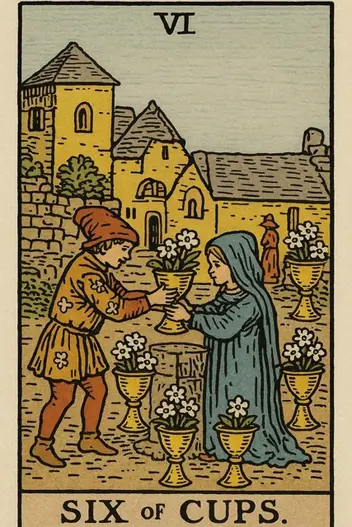
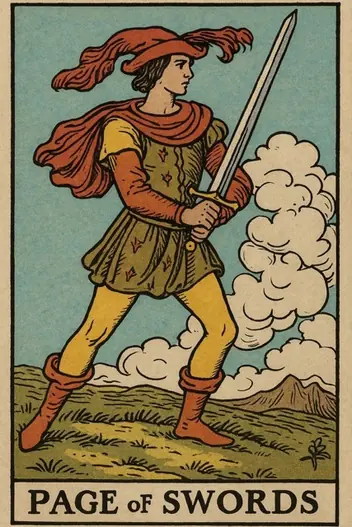
The intersection of the Six of Cups and the Page of Swords creates a fascinating psychological tension. The Six of Cups represents emotional memory, innocence, and a desire to return to a simpler, safer time. It often signals a focus on past relationships, childhood patterns, or unfinished emotional business. In contrast, the Page of Swords is the archetype of intellectual curiosity, mental agility, and a thirst for truth, often delivered with a blunt, unfiltered honesty that can feel disruptive.
When these two cards appear together, they depict a scenario where warm feelings and cherished memories are suddenly confronted by a sharp, critical question. This is not a passive or purely sentimental pairing. It is a call to examine the past not through rose-colored glasses, but through the lens of objective analysis. The seeker is asked to reconcile what they feel about a situation with what they know to be factually true. This combination forces a decision: remain in the comfort of nostalgia, or use new information to redefine your emotional landscape.
Six of Cups and Page of Swords Together: Meaning
The core dynamic of the Six of Cups and Page of Swords is the collision of emotional attachment with intellectual skepticism. The Six of Cups provides the emotional data—feelings of security, fondness, or a longing for the way things were. The Page of Swords supplies the cognitive framework to dissect that data. The result is a powerful internal dialogue: "Is this memory accurate, or am I romanticizing it?" "Are these feelings guiding me, or trapping me?"
This combination often manifests as a person who is revisiting a past relationship, a childhood dream, or a career path they once loved, but they are now armed with new information or a more mature perspective. The energy is investigative, but the subject is emotional. This can lead to productive breakthroughs—such as recognizing a toxic pattern from your upbringing—or to defensive arguments where the seeker uses logic to protect a fragile emotional wound. The key psychological insight here is the integration of head and heart. The Page of Swords does not dismiss the feelings of the Six of Cups; it interrogates them to ensure they are based on reality, not fantasy.
Six of Cups and Page of Swords for Career and Money
Strategic Opportunities:
Audit your professional past. Revisit old contacts, former skills, or projects you abandoned. The Page of Swords gives you the clarity to see which past opportunities are worth reviving.
Strategic Opportunities:
Use research to validate a legacy idea. If you have a business concept rooted in tradition or family history, now is the time to analyze its market viability with cold, hard data.
Calculated Risks:
Avoid making decisions based solely on sentiment. Do not invest in a venture just because it reminds you of a happy time or a mentor. The Page of Swords warns against letting nostalgia override financial logic.
Professionally, this combination is a call for a strategic review of your career narrative. You might be considering a return to a former industry, a role you once held, or a project you shelved years ago. The Six of Cups provides the emotional motivation—the passion, the sense of purpose. The Page of Swords provides the due diligence. Before you act, conduct a thorough SWOT analysis (Strengths, Weaknesses, Opportunities, Threats) of the past situation. Ask: "What has changed since I left? What did I learn that I can now apply differently?" A critical financial warning: Be wary of "sunk cost fallacy." Just because you invested time or emotion into something in the past does not mean it is a wise investment now. The Page of Swords demands that you cut emotional ties from financial decisions.
Your pair is already on the table. Ask your question and draw the clarifying card
or simply focus on it
Six of Cups and Page of Swords as Feelings
If you are single:
This pair suggests you may be idealizing a past lover or a specific "type" from your history. The Page of Swords urges you to objectively evaluate whether this pattern serves your current growth, rather than repeating old cycles.
If you are in a relationship:
You or your partner may be using intellectual arguments to avoid addressing an emotional wound from the past. The challenge is to communicate the truth without dismissing each other's feelings.
In relationships, this combination often signals a crucial conversation about history. One partner may want to rekindle an old flame or revisit a cherished memory, while the other wants to analyze why that memory is so important. The psychological risk is intellectualizing emotions to avoid vulnerability. For example, instead of saying "I miss how we used to laugh together," the Page of Swords energy might say, "Statistically, we were happier then because we had fewer responsibilities." The key relationship advice is to use your analytical skills to understand, not to win an argument. If you are the one bringing the critical voice, ask yourself: "Am I trying to protect myself from being hurt again, or am I genuinely curious about the truth?" If you are the one feeling nostalgic, ask: "Is this a healthy memory to revisit, or am I using it to escape current dissatisfaction?"
The Shadow Side of Six of Cups and Page of Swords
The shadow side of this pairing emerges when the Page of Swords' critical energy becomes weaponized against the Six of Cups' vulnerability. The seeker may use sharp, cynical remarks to dismiss their own or others' tender feelings, labeling nostalgia as "weak" or "irrational." This is a defense mechanism—a cognitive bias known as rationalization, where logic is used to justify avoiding emotional pain. Alternatively, the shadow can manifest as naive optimism (the Six of Cups' shadow), where the seeker ignores clear red flags or new information because they are clinging to a pleasant memory. They might say, "But it was always so good before," while the Page of Swords' data screams, "The circumstances have fundamentally changed." Self-sabotage occurs when the seeker cannot decide which card to trust, oscillating between sentimental decisions and harsh criticism, never achieving integration. The pitfall is analysis paralysis: overthinking a simple emotional need until it becomes a complex intellectual puzzle, leading to inaction.
Uncover hidden insights
Let our advanced Tarot system interpret these archetypes specifically for your personal path.
Six of Cups and Page of Swords Reversed: How to Read It
Six of Cups Reversed:
A blocked resource from the past. You cannot extract a lesson from experience — it is either traumatic or idealized beyond recognition. Advice: Before making plans, conduct an "audit of memories." Separate facts from emotions using a journal. This is not a time for decisions — it is a time for honest inventory.
Page of Swords Reversed:
Internal resistance to new knowledge. You refuse to analyze the past, preferring to live in a sweet illusion. Warning: You risk missing a critical signal that your current strategy is not working. Your intellect is sabotaging you by retreating into empty arguments with yourself.
BOTH Reversed:
Complete imbalance: chaotic past and paralyzed mind. This is a state of "stuck in reflection." Corrective measure: Introduce a strict rule of "1 analysis = 1 action." As soon as you understand something from the past, immediately take a micro-step (make a call, write a line of code, buy a book). Break the cycle of endless rumination.
Six of Cups and Page of Swords: Tarot Advice
How to constructively use the energy of the Six of Cups to balance the Page of Swords? Make the past your ally, not your judge. Your strategy is "archaeology of the future." You take an artifact from the past (a successful case, warm relationships, an old skill), meticulously dissect it using the Page's analytical prowess, and then assemble a new, working mechanism from these pieces.
Do not try to choose between "heartfulness" and "logic." Your strength lies in their synthesis. Use the emotional security of the Six as a proving ground for the Page's bold ideas. Ask yourself: "Which of my old strengths could make this new, risky step more sustainable?" The answer to this question is your strategic plan.
This union requires courage. The courage to look at your "sacred cows" with a cool mind and, perhaps, to let them go, keeping only the dry residue of wisdom. Your task is not to preserve the past, but to capitalize on its experience to create something new. Only then does nostalgia cease to be a brake and become fuel for growth.
Your Next Step: Personal Context Matters
The core message of the Six of Cups and Page of Swords is honest reflection. You are being asked to honor your past without being trapped by it, and to use your mind to understand your heart, not to silence it. This combination is a powerful tool for breaking generational patterns and making informed emotional choices.
While this article provides a deep analysis of the archetypes, the true power of Tarot lies in personal application. Your specific question, your unique history, and your current emotional state will shape the exact meaning of these two cards for you. To get a personalized, in-depth reading that considers your exact situation, use the Fortune Cards app. You can access it on the web or download it to receive a custom interpretation of the Six of Cups and Page of Swords for your specific relationship, career, or personal question—right now.
Interpretation by the Fortune Cards editorial team, based on the Rider–Waite tradition and Jungian archetypes. About our methodology · Updated: 2026-08-26
Other Combinations with Six of Cups
Other Combinations with Page of Swords
Explore Individual Card Meanings
Table of Contents
- Six of Cups and Page of Swords Together: Meaning
- Six of Cups and Page of Swords for Career and Money
- Six of Cups and Page of Swords as Feelings
- The Shadow Side of Six of Cups and Page of Swords
- Six of Cups and Page of Swords Reversed: How to Read It
- Six of Cups and Page of Swords: Tarot Advice
- Your Next Step: Personal Context Matters
Ready to find answers to your questions?
Start your first reading now and look at your situation with fresh clarity. The cards are ready to reveal deeper meaning.