Love Tarot: Strength and Eight of Swords
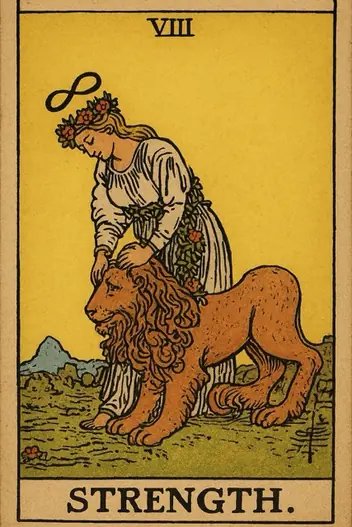
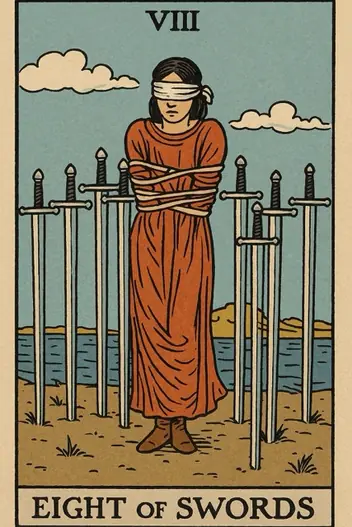
- Arcana
- Strength — Major Arcana; Eight of Swords — Minor Arcana, Swords
- Elements
- Strength — Fire; Eight of Swords — Air
- Elemental interaction
- Friendly elements — energies support each other
- Numerology
- 8 + 8 = 16 → 7
The intersection of Strength and the Eight of Swords is a study in internal conflict. Strength represents raw courage, emotional resilience, and the ability to tame your own impulses—a Jungian integration of the shadow. The Eight of Swords, conversely, depicts a state of self-imposed paralysis, cognitive distortion, and perceived victimhood. When these cards appear together, the core question is not about external obstacles, but about whether you will use your inner power to dismantle the prison of your own making.
This combination forces a pragmatic confrontation: the only thing truly binding you is a limiting belief system. Strength is not about brute force; it is the disciplined application of patience and self-compassion to cut through the mental fog of the Eight of Swords. The path forward requires you to stop waiting for rescue and instead recognize that your agency has been present all along—you just haven't been willing to see it.
What Do Strength and Eight of Swords Mean Together?
The psychological state created by Strength + Eight of Swords is one of latent power trapped by over-analysis. You possess the emotional stamina to handle a difficult situation, but your mind has constructed a narrative of helplessness. The Eight of Swords represents a cognitive bias known as "learned helplessness" —a belief that no action you take will change your circumstances. Strength enters to challenge that story. It asks you to distinguish between real threats and imagined constraints.
Practically, this pairing suggests you are overthinking a problem that requires emotional grit rather than intellectual debate. You may feel boxed in by circumstances, but Strength reveals that the bars of the cage are made of fear, not steel. The key is to stop trying to predict every outcome and instead take one small, courageous action. This could mean having a difficult conversation, ending a draining pattern, or simply acknowledging that you have the resources to cope with uncertainty. The most important insight here is that your perceived lack of options is a symptom of exhaustion, not reality.
Your pair is already on the table. Ask your question and draw the clarifying card
or simply focus on it
Love and Relationships
If you are single:
This combination warns against idealizing unavailable partners or staying in a cycle of self-doubt. Your fear of rejection is blinding you to genuine opportunities. Use Strength to set a boundary with your own inner critic before engaging with new people.
If you are in a relationship:
This pairing signals a dynamic where one partner feels trapped by unspoken rules or past grievances. The relationship is not the cage; the refusal to communicate honestly is.
In relationships, Strength and Eight of Swords point to a breakdown in emotional intelligence. One or both partners may be holding onto resentment or guilt, creating a silent prison of passive-aggression. The Strength card calls for compassionate confrontation—not to attack, but to clarify. If you feel stuck, ask yourself: "What am I afraid to say because I fear the reaction?" The answer is the key to liberation. Bold advice: Schedule a low-stakes, timed conversation (15 minutes) to air one specific frustration. The act of speaking your truth is the strongest move you can make.
Deepen your understanding
Find out exactly what this reading means for your current life situation with our oracle.
What Do Strength and Eight of Swords Indicate for Your Career?
Strategic Opportunities:
Use your emotional resilience to tackle a project you've been procrastinating on due to perfectionism. The first draft is the cage; completion is freedom.
Strategic Opportunities:
Leverage your network for an outside perspective. You are likely overestimating risks and underestimating your own competence. A mentor or colleague can help you see the exit.
Calculated Risks:
Avoid making major financial commitments while feeling trapped or desperate. The Eight of Swords distorts risk assessment. Do not sign contracts or make investments until you have slept on the decision for at least three days.
Professionally, this combination is a red flag for decision paralysis under pressure. You may feel stuck in a role, a negotiation, or a financial strategy that is not serving you. Strength advises you to focus on what you can control: your output, your boundaries, and your next request. If you feel undervalued, the cage is your silence. Bold warning: Do not mistake loyalty for obligation. Staying in a bad situation out of fear of the unknown is a cognitive trap. Financially, this is not a time for high-risk bets; instead, use your inner discipline to create a 90-day plan that allows you to pivot gradually.
What If Strength or Eight of Swords Appears Reversed?
When cards appear in a reversed position, the dynamic becomes distorted, but does not disappear.
If Strength is Reversed:
The potential is blocked. This can manifest as recklessness (an attempt to prove one's strength through aggression) or, conversely, as complete apathy and loss of will. Advice: slow down. Your energy is currently out of control — any action will worsen the situation. First, regain your grounding.
If the Eight of Swords is Reversed:
The person begins to recognize the illusory nature of their limitations, but is not yet ready to act. This is a state of "awakening" — you see that a way out exists, but fear still binds you. Warning: do not confuse awareness with action. You risk getting stuck in analysis without taking a step.
If BOTH are reversed:
Complete imbalance. You may experience guilt about your own strength or, conversely, aggressively deny your vulnerability. This is a state of chaos where you can neither restrain yourself nor take action. The logical way to correct this is to return to basic needs: sleep, food, physical activity. First restore the body's resources, then the psyche's.
Shadow Side & Pitfalls
The shadow manifestation of Strength + Eight of Swords is martyrdom disguised as patience. You may be tolerating a toxic situation, believing that your endurance is noble when it is actually self-abandonment. The cognitive bias here is "bystander apathy" applied to your own life—you wait for someone else to solve the problem while you suffer silently. Alternatively, this can manifest as passive-aggressive control: using your perceived helplessness to manipulate others into rescuing you. The pitfall is that you may confuse emotional exhaustion with wisdom. If you feel stuck for more than a few weeks, you are not contemplating; you are avoiding. The shadow demands you ask: "Am I truly powerless, or am I unwilling to accept the cost of change?"
What Is the Overall Message of Strength and Eight of Swords?
Constructive use of this combination requires a shift in focus from "why I can't" to "how I can". The energy of Strength is ideally suited for taming not a lion, but your own inner critic. Your task is not to break down walls, but to acknowledge that they do not exist. The Eight of Swords is not a prison, but a labyrinth with only one way out — through action.
Strategic advice: use the "anatomy of fear" method. Break your fear down into its components: what exactly is frightening? What is the probability of it happening? What will you do if it does happen? Once fear becomes concrete, it loses its power. Your Strength must be directed toward taking responsibility for your perception, not toward changing external circumstances.
Key takeaway: you are not a victim of circumstances; you are a willing prisoner of your own beliefs. The way out lies in action, no matter how small.
Applying This to Your Situation
The core message of Strength and Eight of Swords is that your inner power is the only tool you need to break free from mental traps. The cage is not your circumstances—it is your belief that you have no choice. You have the courage to feel the fear and act anyway. The general archetype is clear, but the real insight lies in how this dynamic plays out in your specific situation.
To get a deep, personalized interpretation of this exact combination for your unique question, use the Fortune Cards app. While this article provides the framework, the true magic happens when Tarot is applied to your life. The app can be used on the web or downloaded to give you a tailored reading that identifies the exact thought pattern holding you back and the precise action Strength is urging you to take. Stop reading and start breaking your cage. Get your personalized reading now.
Interpretation by the Fortune Cards editorial team, based on the Rider–Waite tradition and Jungian archetypes. About our methodology · Updated: 2026-08-26
Other Combinations with Strength
Other Combinations with Eight of Swords
Explore Individual Card Meanings
Table of Contents
- What Do Strength and Eight of Swords Mean Together?
- Love and Relationships
- What Do Strength and Eight of Swords Indicate for Your Career?
- What If Strength or Eight of Swords Appears Reversed?
- Shadow Side & Pitfalls
- What Is the Overall Message of Strength and Eight of Swords?
- Applying This to Your Situation
Ready to find answers to your questions?
Start your first reading now and look at your situation with fresh clarity. The cards are ready to reveal deeper meaning.