Ten of Wands and Seven of Swords Together in Tarot
- Arcana
- Ten of Wands — Minor Arcana, Wands; Seven of Swords — Minor Arcana, Swords
- Elements
- Ten of Wands — Fire; Seven of Swords — Air
- Elemental interaction
- Friendly elements — energies support each other
- Numerology
- 10 + 7 = 17 → 8
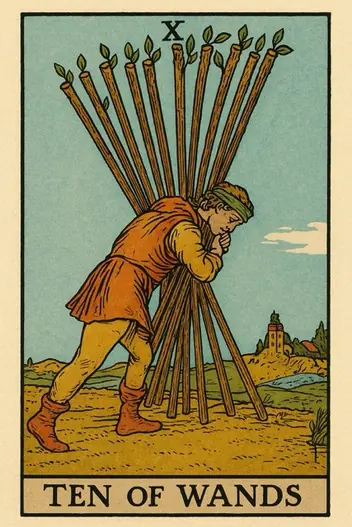
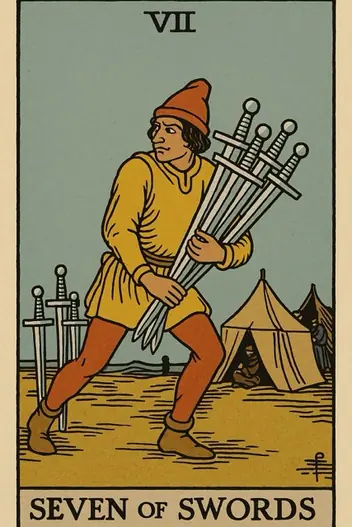
When the Ten of Wands meets the Seven of Swords, we encounter a powerful psychological tension: the weight of overwhelming responsibility colliding with the impulse to escape through cunning or secrecy. The Ten of Wands represents the physical and mental exhaustion of carrying too much—a load that may be self-imposed or externally mandated. The Seven of Swords, in contrast, embodies strategic withdrawal, covert action, and the shadow of deceit. Together, these cards describe a scenario where you are so burdened that you feel compelled to cut corners, hide the truth, or even betray others to lighten your load.
This combination often surfaces when a person is overcommitted and under-resourced, leading to rationalization of dishonest behavior. It’s not about malice, but about survival instincts gone awry. The key psychological insight here is that the burden itself is often the root cause of the deception—not a character flaw, but a symptom of poor boundaries or unsustainable obligations. The challenge is to recognize when your coping mechanisms are undermining the very goals you’re trying to achieve.
Core Dynamics & Interpretation
The core dynamic between these two cards is a conflict between duty and self-preservation. The Ten of Wands demands endurance, responsibility, and visible effort. The Seven of Swords whispers that there’s a smarter, faster, or hidden way out. This creates a cognitive dissonance: you know you should be transparent and diligent, but the pressure is so intense that deception feels like the only viable solution. Psychologically, this is a classic approach-avoidance conflict—you want relief from the burden, but you fear the consequences of the escape route you’re considering.
In practice, this combination often manifests as micromanaging a failing project while secretly shifting blame to others, or taking on extra work at home while hiding your resentment and exhaustion. The Seven of Swords energy is not inherently evil; it represents strategic thinking and mental agility. However, when paired with the crushing weight of the Ten of Wands, that agility turns into manipulation. The real-world implication is that you are likely ignoring the root cause of your overload—perhaps poor delegation, unrealistic expectations, or a refusal to ask for help—and instead focusing on how to game the system.
The most important takeaway is this: the deception is a symptom, not the disease. To resolve this dynamic, you must first address the burden itself. Reduce your load through honest communication, delegation, or boundary-setting. Only then can the Seven of Swords’ strategic energy be channeled constructively—into creative problem-solving rather than covert escape.
What Do Ten of Wands and Seven of Swords Say About Love?
If you are single:
This combination suggests you may be attracted to partners who seem mysterious or unavailable, but you’re also carrying emotional baggage from past relationships. Be cautious of projecting your own need for escape onto a new connection—you might be deceiving yourself about their true intentions.
If you are in a relationship:
There is a significant risk of hidden resentments or secret behaviors between you and your partner. One of you may be shouldering an unfair share of emotional or practical responsibilities, leading to passive-aggressive tactics or outright dishonesty to reclaim personal space.
In relationships, the Ten of Wands and Seven of Swords together point to a power imbalance masked by secrecy. The partner carrying the burden (Ten of Wands) may feel justified in hiding their exhaustion or making small compromises without full transparency. Meanwhile, the other partner might be unaware of the true cost of their expectations, creating a cycle of unspoken debt. The key relationship advice here is to prioritize radical honesty about your capacity. If you are the one feeling overwhelmed, state your limits clearly rather than resorting to silent withdrawal or white lies. If you suspect your partner is hiding something, approach with curiosity rather than accusation—ask directly, “What are you carrying that I don’t see?” This combination warns that unspoken burdens inevitably lead to hidden betrayals, whether emotional or practical. Repair requires both partners to renegotiate responsibilities transparently and release the need for secret coping mechanisms.
Your pair is already on the table. Ask your question and draw the clarifying card
or simply focus on it
Career and Finances
Strategic Opportunities:
Use the Seven of Swords’ mental agility to audit your current workload and identify tasks that can be delegated, automated, or eliminated. This is a time for strategic downsizing, not dishonesty.
Strategic Opportunities:
Channel the Ten of Wands’ endurance into building a reputation for reliability—but only after you’ve honestly communicated your limits. Transparency about capacity can earn you respect and support.
Calculated Risks:
Avoid cutting ethical corners to meet deadlines or quotas. The short-term gain of a “smart” shortcut will likely backfire when discovered, damaging your credibility.
In a career context, this combination is a red flag for burnout-driven dishonesty. You may be tempted to falsify progress reports, take credit for others’ work, or hide mistakes because you feel overwhelmed by your responsibilities. The psychological trap is believing that the ends justify the means—that your heavy load excuses strategic omissions. Financially, the Seven of Swords warns of hidden costs or deceptive transactions. If you’re in negotiations, double-check all documentation and be wary of deals that seem too good to be true. The Ten of Wands suggests that your current financial strain is real, but the Seven of Swords warns that deceiving yourself or others about your situation will only deepen the hole. A critical financial warning: avoid using credit cards or loans to temporarily hide cash flow problems. Instead, create a transparent budget that accounts for your true load and cut expenses accordingly. The strategic move here is to leverage your intelligence for honest efficiency—find smarter ways to work, not sneakier ways to avoid accountability.
Ask your specific question
Don't rely on generic meanings. Get a customized reading tailored specifically to your energies.
Shadow Side & Pitfalls
The shadow of this combination is self-deception compounded by external manipulation. When these energies are blocked or acted upon irrationally, the seeker may develop a victim narrative—“I have to do everything myself, and no one helps me, so I’m justified in my little deceptions.” This cognitive bias allows them to ignore their own role in creating the burden (e.g., saying yes to everything, refusing to delegate) while blaming others for the need to be dishonest. The Seven of Swords’ shadow is paranoia and secrecy; the Ten of Wands’ shadow is martyrdom and resentment. Together, they create a toxic loop: you feel overburdened, so you hide your struggles, which isolates you, which makes the burden feel heavier, which drives you to more extreme deception. Self-sabotage manifests as choosing the path of least resistance—silently quitting a project while pretending to still work on it, or emotionally withdrawing from a partner while staying in the relationship out of obligation. The pitfall is that short-term relief from deception leads to long-term erosion of trust—with others and with yourself.
Reversed Positions: What Changes?
Ten of Wands Reversed:
This is blocked potential and recklessness. The person isn't just tired; they are abdicating responsibility. They drop the burden abruptly and illogically, creating chaos. In combination with the upright Seven of Swords, this means the deceiver (the Seven) is profiting from someone else's recklessness. Advice: do not try to "rescue" someone who abandons their own affairs. Focus on your own strategy.
Seven of Swords Reversed:
This is inner resistance and weakness. The person wants to deceive but lacks the courage or skill. They are tormented by guilt. In combination with the upright Ten of Wands, this is a state of paralysis: you are too tired to lie, and too afraid to tell the truth. Advice: admit your inability to cope. Weakness, when voiced aloud, often inspires more trust than silent suffering.
BOTH Reversed:
Complete imbalance. This is the rejection of strategy and the rejection of effort. The person simultaneously sheds their obligations (reversed Ten) and is incapable of cunning (reversed Seven). They are simply "drifting with the current," losing control. The logical way to correct this is a total revision of values. You need to redefine what is important to you and start with a clean slate, without looking back at past debts.
Ten of Wands and Seven of Swords Combined Message
How can the energy of the Ten of Wands be used constructively to balance the Seven of Swords? The answer is paradoxical: acknowledge your fatigue and your inability to solve everything alone—and then the need for cunning will fall away. The Seven of Swords is not about evil; it is about a lack of resources for direct action. If you reduce your burden (the Ten), you will have the energy for honest, open competition, rather than behind-the-scenes games.
Your strategic advice: transform "cunning" into "strategy." Instead of deceiving, begin maneuvering. The healthy Seven of Swords is the ability to choose your "battles," to avoid direct confrontation where it is disadvantageous, and to find unconventional solutions. The healthy Ten of Wands is the experience that has taught you to set priorities.
The main takeaway:
You are not obligated to carry everything on your shoulders. And you do not need to lie to shed this burden. Use the intellect of the Seven of Swords not for manipulating people, but for optimizing processes. Find what can be automated, delegated, or postponed. And do so openly. An honest acknowledgment of your limits is not a weakness, but the highest form of strategic planning.
Where to Go From Here
The core message of the Ten of Wands and Seven of Swords is clear: your burdens are real, but your escape route must be honest. The solution is not to hide from your responsibilities or manipulate your way out, but to reduce your load through transparent communication and strategic delegation. Recognize that the deception you are considering is a symptom of overwhelm, not a solution. Your next step is to audit your commitments honestly and release what is not yours to carry.
While this article provides a comprehensive archetypal analysis, the true power of Tarot lies in its application to your unique situation. The Fortune Cards app can give you a deep, personalized interpretation of this exact combination for your specific question—whether about a relationship, career decision, or inner conflict. Use the app on the web or download it now to receive a reading that accounts for your personal context, helping you turn this challenging energy into a clear, ethical path forward.
Interpretation by the Fortune Cards editorial team, based on the Rider–Waite tradition and Jungian archetypes. About our methodology · Updated: 2026-08-26
Other Combinations with Ten of Wands
Other Combinations with Seven of Swords
Explore Individual Card Meanings
Ready to find answers to your questions?
Start your first reading now and look at your situation with fresh clarity. The cards are ready to reveal deeper meaning.