Ten of Wands and Three of Pentacles Tarot as Feelings
- Arcana
- Ten of Wands — Minor Arcana, Wands; Three of Pentacles — Minor Arcana, Pentacles
- Elements
- Ten of Wands — Fire; Three of Pentacles — Earth
- Elemental interaction
- Neutral elements — energies coexist without conflict
- Numerology
- 10 + 3 = 13 → 4
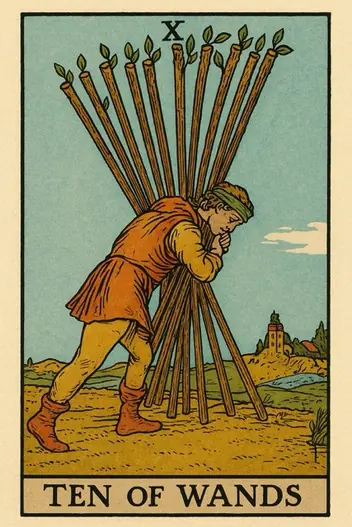
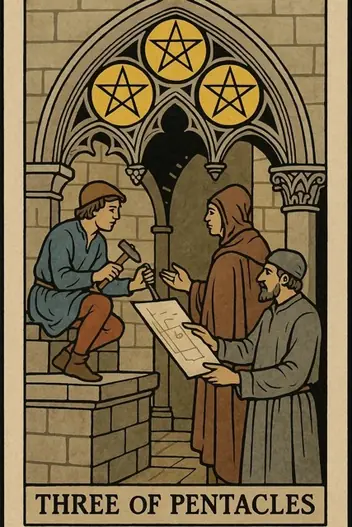
When the Ten of Wands collides with the Three of Pentacles, we witness a potent archetypal tension: the weight of accumulated responsibility meeting the focused discipline of skilled craftsmanship. Psychologically, this is the moment when a person has taken on too much—perhaps out of duty, ambition, or a fear of delegating—yet they are also deeply committed to doing the work well. The result is a state of heroic overextension, where the seeker is not merely busy but is actively building something of lasting value while their own resources deplete.
From a Jungian perspective, this pair represents the Shadow of the Perfectionist. The Three of Pentacles calls for collaboration, learning, and incremental progress, but the Ten of Wands pressures the individual to carry the entire project alone. The key insight here is that competence without boundaries leads to burnout. The cards ask: Are you building a cathedral, or are you just carrying bricks for everyone else?
Ten of Wands and Three of Pentacles Combination Meaning
The psychological state created by this combination is one of strategic exhaustion. You are likely in a phase where your expertise is recognized—colleagues, partners, or clients see your skill and trust you with critical tasks. However, the Ten of Wands warns that this trust can morph into an unspoken expectation that you will always shoulder the heaviest load. The core dynamic is a trade-off between quality and capacity. You are producing high-standard work, but the cost is your personal bandwidth and emotional reserves.
In practical terms, this pairing suggests you are operating in a "crunch mode" that is unsustainable. The Three of Pentacles energy wants you to refine your process, learn new techniques, and collaborate effectively. But the Ten of Wands energy is telling you that you have already exceeded your optimal workload. The cognitive bias at play is the sunk cost fallacy: you feel you have invested so much that stopping or delegating now would waste your effort. The truth is that the most strategic move is to restructure your workflow, not just push harder.
This combination also highlights the difference between being a leader and being a martyr. The Three of Pentacles is a card of apprenticeship and teamwork; it thrives on shared knowledge. The Ten of Wands, however, is solitary burden-bearing. When these energies merge, you must ask yourself: Am I teaching others to carry their load, or am I hoarding responsibility out of a need for control?
Your pair is already on the table. Ask your question and draw the clarifying card
or simply focus on it
Career and Finances
Strategic Opportunities:
Delegate specific tasks to trusted colleagues or freelancers. The Three of Pentacles rewards collaboration—use it to offload repetitive work while you focus on high-value strategy.
Strategic Opportunities:
Invest in skill-building or training that makes your work more efficient. This could mean learning a new software, automating a process, or hiring a mentor to refine your methods.
Calculated Risks:
Avoid taking on new projects until you have cleared your current backlog. The Ten of Wands warns that saying "yes" to more work now will compromise the quality of everything you touch.
In a professional context, this combination is a warning against over-promising and under-delivering. You may be the go-to expert in your field, but the Three of Pentacles reminds you that even master craftsmen need time to refine their work. Financially, this pair suggests you are generating steady income through your skills, but the cost is your time and energy. A critical financial warning: do not confuse activity with productivity. You may be billing many hours, but if you are constantly firefighting, your profit margin is actually shrinking due to burnout and errors.
Strategically, the best move is to systemize your workflow. Create standard operating procedures, train a junior team member, or use project management tools to track progress. The Three of Pentacles energy thrives on structure; apply it to reduce the Ten of Wands chaos. Remember that your career longevity depends on sustainable output, not heroic sprints.
What Do Ten of Wands and Three of Pentacles Say About Love?
If you are single:
This pair suggests you may be approaching potential partners with a "prove your worth" mindset. You are so focused on your own goals and responsibilities that you may overlook someone who offers genuine support. Evaluate new connections based on whether they lighten your load, not just impress you.
If you are in a relationship:
You or your partner may be over-functioning in the relationship, taking on the majority of emotional labor or practical tasks. This creates an imbalance where one person feels burdened and the other feels inadequate.
The relationship dynamics here are defined by unspoken contracts and unequal distribution of effort. One partner may be acting as the "master craftsman" of the relationship—planning dates, managing finances, solving problems—while the other feels like an apprentice who is never trusted to do things correctly. The key advice is to explicitly renegotiate roles. The Three of Pentacles is a card of collaboration, not hierarchy. If you feel overwhelmed, communicate your capacity clearly and allow your partner to step up. This is not a sign of weakness; it is an act of emotional intelligence that prevents resentment.
Boldly, the healthiest path forward is to stop treating your relationship as a solo project. The Ten of Wands burden is often self-imposed through a fear of disappointing others. Recognize that asking for help is a form of strength, and that true partnership involves shared weight.
Get a personalized interpretation
Unlock the combined meaning of your cards in the context of your unique question — for free.
Shadow Side & Pitfalls
The shadow manifestation of this pairing is perfectionism disguised as martyrdom. You may believe that no one else can do the work as well as you, so you refuse to delegate. This is a cognitive bias known as the "curse of knowledge" : you assume others lack your expertise, so you take on everything yourself. The result is chronic exhaustion, a decline in work quality, and strained relationships.
Another pitfall is passive-aggressive resentment. You might agree to take on more responsibility (Ten of Wands) while internally fuming that no one helps you. Instead of communicating your limits, you may "punish" others by withdrawing or becoming hypercritical. This is a classic Shadow of the Three of Pentacles—the apprentice who resents the master, or the master who resents the apprentice's incompetence. Self-sabotage emerges when you equate your self-worth with how much you can endure. Recognize that saying "no" is not a failure; it is a strategic choice that protects your long-term output.
Reversed Ten of Wands and Three of Pentacles Explained
When cards appear in a reversed position, the dynamic becomes distorted, but does not disappear. This indicates blocked mechanisms or their pathological manifestation.
If the Ten of Wands is reversed:
This is the release of an unbearable burden, but not through proper delegation, but through a reckless abandonment of obligations. You risk dropping a project or relationship halfway through, without seeing it through to completion, due to a sudden bout of exhaustion. Advice: do not act rashly, but structure your withdrawal.
If the Three of Pentacles is reversed:
This is an internal resistance to learning and collaboration. You reject help not because you are busy, but out of pride or fear of appearing incompetent. The quality of work declines, yet you stubbornly continue to do everything your own way. Warning: your self-isolation leads to professional degradation.
If BOTH are reversed:
Complete imbalance. You are simultaneously overloaded and ineffective. This is a state of "running on a hamster wheel" with zero results. The logical way to correct this is a complete stop. You need an audit of all current tasks and, likely, a change in your field of activity or approach to work.
Ten of Wands and Three of Pentacles Combined Message
To constructively harness the energy of this pair, it is necessary to invert the hierarchy of values. The Three of Pentacles (quality, mastery, teamwork) must become the foundation, while the Ten of Wands (volume, obligations) is merely a temporary superstructure. Your strategic task is not to carry the burden, but to build a mechanism that will move it for you. This requires a firm rejection of the "martyr" role and a transition to the role of "architect."
Practically, this means implementing the "80/20" rule: 80% of your time should be spent on what you do best (Three of Pentacles), and only 20% on maintaining control over routine (Ten of Wands). If the proportion is reversed, you are in crisis. A deep strategic piece of advice: learn to say "no" to opportunities. Every new opportunity that does not cancel out old obligations is a trap. Use the energy of the Ten of Wands not to carry everything, but to clear space for your true mastery.
Where to Go From Here
The core message of Ten of Wands and Three of Pentacles is that mastery requires boundaries. You have the skills and dedication to build something significant, but only if you manage your capacity with ruthless honesty. The path forward is not to work harder, but to work smarter by leveraging collaboration and systemization. This combination is a call to stop being the sole carrier of your project's weight and start becoming its architect.
While this article provides a deep understanding of these archetypes, the true power of Tarot lies in applying it to your unique situation. The Fortune Cards app allows you to input your specific question—whether about a relationship, a career decision, or a personal challenge—and receive a personalized interpretation of this exact card combination tailored to your context. You can use the app on the web or download it now to get the clarity you need to move forward with confidence.
Interpretation by the Fortune Cards editorial team, based on the Rider–Waite tradition and Jungian archetypes. About our methodology · Updated: 2026-08-26
Other Combinations with Ten of Wands
Other Combinations with Three of Pentacles
Explore Individual Card Meanings
Table of Contents
Ready to find answers to your questions?
Start your first reading now and look at your situation with fresh clarity. The cards are ready to reveal deeper meaning.