Ten of Wands and Two of Swords Reversed in Tarot
- Arcana
- Ten of Wands — Minor Arcana, Wands; Two of Swords — Minor Arcana, Swords
- Elements
- Ten of Wands — Fire; Two of Swords — Air
- Elemental interaction
- Friendly elements — energies support each other
- Numerology
- 10 + 2 = 12 → 3
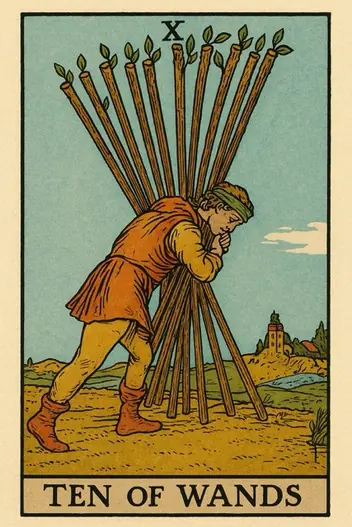
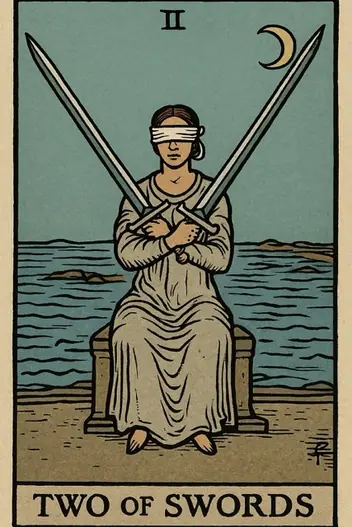
When the Ten of Wands meets the Two of Swords, we encounter a powerful psychological conflict: the overwhelming weight of responsibility colliding with a deliberate refusal to see a clear path forward. This is not a card of easy answers, but a snapshot of a mind under siege. The Ten of Wands represents the physical and mental exhaustion from carrying too many burdens—projects, obligations, or emotional debts—while the Two of Swords signifies a willful blindness, a strategic decision to avoid making a choice because all options feel equally painful. Together, they depict a person who is overworked, overburdened, and paralyzed by the very need to decide which load to drop.
This combination often surfaces when you have taken on more than is sustainable, yet you are trapped in a state of analysis paralysis. You are aware of the weight, but you are refusing to look at the full picture. The psychological tension here is high: the ego wants to maintain control and avoid the pain of a difficult decision, but the body and spirit are crying out for relief. The core question becomes: How do you move forward when you are too tired to think and too scared to choose?
Ten of Wands and Two of Swords Together: Meaning
The central dynamic of the Ten of Wands and Two of Swords is a defensive stalemate with your own life. Psychologically, this represents a state of learned helplessness combined with cognitive dissonance. You are working incredibly hard (Ten of Wands) to maintain a situation that your deeper intuition (Two of Swords) knows is unsustainable. The Two of Swords’ blindfold is not ignorance; it is a conscious act of emotional self-preservation. You are avoiding the glaring truth because acknowledging it would force you to drop something—or someone—and that loss feels unbearable.
In practical terms, this is the energy of someone who has said "yes" to too many things and now cannot say "no" because they don't know which commitment to break. The burden has become a crutch. The fear of making the wrong choice is so strong that you choose to make no choice at all, which is itself a choice. This leads to a chronic state of low-grade anxiety and physical fatigue. The key insight here is that your workload is not the problem; your refusal to prioritize is. You are using the busyness of the Ten of Wands to avoid the painful clarity required by the Two of Swords.
Your pair is already on the table. Ask your question and draw the clarifying card
or simply focus on it
Ten of Wands and Two of Swords in Career Readings
Strategic Opportunities:
Delegate or automate. Identify the one task that consumes the most energy but yields the least return. Your next growth point is in letting go of control.
Strategic Opportunities:
Schedule a decision deadline. Give yourself 48 hours to gather the minimum viable data, then make a call. Imperfect action beats perfect paralysis.
Calculated Risks:
Do not take on new projects right now. Your plate is full, and your judgment is clouded by fatigue. Saying "yes" to anything new is a high-risk move.
Professionally, the Ten of Wands and Two of Swords is a red flag for burnout and poor strategic decisions. You are likely over-functioning in your current role, perhaps covering for a colleague or clinging to a project that has passed its expiration date. The Two of Swords warns that you are ignoring market signals, feedback from your boss, or your own declining performance metrics. The financial risk here is that you will make a costly error due to sheer exhaustion. You may be avoiding a necessary negotiation about salary or resources because you don't want to rock the boat. The pragmatic move is to triage. List your top three responsibilities. If you cannot do all three well, you must cut one. The longer you wait, the more damage you do to your reputation and your health. Treat this as a crisis of resource allocation, not a test of endurance.
Your unique Tarot reading
See how these cards interact with your destiny. Start a free personal reading now.
Ten of Wands and Two of Swords as Feelings
If you are single:
This combination suggests you are carrying emotional baggage from a past relationship or unrealistic expectations about a new connection. You are avoiding a clear-eyed evaluation of a potential partner because you are afraid of being hurt again or of starting over. The burden here is your own history, not the new person.
If you are in a relationship:
You and your partner may be stuck in a silent stalemate. One or both of you are carrying the weight of unresolved issues (chores, finances, emotional labor) but are refusing to talk about the core problem. The silence is the real enemy.
In relationships, this pair signals a dangerous dynamic of unspoken resentment. The Ten of Wands partner feels like they are doing all the work, while the Two of Swords partner is emotionally unavailable or deliberately avoiding a difficult conversation. The blindfold must come off for the burden to be shared. The path forward requires a structured, honest conversation where both parties agree to look at the facts without blame. If you are the one carrying the load, you must stop protecting your partner from the truth. If you are the one avoiding the issue, you must recognize that your silence is a form of aggression. The relationship cannot heal until you both agree to see the same reality.
Negative Meaning of Ten of Wands and Two of Swords
The shadow side of this combination is martyrdom masquerading as virtue. You may be secretly proud of how much you are suffering, using your burden as a badge of honor to avoid the vulnerability of asking for help or making a tough choice. The cognitive bias at play is the sunk cost fallacy—you continue to pour energy into a failing situation because you have already invested so much. This leads to self-sabotage through exhaustion; you become so tired that you eventually make a rash, poorly-considered decision that you could have avoided with earlier clarity. Another pitfall is passive-aggressive behavior: you are not saying "no," but your resentment leaks out in subtle ways, damaging relationships. The irrational action here is to double down on the workload while stubbornly refusing to see the obvious solution. You are not being noble; you are being avoidant.
Ten of Wands and Two of Swords Reversed Meaning
If the Ten of Wands is reversed, it indicates sabotage through the abdication of responsibility. You are not solving the problem, but simply dumping it on others or falling into recklessness ("I don't care anymore"). This is dangerous because you risk destroying your reputation as a reliable person. Advice: acknowledge your fatigue and ask for help openly, not through demonstrative inaction.
If the Two of Swords is reversed, it means internal resistance turning into conflict. You can no longer remain silent, and suppressed emotions burst out in the form of impulsive, ill-considered decisions. The risk here is saying too much or quitting "in the heat of the moment." Advice: use the "10-second technique" — before reacting, pause and take a deep breath.
If BOTH cards are reversed, this is complete imbalance. You have simultaneously shed the burden and lost control of the situation. This is a state of chaos and powerlessness. The only logical way to rectify the situation is to introduce a rigid external structure. Hire a coach, ask a friend to monitor your schedule, or use strict time management. You need an external framework until you can restore your internal one.
Overall Meaning of Ten of Wands and Two of Swords
How to constructively use the energy of the Ten of Wands to balance the Two of Swords? The key lies in forced simplification. The Ten of Wands gives you strength and endurance, but in this context, that strength is wasted on holding a burden. You need to redirect it into action. Strategic advice: make the decision that any choice is better than no choice at all. Choose a "good enough" option, not a perfect one. Allow yourself to be wrong. This will relieve the pressure of perfectionism that blocks the Two of Swords.
The second step is radical delegation. The Ten of Wands tells you: "You can carry this alone." But the reality is that you don't have to. Identify one task you hate the most and give it to someone else (or simply stop doing it). You'll be surprised that the world doesn't collapse. This act will free up the mental space needed for the Two of Swords to finally remove its blindfold and see a clear path.
Finally, use the "small steps" method. Don't try to solve all problems at once. Take the smallest, most insignificant task and complete it right now. This action will break the cycle of paralysis. Remember: clarity comes not through thinking, but through action. Once you start moving, the burden will no longer feel so heavy, and the choice will no longer seem so frightening.
Applying This to Your Situation
The core message of the Ten of Wands and Two of Swords is a call to courageous clarity. You cannot carry the load and keep your eyes closed. The first step is to acknowledge that your current strategy is failing. The second step is to make one difficult decision—to drop one burden, to start one conversation, or to accept one painful truth. The relief will come not from doing more, but from seeing more clearly.
While this analysis provides the universal archetype, the true power of Tarot lies in how these cards apply to your specific situation. Your unique context—your job, your partner, your past—changes what the "burden" and the "blindspot" actually are. To get a deep, personalized interpretation of this exact combination for your question right now, use the Fortune Cards app. Available on the web or for download, it uses your specific query to turn these archetypes into actionable, psychological insights tailored just for you. Stop carrying the weight of indecision alone—get the clarity you need today.
Interpretation by the Fortune Cards editorial team, based on the Rider–Waite tradition and Jungian archetypes. About our methodology · Updated: 2026-08-26
Other Combinations with Ten of Wands
Other Combinations with Two of Swords
Explore Individual Card Meanings
Table of Contents
- Ten of Wands and Two of Swords Together: Meaning
- Ten of Wands and Two of Swords in Career Readings
- Ten of Wands and Two of Swords as Feelings
- Negative Meaning of Ten of Wands and Two of Swords
- Ten of Wands and Two of Swords Reversed Meaning
- Overall Meaning of Ten of Wands and Two of Swords
- Applying This to Your Situation
Ready to find answers to your questions?
Start your first reading now and look at your situation with fresh clarity. The cards are ready to reveal deeper meaning.