The Hierophant and Five of Wands Meaning in Tarot
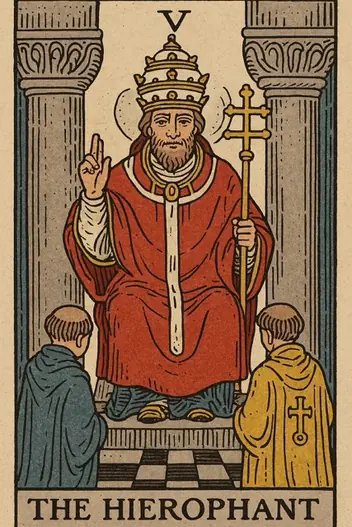
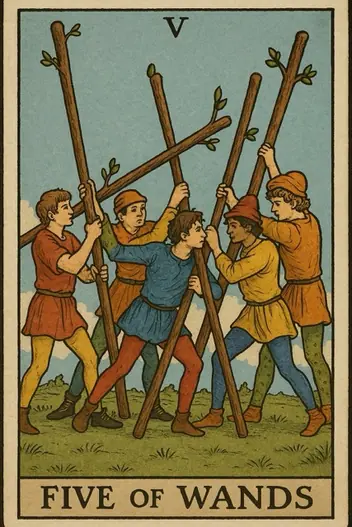
- Arcana
- The Hierophant — Major Arcana; Five of Wands — Minor Arcana, Wands
- Elements
- The Hierophant — Earth; Five of Wands — Fire
- Elemental interaction
- Neutral elements — energies coexist without conflict
- Numerology
- 5 + 5 = 10 → 1
When The Hierophant, the card of established systems, mentors, and shared belief structures, collides with the Five Of Wands, the card of chaotic competition and clashing egos, you get a powerful psychological tension. This combination represents a conflict between the need for conformity and the eruption of dissent. It points to a situation where an established authority, a set of rules, or a traditional path is being actively challenged by individuals or competing ideas. The core question becomes: can the structure hold, or must it be broken to allow for growth?
This is not a passive pairing. It demands that you confront the friction between what is expected of you and what you, or others, actually want. The Hierophant provides the framework—the institution, the relationship contract, the career ladder—while the Five of Wands introduces the raw, competitive energy that threatens to tear it apart. The key insight here is that this conflict is not necessarily destructive; it can be a crucible for refining your values and strengthening your position, provided you manage the chaos with strategic discipline.
The Hierophant and Five of Wands Card Meaning Explained
The psychological state created by The Hierophant and Five of Wands is one of cognitive dissonance. You are trying to operate within a system—a job, a relationship, a spiritual community—that demands compliance, yet you are surrounded by or participating in open disagreement. This creates a fracture between your desire for stability and the reality of friction. You may feel torn between upholding the "right" way of doing things and the urge to fight for your own perspective. The challenge is to avoid letting this tension paralyze you or turn into a power struggle that serves no one.
From a strategic standpoint, this card pair signals a high-stakes negotiation. The Hierophant represents the rules of the game, and the Five of Wands represents the players who are jockeying for position. Your mindset should shift from "who is right" to "what structure can accommodate these competing needs?" This is a time for clear-headed mediation, not blind adherence to tradition. The most pragmatic approach is to treat the conflict as a problem to be solved, not a war to be won. Acknowledge the legitimacy of the challenge before you defend the status quo.
Real-world implications are clear: you are likely facing a situation where a mentor, boss, or partner is being questioned, or where a long-held belief system is under fire from peers or rivals. The outcome depends on your ability to separate the person from the principle. Can you challenge the system without burning the bridge? Can you defend your position without becoming dogmatic? The psychological maturity required here is high, as you must balance assertiveness with respect for established processes.
Your pair is already on the table. Ask your question and draw the clarifying card
or simply focus on it
The Hierophant and Five of Wands: Career and Money
Strategic Opportunities:
Use the competitive energy to sharpen your skills and prove your value within your current role or industry.
Strategic Opportunities:
Seek mentorship from a senior figure who can help you navigate internal politics or market rivalry.
Calculated Risks:
Avoid publicly challenging your boss or a key stakeholder without a clear, data-backed alternative.
In your professional life, this combination signals a highly competitive environment where you must play by the rules while fighting for your place. You may be in a workplace where there is a clear hierarchy and established procedures, but colleagues are constantly vying for promotions, credit, or resources. The pragmatic approach is to use the system to your advantage. Document your achievements, adhere to protocols, and let the results speak for themselves. Do not get drawn into petty office politics (the shadow of the Five of Wands) that could damage your reputation.
A critical financial warning: this is not a time for speculative investments or risky ventures that go against conventional wisdom. The Hierophant favors conservative, proven financial strategies. The Five of Wands warns against getting into bidding wars or competitive spending (e.g., overextending on a house or car to "keep up"). Instead, focus on building your professional credibility and network. If you are in a negotiation, prepare thoroughly, know the market standards, and be ready to walk away if the terms are unfair. The best career move is to become the expert who can mediate conflict and bring structure to chaos.
The Hierophant and Five of Wands as Feelings
If you are single:
This combination suggests you may be attracted to someone from a different social, cultural, or religious background, creating friction with your own values or family expectations. Evaluate whether the conflict is a growth opportunity or a fundamental incompatibility.
If you are in a relationship:
You are likely experiencing a period of intense arguments over roles, responsibilities, or shared beliefs. This is a test of your partnership's foundation.
In relationships, The Hierophant and Five of Wands often point to a power struggle over who sets the rules. One partner may be the traditionalist, expecting the other to conform to a specific role (e.g., who handles finances, how holidays are spent, or what constitutes loyalty). The other partner, embodying the Five of Wands, feels stifled and pushes back with arguments, competition, or even passive-aggressive defiance. The danger is that this becomes a repetitive cycle of "my way versus your way" without any resolution.
The key relationship advice is to shift from competing to collaborating. You need a third option—a new set of shared agreements that honors both the need for structure (Hierophant) and the need for individual expression (Five of Wands). This requires emotional intelligence to name the underlying fear: is the traditional partner afraid of losing control? Is the rebellious partner afraid of being engulfed? Set a boundary that arguments are for problem-solving, not for winning. Consider couples counseling or a neutral third party (a Hierophant figure) to mediate the conflict and create a new, healthier framework for your connection.
Get a personalized interpretation
Unlock the combined meaning of your cards in the context of your unique question — for free.
The Hierophant and Five of Wands Reversed: What Changes?
When cards appear in a reversed position, the dynamic becomes distorted, but does not disappear. Suppressed or destructive forms of the core conflict come to the forefront.
If The Hierophant is reversed:
This points to the destruction of authority without an alternative. You reject all rules, but offer nothing in return. This is a path to anarchy and chaos. Advice: do not burn your bridges until you have built a new one. Find at least one point of support—a person or a principle you trust.
If the Five of Wands is reversed:
The energy of struggle turns inward. This is classic self-sabotage and internal conflict. You fear open argument, so you provoke passive resistance or engage in self-criticism. Warning: do not confuse diplomacy with cowardice. Your silence will not solve the problem; it will only make it worse.
If BOTH are reversed:
A complete loss of bearings. You do not know what you are fighting against or what you are relying on. This is a state of learned helplessness, where a person vacillates between rebellion and submission, achieving neither. Advice: temporarily abandon any struggle. Focus on basic needs and restoring your inner core before entering a new conflict.
The Shadow Side of The Hierophant and Five of Wands
When this energy is blocked or misdirected, it manifests as rigid dogmatism or chaotic rebellion. The shadow of the Hierophant is the tyranny of tradition—clinging to outdated rules simply because "that's how it's always been done." The shadow of the Five of Wands is gratuitous conflict—arguing for the sake of arguing, or sabotaging collaboration out of ego. Together, they create a toxic loop: one person doubles down on control, while the other escalates resistance. This leads to burnout, broken trust, and missed opportunities.
Cognitive biases to watch for include the "sunk cost fallacy" (staying in a bad situation because you've invested so much time) and "confirmation bias" (only listening to information that supports your side of the argument). Self-sabotage occurs when you ignore the need for a new structure because you're too invested in being right. Poor judgment here means mistaking stubbornness for principle or mistaking conflict for passion. The shadow outcome is a fractured team, a broken relationship, or a career setback caused by unnecessary antagonism.
The Hierophant and Five of Wands: The Combined Message
Constructive use of this dynamic requires you to assume the role of a "reformer" rather than a "revolutionary." The Hierophant grants you an understanding of the system, its rules, and its levers of influence. The Five of Wands provides the energy to change them. Your task is not to destroy the temple, but to rebuild it while preserving the load-bearing walls.
Strategically, you need to institutionalize the conflict. Create a formal platform for discussing disagreements—whether it's regular meetings with management, working groups for process optimization, or simply an "hour of honest conversation" with a partner. Transform the chaos of an argument into a structured dialogue. This will lower the level of anxiety and allow emotions to be channeled into a rational course.
The main takeaway: respect your opponent, but do not fear arguing with them. The Hierophant teaches us to respect tradition, while the Five of Wands teaches us to respect ourselves. The combination of these cards suggests that true growth occurs not in the silence of agreement, but in the noise of constructive debate. Your task is to find that point where respect for the past does not hinder building the future.
Your Next Step: Personal Context Matters
The core message of The Hierophant and Five of Wands is that structure and conflict are not opposites, but partners in evolution. You are being called to challenge the rules without destroying the game, and to defend your position without losing your integrity. The resolution lies in finding a new framework that respects both tradition and individuality. This is a call for mature leadership, not blind obedience or reckless rebellion.
However, this general archetype is only the starting point. The true power of Tarot lies in applying these insights to your specific life situation. To get a deep, personalized interpretation of this exact combination for your unique question, use the Fortune Cards app. Whether you access it on the web or download it, the app provides a tailored reading that considers your context, your energy, and the exact area of your life you need guidance on. Stop guessing—start understanding.
Interpretation by the Fortune Cards editorial team, based on the Rider–Waite tradition and Jungian archetypes. About our methodology · Updated: 2026-08-26
Other Combinations with The Hierophant
Other Combinations with Five of Wands
Explore Individual Card Meanings
Table of Contents
- The Hierophant and Five of Wands Card Meaning Explained
- The Hierophant and Five of Wands: Career and Money
- The Hierophant and Five of Wands as Feelings
- The Hierophant and Five of Wands Reversed: What Changes?
- The Shadow Side of The Hierophant and Five of Wands
- The Hierophant and Five of Wands: The Combined Message
- Your Next Step: Personal Context Matters
Ready to find answers to your questions?
Start your first reading now and look at your situation with fresh clarity. The cards are ready to reveal deeper meaning.