Love Tarot: The Hierophant and Two of Swords
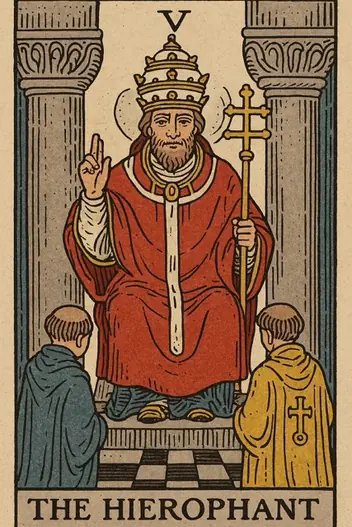

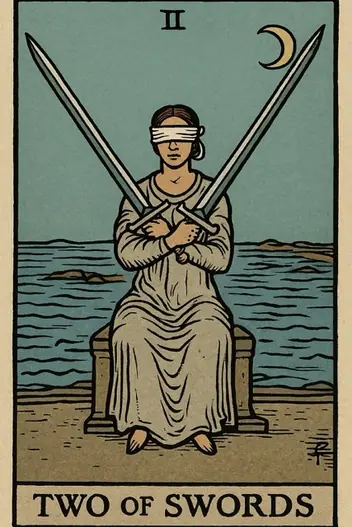
- Arcana
- The Hierophant — Major Arcana; Two of Swords — Minor Arcana, Swords
- Elements
- The Hierophant — Earth; Two of Swords — Air
- Elemental interaction
- Opposing elements — energies create tension
- Numerology
- 5 + 2 = 7
When the Hierophant—the archetype of tradition, institutional authority, and moral structure—meets the Two of Swords—the archetype of deliberate blindness, inner conflict, and stalemate—we see a person caught between a rigid external system and their own internal refusal to see clearly. This combination often appears when a seeker is clinging to a conventional rule or belief while simultaneously blocking out the emotional truth that contradicts it. The result is a psychic paralysis: the head says "follow the rules," but the heart is blindfolded, refusing to look at the consequences.
Psychologically, this pairing signals a defense mechanism of intellectualization mixed with denial. You may be using established norms (family expectations, religious dogma, corporate policy) as a shield against making a difficult personal decision. The Hierophant provides the script; the Two of Swords provides the willful ignorance. The key strategic question here is: Are you obeying a rule that no longer serves you, simply because it is easier than facing the unknown?
What Do The Hierophant and Two of Swords Mean Together?
The core dynamic of this combination is a battle between external conformity and internal split. The Hierophant represents a stable, often rigid framework—a set of values, a code of conduct, or a mentor figure that demands allegiance. The Two of Swords represents a state of conscious indecision, where the seeker holds two opposing truths at arm's length, refusing to integrate them. When these energies collide, the seeker often feels stuck between following the path of least resistance (the established order) and confronting a truth that would shatter that order.
This creates a high-risk psychological state: you are likely using the authority of the Hierophant to justify your inaction. For example, you might tell yourself, "My religion says divorce is wrong," while simultaneously feeling the pain of a loveless marriage. The Two of Swords here is not just indecision—it is active self-deception. You are holding the blindfold in place because the alternative (challenging the tradition) feels too destabilizing. The pragmatic insight is that this stalemate will not resolve until you are willing to set aside the blindfold and critically evaluate which parts of the tradition are genuinely ethical and which are simply comfortable.
The real-world implication is a paralysis in decision-making that masquerades as moral clarity. You may believe you are being principled, but in truth, you are being avoidant. The path forward requires intellectual honesty: you must differentiate between the wisdom of tradition (which can guide) and the tyranny of tradition (which can trap). Boldly ask yourself: "Am I protecting my integrity, or am I protecting my fear of change?"
Career and Finances
Strategic Opportunities:
Use this energy to re-evaluate the "rules of the game" in your industry. Are you following a career path because it is expected, or because it truly fits your skills? This is a powerful time to audit your professional values and align them with your actual work.
Strategic Opportunities:
Consider seeking mentorship from a seasoned professional who can help you see the blind spots. The Hierophant, in its positive form, represents wise counsel. Use this to gain clarity on a stalled project or negotiation.
Calculated Risks:
Do not make a major financial commitment based solely on tradition or authority. Avoid signing contracts or accepting promotions that require you to ignore your doubts. The Two of Swords warns that ignoring red flags now will lead to a costly reckoning later.
From a career perspective, this combination often appears when a professional is stuck between a stable but soul-crushing job (the Hierophant’s security) and the fear of starting something new (the Two of Swords’ indecision). You may be rationalizing your stagnation with phrases like "This is the safe path" or "This is what my family expects." The strategic insight is that your blindfold is your biggest liability.
Financially, this pairing warns against making decisions based on dogma rather than data. For example, you might refuse to invest in a certain asset class because "that's not what prudent people do," even though the numbers suggest a solid opportunity. Conversely, you might stay in a bad investment because "you should never sell at a loss." Boldly challenge any financial rule that you cannot justify with current facts. The most pragmatic action is to gather objective information, consult a trusted advisor (not a sycophant), and then make a decision based on reality, not tradition.
Your pair is already on the table. Ask your question and draw the clarifying card
or simply focus on it
The Hierophant and Two of Swords in Love Tarot
If you are single:
This pairing suggests you are evaluating a potential partner through a rigid checklist (e.g., "They must meet my family's approval" or "They must share my exact faith") while ignoring your own gut feelings about the connection. You may be using external standards to avoid emotional vulnerability.
If you are in a relationship:
You and your partner may be stuck in a power struggle over values or rules, with one person demanding conformity to a traditional role (the Hierophant) while the other refuses to discuss the underlying issues (the Two of Swords). This is a classic "stonewalling" dynamic.
In relationships, this combination often indicates a crisis of loyalty versus authenticity. One partner may be enforcing a traditional expectation (e.g., "We must stay together for the children" or "A good spouse does X") while the other partner is emotionally shut down, refusing to engage in honest dialogue about their dissatisfaction. The key relationship advice here is to recognize that silence is not peace. The Two of Swords’ blindfold is a symptom of a deeper wound: the fear that speaking the truth will destroy the relationship.
To break the stalemate, you must create a safe container for honesty. This may require a neutral third party (a therapist, a counselor, or a wise mentor—the healthy version of the Hierophant) who can help you both articulate the rules you are following and question whether they still serve your mutual growth. Boldly prioritize emotional transparency over institutional loyalty. If you continue to obey a dead rule, you will suffocate the life out of the relationship.
Reversed Positions: What Changes?
If The Hierophant is Reversed:
This indicates a rebellion against the system without a strategy. You reject traditions and authorities but offer nothing in return. Instead of a wise choice (Two of Swords), you risk committing an impulsive act that will destroy your reputation. Advice: Do not confuse freedom with chaos. Before breaking down old structures, create a new foundation.
If the Two of Swords is Reversed:
This is a breakthrough! The "blindfold" falls away, but the information you see may be painful. You can no longer ignore the problem. Warning: A shock of reality or guilt over past inaction is possible. Use the energy of The Hierophant (even in its reversed form) to find support from a psychologist or coach.
If BOTH are Reversed:
Complete imbalance. You simultaneously rebel against all rules and refuse to see the consequences of your actions. This is a self-destruction scenario. The logical way to correct this: temporarily accept a strict external discipline (sports, routine, working with a mentor) to stop the chaos, and then, in a calm state, make a conscious choice.
Deepen your understanding
Find out exactly what this reading means for your current life situation with our oracle.
What Are the Risks of The Hierophant and Two of Swords?
The shadow of this combination is a dangerous form of willful ignorance masked as moral righteousness. The seeker may become a zealot, using the Hierophant's authority to justify cruelty, exclusion, or stagnation. The Two of Swords’ blindfold is not a peaceful meditation; it is a refusal to see the harm being caused by rigid adherence to a flawed system. This can manifest as cognitive dissonance—holding two contradictory beliefs (e.g., "I am a good person" and "I am staying in a toxic relationship") and refusing to resolve the conflict.
Another major pitfall is passive-aggressive compliance. You may outwardly follow the rules (the Hierophant) while inwardly seething with resentment (the Two of Swords). This creates a toxic inner life where you feel powerless and victimized, even though you are actively choosing not to change your circumstances. The shadow here is self-sabotage through obedience. You are not a martyr; you are a volunteer for your own suffering.
Beware of the cognitive bias known as "authority bias"—the tendency to overvalue the opinion of an authority figure, even when it contradicts your own experience. The Two of Swords warns that you may be deferring your own judgment to a parent, boss, or institution that is not actually looking out for your best interests. The shadow resolution requires radical responsibility: you must admit that the blindfold is in your own hands, and only you can remove it.
Synthesis: Strategic Conclusion
How to constructively use the Hierophant's energy to balance the Two of Swords? The answer is to create a ritual of choice. The Hierophant is a master of rituals and procedures. You need to formalize the decision-making process to break free from the stupor.
First Step:
Acknowledge that the status quo is an illusion of security. You are already paying a price for your inaction (loss of time, energy, opportunities). Write down this price.
Second Step:
Use the Hierophant archetype to gather objective data. Consult an expert, read a book, find statistics. Transform the emotional conflict (Two of Swords) into a rational task (Hierophant). Create a "decision matrix" with criteria (e.g., benefits, risks, alignment with values) and rate each option on a 10-point scale.
Third Step:
Make a decision and set a date for its execution. The ritual (Hierophant) will lend your choice power and legitimacy. Even if you are wrong, a choice made is always progress compared to paralysis. You will gain data to adjust your course. The main takeaway: The Hierophant and the Two of Swords teach us that true wisdom is not blind adherence to rules, but the courage to use structure to make a conscious, free choice.
Your Next Step: Personal Context Matters
The core message of The Hierophant and Two of Swords is that you are trapped between a rule you respect and a truth you refuse to see. The path forward is not to blindly abandon tradition, nor to stubbornly maintain your denial. It is to critically examine which parts of your inherited structure are genuinely ethical and which are simply comfortable. You must remove the blindfold, not to reject the Hierophant, but to see it clearly for the first time. Only then can you decide whether to follow, adapt, or leave.
Your next step is to apply this archetype to your own life. While this analysis provides the general psychological framework, the real power of Tarot lies in its personal relevance to your specific situation. To get a deep, personalized interpretation of how The Hierophant and Two of Swords interact with your unique question, relationship, or career decision, use the Fortune Cards app. You can access it on the web or download it now. It will help you move beyond general advice into actionable, context-specific guidance that respects your intelligence and your autonomy.
Interpretation by the Fortune Cards editorial team, based on the Rider–Waite tradition and Jungian archetypes. About our methodology · Updated: 2026-08-26
Other Combinations with The Hierophant
Other Combinations with Two of Swords
Explore Individual Card Meanings
Table of Contents
Ready to find answers to your questions?
Start your first reading now and look at your situation with fresh clarity. The cards are ready to reveal deeper meaning.