Three of Cups and Eight of Cups Tarot as Feelings

- Arcana
- Three of Cups — Minor Arcana, Cups; Eight of Cups — Minor Arcana, Cups
- Elements
- Three of Cups — Water; Eight of Cups — Water
- Elemental interaction
- Same element — energies intensify each other
- Numerology
- 3 + 8 = 11 → 2
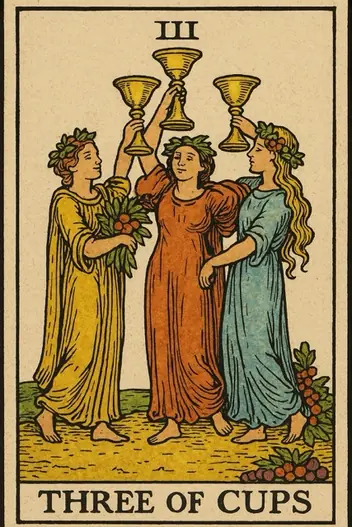
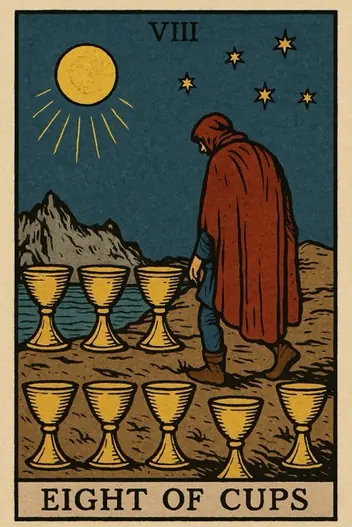
The Three of Cups represents emotional fulfillment, social bonding, and shared joy—a moment when connections feel effortless and rewarding. The Eight of Cups, in contrast, embodies deliberate departure, emotional closure, and the courage to leave behind what no longer serves you. When these two cards appear together, they create a powerful tension: the desire to savor present happiness clashes with the inner call to walk away from a situation that has reached its natural end.
Psychologically, this combination signals a critical juncture where you must reconcile your need for belonging with your need for authenticity. You may feel deeply connected to a group, relationship, or career path, yet simultaneously sense that staying has become a form of self-betrayal. The key is recognizing that true emotional intelligence involves knowing when to celebrate what was, and when to honor the journey ahead—even if it means leaving the party early.
Three of Cups and Eight of Cups Combination Meaning
The psychological state created by this pairing is one of bittersweet awareness. You are likely experiencing a period where social validation and personal integrity are in direct conflict. The Three of Cups energy pulls you toward comfort, camaraderie, and the safety of the familiar. The Eight of Cups pushes you toward solitude, introspection, and the uncomfortable but necessary act of walking away.
In practice, this often manifests as a decision point in a friendship, romantic partnership, or team environment. You may feel genuine warmth and appreciation for the people around you—yet simultaneously recognize that the emotional cost of staying is quietly eroding your sense of self. The pragmatic insight here is that departure does not negate the value of what came before. You can honor the joy you’ve shared while still choosing to leave. The strategic action is to acknowledge your gratitude openly, then move decisively without guilt or over-explanation.
This combination also warns against the trap of false loyalty. The Three of Cups can make you feel obligated to maintain harmony, even when your inner compass says it’s time to go. True emotional maturity is knowing that leaving a healthy situation is sometimes the most loving choice—for yourself and for others. The Eight of Cups asks you to trust your capacity to find new sources of connection after the departure is complete.
What Do Three of Cups and Eight of Cups Indicate for Your Career?
Strategic Opportunities:
Leverage your current network for referrals or emotional support before making a career transition. The Three of Cups energy can provide a soft landing if you plan your exit carefully.
Strategic Opportunities:
Use this time to celebrate your professional achievements and acknowledge what you’ve learned. This builds confidence for the next move.
Calculated Risks:
Avoid making a departure purely out of boredom or frustration. The Eight of Cups is about strategic withdrawal, not impulsive flight. Ensure you have a clear next step or financial buffer before leaving.
In a professional context, this combination signals a crossroads between team cohesion and personal ambition. You may be part of a supportive work environment or collaborative project that feels good—but you’re increasingly aware that your growth requires stepping away from the group dynamic. Financially, this is not a time for reckless spending or sudden career changes. Instead, use the Three of Cups’ social energy to gather information, build bridges, and secure references. Then, apply the Eight of Cups’ discipline to execute your departure with precision. The most pragmatic approach is to treat your exit as a project: plan it, communicate it clearly, and execute it without emotional drama. This reduces risk and preserves the goodwill you’ve built.
Your pair is already on the table. Ask your question and draw the clarifying card
or simply focus on it
Love and Relationships
If you are single:
This pair suggests you are currently torn between enjoying a casual, fun connection and sensing it lacks long-term potential. Honor the good moments, but don’t confuse temporary joy with lasting compatibility. Use this time to clarify your deeper emotional needs before committing further.
If you are in a relationship:
You may be in a partnership that feels warm and supportive on the surface, yet you sense an underlying emotional distance or unspoken issue. The relationship may have reached a plateau where growth requires either a difficult conversation or a conscious separation.
The relationship dynamics here revolve around the tension between comfort and authenticity. You might feel genuinely cared for, yet increasingly aware that your individual path is diverging from your partner’s or group’s trajectory. The key is to avoid mistaking loyalty for obligation. If you stay out of fear of hurting others, you risk building resentment that will eventually poison the connection. The healthiest path is to communicate your internal shift honestly, then take action—whether that means renegotiating boundaries, taking space, or ending the relationship with gratitude. This combination often appears when a relationship has served its purpose of teaching you about joy and connection, but now requires you to move on to the next stage of your personal evolution.
Reversed Three of Cups and Eight of Cups Explained
When cards appear in a reversed position, the dynamic becomes distorted, turning into sabotage and self-deception.
Three of Cups Reversed:
The potential for joy and social support is blocked. You may suffer from loneliness in a crowd or disappointment in friends. Warning: Do not try to "force" a celebration or revive old connections that have run their course. This will lead to even greater disappointment. Focus on the quality, not the quantity, of your contacts.
Eight of Cups Reversed:
This is a classic scenario of internal resistance to change. You know you need to leave, but fear, guilt, or laziness keep you in place. Advice: Understand that your "loyalty" is a form of cowardice. You are not afraid of losing people, but of facing the unknown. Start with a small step—for example, delegating one social obligation.
BOTH reversed:
Complete imbalance. You are simultaneously isolated from support (Three of Cups) and paralyzed before departure (Eight of Cups). This is a state of apathy and depression. Logical way to correct it: First, restore a basic social connection (with at least one person) to alleviate the sharpness of loneliness. Then, using this anchor point, plan a rational, step-by-step exit from the toxic environment. Do not try to solve both problems at once.
Deepen your understanding
Find out exactly what this reading means for your current life situation with our oracle.
What Are the Risks of Three of Cups and Eight of Cups?
The shadow side of this combination emerges when the seeker confuses emotional comfort with personal alignment. You may stay in a situation far too long because it feels good—ignoring the quiet voice that says it’s time to leave. This is a classic cognitive bias known as the “sunk cost fallacy”: you overvalue the time and energy already invested, even when staying no longer serves your growth.
Another pitfall is using the Three of Cups’ social joy as a distraction from the Eight of Cups’ call to action. You might over-commit to parties, group projects, or romantic dates to avoid the discomfort of a necessary goodbye. This avoidance only delays the inevitable, often making the eventual departure more painful. Alternatively, you could swing to the opposite extreme—leaving abruptly without acknowledging the genuine value of what you’re abandoning, which can damage relationships and create unnecessary regret.
Finally, watch for the trap of “saving face.” The Three of Cups can make you overly concerned with how others perceive your departure. True emotional intelligence prioritizes your internal truth over external approval. If you find yourself rationalizing why you should stay (e.g., “they need me,” “it’s not that bad,” “I’ll hurt their feelings”), pause and ask: Am I staying out of love, or out of fear?
Synthesis: Strategic Conclusion
Constructive use of this energy requires rigorous strategic discipline. The Three of Cups provides you with a resource—social capital and emotional support. The Eight of Cups gives you a direction—a vector toward an unknown but necessary future. Your task is not to choose between them, but to use one to pay for the other.
A practical algorithm for action: first, leverage your network of contacts (Three of Cups) to gather information, resources, and a "safety net" for your departure (Eight of Cups). Then—break the cycle. Arrange a "farewell party" (symbolic or real) to close the gestalt, and immediately afterward, begin moving along the new path. Do not look back—this is the cardinal rule.
Deep strategic advice:
Stop perceiving departure as a loss. The Eight of Cups is not about severing ties, but about redistributing energy. You are not losing friends; you are changing the format of the relationships. Those who truly matter will remain with you even without the "parties." Those who leave were merely "fellow travelers." Accept this as a natural selection of your social circle. Only then can you move toward your true goals without feeling like a traitor.
Your Next Step: Personal Context Matters
The core message of Three of Cups and Eight of Cups is this: You can honor the joy of what was, while still choosing to walk toward what will be. Your emotional connections are real—but they are not permanent cages. The most courageous act is to celebrate the gift of a chapter that has ended, and trust yourself to find new joy in the next one. Your personal context—your specific relationships, career goals, and inner conflicts—will determine whether this is a time for gentle transition or a decisive break.
While this article provides a general archetype, the true magic happens when Tarot is applied to your unique situation. Use the Fortune Cards app to get a deep, personalized interpretation of this exact combination for your specific question right now. You can use the app on the web or download it to uncover the precise guidance your psyche needs. Your next step is waiting—take it with clarity and confidence.
Interpretation by the Fortune Cards editorial team, based on the Rider–Waite tradition and Jungian archetypes. About our methodology · Updated: 2026-08-26
Other Combinations with Three of Cups
Other Combinations with Eight of Cups
Explore Individual Card Meanings
Table of Contents
- Three of Cups and Eight of Cups Combination Meaning
- What Do Three of Cups and Eight of Cups Indicate for Your Career?
- Love and Relationships
- Reversed Three of Cups and Eight of Cups Explained
- What Are the Risks of Three of Cups and Eight of Cups?
- Synthesis: Strategic Conclusion
- Your Next Step: Personal Context Matters
Ready to find answers to your questions?
Start your first reading now and look at your situation with fresh clarity. The cards are ready to reveal deeper meaning.