Three of Cups and Ten of Swords Reversed in Tarot
- Arcana
- Three of Cups — Minor Arcana, Cups; Ten of Swords — Minor Arcana, Swords
- Elements
- Three of Cups — Water; Ten of Swords — Air
- Elemental interaction
- Neutral elements — energies coexist without conflict
- Numerology
- 3 + 10 = 13 → 4
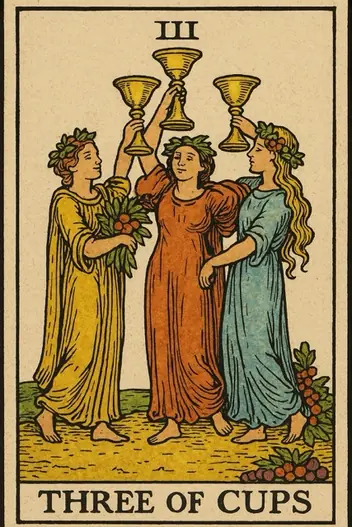
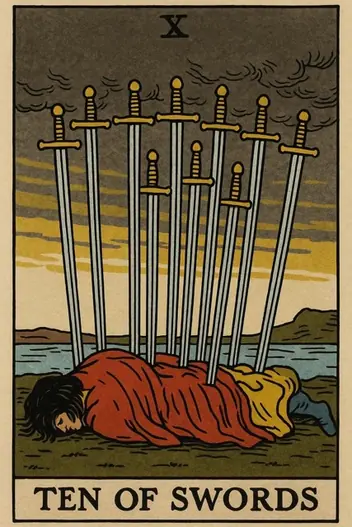
The Three Of Cups and Ten Of Swords combination presents a stark psychological contrast: the joy of communal connection meeting the finality of a painful ending. In Jungian terms, this pairing represents the shadow of overextension—where the desire for social harmony and shared pleasure (Three Of Cups) collides with the harsh reality of betrayal, exhaustion, or abrupt termination (Ten Of Swords). Pragmatically, this suggests that what appears as a joyful alliance may be masking an underlying vulnerability or unspoken conflict.
When these two archetypes intersect in a reading, the core dynamic is cause-and-effect: the energy of celebration and mutual support can become a blind spot for impending collapse. The Three Of Cups embodies extraverted feeling—a focus on collective emotional harmony—while the Ten Of Swords represents the shadow of the martyr—a sense of being overwhelmed by external forces. The key insight here is that the Ten Of Swords often follows a period of denial or avoidance, and the Three Of Cups may have been the distraction that allowed a problem to fester.
Three of Cups and Ten of Swords Together: Meaning
The psychological state created by this pairing is one of emotional dissonance. You may find yourself in a situation where social bonds feel rewarding yet are simultaneously draining your resilience. The Three Of Cups signals a network of friends, collaborators, or supporters, but the Ten Of Swords warns that this support system may be unsustainable or even toxic. A common real-world scenario is a team or friend group that celebrates collective achievements while ignoring a brewing crisis—only to have it erupt as a painful betrayal or sudden collapse.
The core dynamic is cyclical: the Three Of Cups represents the peak of social bonding, while the Ten Of Swords represents the inevitable low point. This is not random bad luck but a predictable pattern of over-investment in group identity at the expense of individual boundaries. The psychological challenge is to recognize when communal joy becomes a form of collective avoidance. For example, a workplace team that regularly celebrates "wins" might be masking a leadership failure or an unsustainable workload. The Ten Of Swords forces the confrontation: the party is over, and the consequences are unavoidable.
The most important takeaway is that this combination demands strategic detachment. The Three Of Cups energy can be seductive—it feels good to belong—but the Ten Of Swords is a reality check. Your next move is not to save the group or repair the rupture, but to assess what is truly worth preserving from the wreckage. This is a time for surgical emotional intelligence: cut ties with what drains you, and salvage only the authentic connections that survived the collapse.
Three of Cups and Ten of Swords for Career and Money
Strategic Opportunities:
Use your social network to identify new roles or projects after a painful exit. The Three Of Cups suggests your connections are still valuable, even if the current situation has collapsed.
Strategic Opportunities:
This is a time to rebuild your reputation by focusing on a small, loyal team rather than a large, dysfunctional one. Quality over quantity.
Calculated Risks:
Avoid immediately joining another group or team without a thorough evaluation of its culture and stability. The Ten Of Swords warns against repeating the same pattern.
In career readings, this combination often points to a toxic work environment disguised as a "family" culture. The Three Of Cups represents team bonding, social events, and a sense of camaraderie, while the Ten Of Swords represents a sudden layoff, a public failure, or a betrayal by a colleague. The pragmatic interpretation is that the social capital you invested may have been misallocated. You may have prioritized relationships over results, or you may have ignored red flags because of the emotional rewards of belonging.
Financially, this is a warning against joint ventures or shared investments with friends or close colleagues. The Three Of Cups energy can lead to overconfidence in group decisions (e.g., "everyone thinks this is a good idea"), while the Ten Of Swords signals a complete loss. Bold financial warning: Do not co-sign loans, enter profit-sharing agreements, or pool resources with a group until you have independently verified the numbers and legal structure. The best strategic move is to treat this as a reset: cut financial ties with the troubled group, take a temporary loss if necessary, and rebuild your financial foundation on your own terms.
Your pair is already on the table. Ask your question and draw the clarifying card
or simply focus on it
Three of Cups and Ten of Swords as Feelings
If you are single:
This pairing warns against entering a relationship driven by social pressure or a desire to fit in. The Three Of Cups may represent a friend group or social circle that encourages a match, but the Ten Of Swords suggests this connection will end painfully. Evaluate the relationship on its own merits, not on group approval.
If you are in a relationship:
This combination signals a power imbalance where one partner is over-functioning to maintain harmony while the other is withdrawing or betraying trust. The celebration (Three Of Cups) may be a mask for resentment or exhaustion.
In relationships, the Three Of Cups and Ten Of Swords often appear when external social dynamics are destabilizing the partnership. Perhaps you and your partner are part of a close-knit friend group, and a conflict within that group is spilling into your relationship. Alternatively, one partner may be using social activities (parties, gatherings, shared hobbies) to avoid addressing a deeper issue—such as infidelity, financial stress, or emotional neglect. The Ten Of Swords represents the moment this avoidance becomes impossible to sustain.
The key relationship advice is to stop performing happiness and address the underlying tension directly. Bold communication is essential here: schedule a time to discuss the elephant in the room without distractions. If you are the one feeling betrayed (Ten Of Swords), resist the urge to blame the group or your partner entirely—instead, examine your own role in ignoring the warning signs. The Three Of Cups energy can also be a resource: lean on a single, trusted friend outside the immediate conflict for perspective, but avoid rallying the group for support, as that may escalate the drama.
The Shadow Side of Three of Cups and Ten of Swords
The shadow side of the Three Of Cups and Ten Of Swords combination is codependency disguised as community. The seeker may be unconsciously using social bonds to avoid personal responsibility, self-reflection, or difficult decisions. A common cognitive bias here is the "halo effect" —because the group feels good (Three Of Cups), you assume it is good for you. This leads to poor judgment in relationships, finances, and career decisions.
Another pitfall is martyrdom: the Ten Of Swords can trigger a narrative of victimhood, where the seeker blames the group or external forces for their pain, rather than acknowledging their own agency in staying too long. The shadow manifests as passive-aggressive behavior—smiling in public (Three Of Cups) while secretly resenting or plotting revenge (Ten Of Swords). This is self-sabotage because it prevents closure and prolongs the cycle of pain.
The most dangerous cognitive bias is sunk cost fallacy: the belief that because you have invested so much in a relationship, job, or project, you cannot walk away. The Three Of Cups amplifies this by making the social investment feel personal and valuable. The Ten Of Swords then delivers the painful lesson that staying past the point of collapse only increases the damage. The shadow path is to cling to the "good old days" (Three Of Cups) while refusing to accept that the ending (Ten Of Swords) is final and necessary.
Uncover hidden insights
Let our advanced Tarot system interpret these archetypes specifically for your personal path.
Three of Cups and Ten of Swords Reversed: How to Read It
When cards appear in a reversed position, the dynamics become more complex and less obvious, but no less destructive.
If the Three of Cups is Reversed:
Social support vanishes. Friends turn away, the celebration is cancelled. You are left alone with the catastrophe. Instead of numbing the pain, you are forced to experience it. Advice: do not look for someone to blame; use the isolation for deep reflection without distractions.
If the Ten of Swords is Reversed:
This indicates an internal resistance to an inevitable ending. You know the relationship or project is dead, but you cling to it, trying to feign joy. This is a state of psychological paralysis. Advice: acknowledge that your "cheerfulness" is a defense mechanism. Take a step back and allow the process to conclude.
If BOTH are Reversed:
Complete imbalance. You can neither truly rejoice nor truly suffer. This is a state of emotional anesthesia. The most dangerous scenario—you risk losing contact with your feelings. The logical course of correction: consult a psychologist or coach who can help you "switch on" your emotions anew, starting with basic grief.
Three of Cups and Ten of Swords: The Combined Message
How can the energy of the Three of Cups be used constructively to balance the destructive force of the Ten of Swords? The answer lies in a paradigm shift: transform the funeral into a wake, not a party. The Ten of Swords is an ending, but the Three of Cups can provide the strength for a ritual of farewell.
Your strategy is conscious closure. Do not attempt to ignore the pain or drown it out with alcohol and noise. Instead, invite your closest people (Three of Cups) and honestly say: "I am experiencing a collapse. I don't know what comes next, but I need your support to get through this moment." This transforms social energy from an anesthetic into a resource.
The deep strategic advice: use the principle of a "controlled crisis." You cannot avoid the blow of the Ten of Swords, but you can control how you react to it. Organize a "celebration of liberation" from the old. Burn the bridges beautifully. When you stop fearing the end and begin to celebrate it as a liberation, the Three of Cups becomes not an escape from reality, but a tool for creating a new one. Clarity comes when you stop laughing at jokes that aren't funny to you and start crying where it is necessary.
Your Next Step: Personal Context Matters
The core message of Three Of Cups and Ten Of Swords is that not all endings are failures, and not all celebrations are healthy. This combination asks you to distinguish between genuine support and collective avoidance, and to have the courage to walk away when a group or relationship has become toxic. The pain of the Ten Of Swords is real, but it also clears the way for a more authentic and sustainable connection in the future.
While this article provides a general archetypal analysis, your specific situation requires a personalized reading. The true power of Tarot lies in applying these symbols to your unique life circumstances—your relationships, career challenges, and emotional blind spots.
Ready to go deeper? Use the Fortune Cards app to get a tailored interpretation of this exact combination for your specific question. Whether you are on the web or download the app, you will receive a detailed, psychologically-informed reading that considers your personal context. Stop guessing—get the clarity you need to make your next move with confidence.
Interpretation by the Fortune Cards editorial team, based on the Rider–Waite tradition and Jungian archetypes. About our methodology · Updated: 2026-09-17
Other Combinations with Three of Cups
Other Combinations with Ten of Swords
Explore Individual Card Meanings
Table of Contents
- Three of Cups and Ten of Swords Together: Meaning
- Three of Cups and Ten of Swords for Career and Money
- Three of Cups and Ten of Swords as Feelings
- The Shadow Side of Three of Cups and Ten of Swords
- Three of Cups and Ten of Swords Reversed: How to Read It
- Three of Cups and Ten of Swords: The Combined Message
- Your Next Step: Personal Context Matters
Ready to find answers to your questions?
Start your first reading now and look at your situation with fresh clarity. The cards are ready to reveal deeper meaning.