Three of Swords and Eight of Pentacles Meaning in Tarot
- Arcana
- Three of Swords — Minor Arcana, Swords; Eight of Pentacles — Minor Arcana, Pentacles
- Elements
- Three of Swords — Air; Eight of Pentacles — Earth
- Elemental interaction
- Opposing elements — energies create tension
- Numerology
- 3 + 8 = 11 → 2
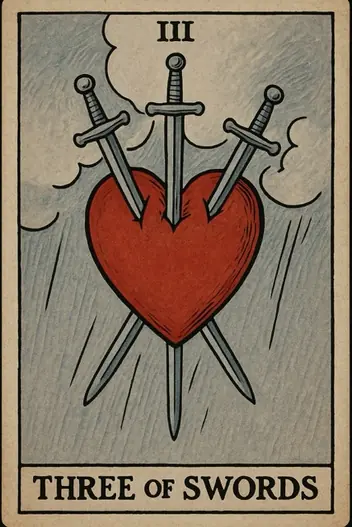
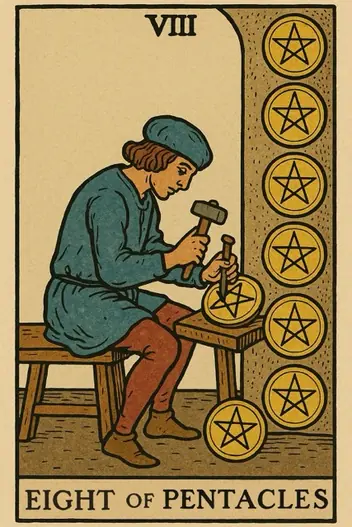
The Three of Swords represents the piercing moment of cognitive dissonance—when reality cuts through a cherished illusion. The Eight of Pentacles embodies the discipline of focused repetition, the daily grind of mastery. When they collide, the message is stark but potent: you cannot heal by ignoring the wound; you must work through it with the same patience a craftsman applies to raw material.
This pairing strips away romanticism. It suggests that your current emotional pain or disappointment is not a sign to stop, but a signal to refine your approach. The mind (Swords) is wounded, but the hands (Pentacles) must keep moving. This is not about toxic positivity; it is about pragmatic grief management. You are being asked to treat your suffering as a project—something to be studied, deconstructed, and rebuilt with deliberate effort.
Three of Swords and Eight of Pentacles: How These Energies Interact
The psychological state here is one of controlled vulnerability. The Three of Swords forces a confrontation with a painful truth—perhaps a betrayal, a failed expectation, or a deep-seated insecurity. The Eight of Pentacles insists you channel that emotional energy not into rumination, but into skillful action. This is the archetype of the "wounded worker": someone who uses their craft as a container for their grief.
The key insight is that avoidance is not an option. The Three of Swords cuts through denial; the Eight of Pentacles demands you show up anyway. This combination often appears when you are tempted to quit a project or relationship because it hurts. Instead, it advises you to keep your hands busy while your heart mends. The work itself becomes a form of therapy—not by distracting you, but by giving your pain a structured outlet. You are not escaping the pain; you are transforming it into competence.
This is a high-risk, high-reward dynamic. The risk is workaholism or emotional suppression—using labor to avoid feeling. The reward is resilience through mastery—coming out of the storm with a new skill, a clearer sense of self, and a hardened ability to handle disappointment. The Eight of Pentacles provides the scaffolding; the Three of Swords provides the motivation to build.
Your pair is already on the table. Ask your question and draw the clarifying card
or simply focus on it
Three of Swords and Eight of Pentacles as Feelings
If you are single:
This pair warns against rushing into a new connection to numb an old wound. Use this time to work on your own emotional literacy rather than seeking a distraction. The right partner will meet you when you are whole, not when you are patching holes with romance.
If you are in a relationship:
You or your partner may be using work, hobbies, or routine as a shield against addressing a painful issue. The relationship needs honest dialogue, not just busy schedules. The "cut" of the Three of Swords must be discussed, not hidden beneath the Eight of Pentacles' productivity.
In relationships, this combination signals a critical juncture between avoidance and intimacy. The Three of Swords often points to a specific hurt—a breach of trust, a long-held resentment, or a painful truth finally spoken. The Eight of Pentacles suggests that the way forward is not through grand gestures or dramatic apologies, but through consistent, small acts of repair. Bold relationship advice: treat your partnership like a craft you are learning. Show up daily, do the unglamorous work of listening, and practice vulnerability like a skill. The pain will not vanish overnight, but it will be integrated into a stronger bond if you commit to the process.
However, beware of the shadow dynamic: one partner playing the "wounded one" while the other plays the "fixer." The Eight of Pentacles can become a tool for one person to over-function, compensating for the other's emotional withdrawal. The healthy path requires equal responsibility for the repair work.
Three of Swords and Eight of Pentacles: Career and Money
Strategic Opportunities:
Turn criticism into a curriculum. A recent failure or harsh feedback is not a verdict; it is data. Use the Three of Swords' clarity to identify exactly where you need to improve, then apply the Eight of Pentacles' discipline to upskill in that area.
Strategic Opportunities:
Leverage emotional discipline for high-stakes negotiations. If you feel hurt or undervalued at work, channel that energy into building a stronger case for a raise or promotion. Let your work product speak louder than your grievance.
Calculated Risks:
Do not make major financial moves while emotionally raw. The Three of Swords clouds judgment with pain. The Eight of Pentacles tempts you to "work harder" to compensate for a loss—which can lead to burnout or poor investments. Step back, stabilize, then act.
In the professional realm, this combination is a blueprint for turning failure into expertise. The Eight of Pentacles is the card of the apprentice, the journeyman, the person who grinds until mastery. Paired with the Three of Swords, it suggests that you have just received a painful lesson about your current skill level or market value. The mature response is not to quit or blame, but to identify the gap and fill it with deliberate practice.
Financially, this is a time for conservative, skill-based investment. Instead of chasing speculative gains, invest in your own education, tools, or certifications. The Three of Swords warns against debt taken to soothe emotional wounds (e.g., retail therapy). The Eight of Pentacles advises slow, steady accumulation of value. Your most reliable asset right now is your ability to produce quality work. Bold financial warning: do not use credit to "buy" your way out of emotional pain. That path leads from one cut to another.
Get a personalized interpretation
Unlock the combined meaning of your cards in the context of your unique question — for free.
Three of Swords and Eight of Pentacles Reversed: What Changes?
If the cards appear in a reversed position, the dynamic becomes distorted, but does not disappear.
If the Three of Swords is reversed:
The pain is denied or suppressed. You do not see the problem, but you continue to work (Eight upright). This is meaningless busywork. You fix what is not broken in order to avoid thinking about what is actually broken. Warning: this is a path to professional burnout.
If the Eight of Pentacles is reversed:
The pain is acknowledged (Three upright), but the ability to act is paralyzed. You are stuck in the trauma, unable to begin even minor repairs. This is a state of victimhood that requires not labor, but basic psychological support. Advice: start with one single, simplest action — wash the dishes or clear off a table.
If BOTH are reversed:
Complete dysfunction. You deny the pain and refuse any work on yourself. This is stagnation in its purest form. The only logical way to correct this is to admit that you are not okay and seek external help (a mentor, psychologist, coach). It is almost impossible to break this loop on your own.
Negative Meaning of Three of Swords and Eight of Pentacles
The shadow of this pairing is masochistic productivity—using work as a punishment for feeling pain. You may unconsciously believe that if you just suffer enough through labor, you will earn the right to heal. This is a cognitive bias known as the "just-world hypothesis" twisted inward: you think your pain is a debt that must be paid by effort. In reality, healing and working are parallel processes, not sequential ones.
Another pitfall is perfectionism born from fear of rejection. The Three of Swords' wound can make you hyper-sensitive to criticism, causing the Eight of Pentacles to manifest as obsessive over-polishing. You may refuse to release a project or idea until it is "perfect," because another failure would feel unbearable. This is self-sabotage disguised as diligence. The shadow here is the refusal to accept that all work involves risk of pain.
Finally, watch for emotional numbness. If you use the Eight of Pentacles' focus to completely suppress the Three of Swords' grief, you risk a long-term disconnection from your own feelings. The work becomes a drug, not a craft. True mastery requires emotional honesty—the ability to feel the cut and still choose to work.
Three of Swords and Eight of Pentacles: Tarot Advice
How to constructively use this energy? The rule is: do not work to forget — work to understand. The energy of the Three of Swords is a surgical scalpel. The energy of the Eight of Pentacles is a sewing needle. First, you must lance the abscess (honestly acknowledge the mistake, endure the loss), and then carefully, stitch by stitch, sew the wound shut with a new skill.
Your strategic task is to create a ritual of "pain processing." Set aside 20 minutes a day for reflection: write down what affected you and what you can do right now to fix it. Do not try to fix everything at once. Choose one specific competency (e.g., negotiation skills or time management) and dedicate the next month to it. Pain will become your fuel, and discipline your engine.
This combination teaches us the main lesson: true resilience is not about never falling, but about getting up each time and doing your work better than yesterday. This is not magic; it is a craft. And it requires the courage to admit that sometimes the only way forward is to pass through your own heart with tools in hand.
Where to Go From Here
The core message of Three of Swords and Eight of Pentacles is that pain is not a stop sign; it is a syllabus. You are being asked to treat your current disappointment as a curriculum for growth. The wound is real, but so is your capacity to learn from it. Do not let grief paralyze you, and do not let work anesthetize you. Let your hands move while your heart heals.
However, this general interpretation is only a map. The real power of Tarot lies in how these archetypes interact with your specific situation—your history, your question, your unique emotional landscape. To get a reading that speaks directly to your life, use the Fortune Cards app. Whether on the web or downloaded to your device, the app provides a deep, personalized interpretation of this exact combination for your specific question right now. Stop guessing. Start working with your own story.
Interpretation by the Fortune Cards editorial team, based on the Rider–Waite tradition and Jungian archetypes. About our methodology · Updated: 2026-09-17
Other Combinations with Three of Swords
Other Combinations with Eight of Pentacles
Explore Individual Card Meanings
Table of Contents
- Three of Swords and Eight of Pentacles: How These Energies Interact
- Three of Swords and Eight of Pentacles as Feelings
- Three of Swords and Eight of Pentacles: Career and Money
- Three of Swords and Eight of Pentacles Reversed: What Changes?
- Negative Meaning of Three of Swords and Eight of Pentacles
- Three of Swords and Eight of Pentacles: Tarot Advice
- Where to Go From Here
Ready to find answers to your questions?
Start your first reading now and look at your situation with fresh clarity. The cards are ready to reveal deeper meaning.