The Tower and Nine of Swords Tarot Combination
- Arcana
- The Tower — Major Arcana; Nine of Swords — Minor Arcana, Swords
- Elements
- The Tower — Fire; Nine of Swords — Air
- Elemental interaction
- Friendly elements — energies support each other
- Numerology
- 16 + 9 = 25 → 7
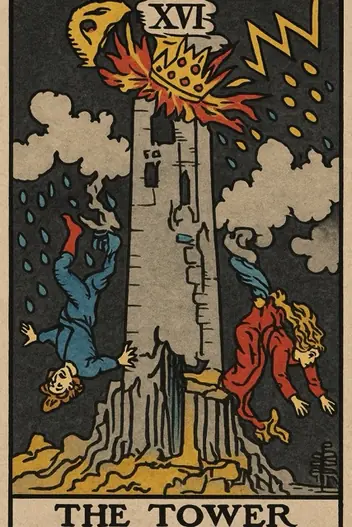
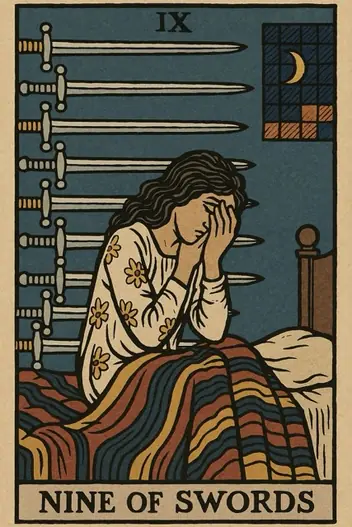
When The Tower—the archetype of sudden upheaval and structural collapse—collides with the Nine of Swords—the card of paralyzing anxiety and catastrophic thinking—the result is a psychological storm of immense intensity. This pairing represents the moment a deeply held belief system, security blanket, or life structure is violently shattered, leaving the seeker to confront the raw, unfiltered fears that were previously held at bay. The Tower destroys the external framework; the Nine of Swords magnifies the internal noise.
From a Jungian perspective, this combination forces an encounter with the Shadow—that part of the psyche we suppress. The Tower removes the mask of control, while the Nine of Swords forces you to listen to the screaming voices of your own worst-case scenarios. Strategically, this is not a time for impulsive action or denial. It is a critical juncture for triage: you must separate objective reality from subjective terror. The key is to recognize that while the collapse is real, the worst of the nightmare is often a product of your own mind, not the external event itself.
The Tower and Nine of Swords Together: Meaning
The core dynamic here is the interplay between external crisis and internal panic. The Tower represents an event that is often sudden, disruptive, and beyond your control—a job loss, a breakup, a betrayal, or a sudden health scare. The Nine of Swords represents the sleepless nights, the obsessive rumination, and the feeling of being trapped in a loop of "what-ifs." Together, they create a feedback loop where the external shock triggers an internal avalanche of fear, which in turn paralyzes your ability to respond effectively.
Psychologically, this is a state of acute cognitive dissonance. Your pre-existing worldview has been invalidated, and your mind is scrambling to make sense of the chaos. The danger is catastrophizing—turning a manageable problem into an existential threat. Pragmatically, the first step is to break the feedback loop. This means physically removing yourself from the triggering environment (if possible), grounding yourself through breath or movement, and then objectively listing the facts of the situation. What has actually changed? What is a real threat, and what is a fear-based projection?
The strategic insight here is that the Tower’s destruction is not random; it removes what is unsustainable. The Nine of Swords’ anxiety is a signal, not a sentence. Your task is to use the clarity of the crisis to identify which fears are valid warnings (e.g., “I need to change my career path”) and which are irrational noise (e.g., “I will never be happy again”). This is a forced stress test for your psychological resilience. The outcome depends on your ability to shift from reactive panic to strategic assessment within the first 48 hours of the event.
The Tower and Nine of Swords in Career Readings
Strategic Opportunities:
The collapse of a failing project or company culture creates a clean slate. Use the crisis to pivot to a more aligned career path.
Strategic Opportunities:
Your anxiety is a map of your deepest professional fears. Address them directly—e.g., if you fear public speaking, take a course immediately.
Calculated Risks:
Do not make major financial moves (e.g., quitting without a plan, taking on debt) while in a state of acute stress. Wait until sleep and rational thinking return.
In the professional realm, this combination often signals a sudden termination, a project failure, or a public mistake that feels catastrophic. The Nine of Swords amplifies the fear of financial ruin, professional reputation damage, or being “found out” as an imposter. The pragmatic approach is to treat this as a liquidity crisis—both financial and psychological. Your immediate priority is to stabilize your cash flow and your mental state. Do not make long-term career decisions from a place of panic.
Strategic action plan:
First, audit your worst-case scenario. Write down the absolute worst outcome (e.g., “I lose my job and can’t pay rent for two months”). Then, create a concrete, step-by-step contingency plan for that scenario. This act of planning—of turning abstract fear into a tangible to-do list—is the most effective antidote to the Nine of Swords’ paralysis. Second, identify one small, low-risk action you can take within 24 hours (e.g., update your resume, schedule a networking call). This breaks the feeling of helplessness. Financially, this is a time for austerity, not investment. Protect your cash reserves. The Tower’s destruction is temporary, but the Nine of Swords’ anxiety can lead to impulsive, wealth-destroying decisions if you are not careful.
Your pair is already on the table. Ask your question and draw the clarifying card
or simply focus on it
The Tower and Nine of Swords Love Outcome
If you are single:
This combination warns against seeking comfort in a new connection as a distraction from internal turmoil. You are not ready for a healthy relationship until you process the underlying anxiety. Do not mistake intensity for intimacy.
If you are in a relationship:
A sudden revelation or betrayal is likely. The Tower represents a truth that shatters the relationship’s foundation. The Nine of Swords warns that silence and avoidance will only amplify the pain. Open, raw communication is non-negotiable.
In relationships, this pairing signals a crisis of trust and security. The Tower often manifests as a sudden exposure of a hidden truth—infidelity, a secret debt, a fundamental value clash. The Nine of Swords represents the ensuing spiral of guilt, shame, and sleepless nights for one or both partners. The key psychological trap is the urge to assign blame rather than examine the structural flaws in the relationship’s foundation. A partner may become the “villain” in the seeker’s internal narrative, but this is a projection of their own fear of being vulnerable.
Strategic advice for couples:
Resist the urge to make permanent decisions during the acute phase. The first 72 hours are dominated by the Nine of Swords’ panic. Instead, establish a temporary communication protocol (e.g., “We will talk about this for 30 minutes, then take a break”) to prevent emotional flooding. After the initial shock subsides, use the Tower’s destruction as an opportunity to rebuild on a more honest foundation. This may mean ending the relationship, but if both partners can face the fear together, it can forge a deeper, more resilient bond. Boundaries are crucial: do not let the anxiety of one partner dominate the decision-making process.
The Tower and Nine of Swords Reversed: How to Read It
If The Tower is Reversed:
The external crisis is blocked or delayed, but the internal tension (Nine of Swords) remains. You live in anticipation of the blow, which is psychologically even harder than the blow itself. Advice: provoke a "controlled Tower." Initiate the unpleasant but necessary conversation or resignation yourself. This will return a sense of control to you.
If the Nine of Swords is Reversed:
The anxiety is suppressed, but not gone. You deny the scale of the catastrophe, acting with bravado. Risk: you fail to see real threats. This is a path to a stronger blow later. It is necessary to artificially lower your level of optimism and honestly assess the damage.
If BOTH are Reversed:
Complete imbalance. The crisis is denied, anxiety is repressed into the subconscious, leading to psychosomatic issues (illness, accidents). This is a state of chronic dissociation. Correction: return to the body. Sports, cold showers, a daily routine. Only through physical stabilization will you be able to see reality, rather than its distorted version.
Deepen your understanding
Find out exactly what this reading means for your current life situation with our oracle.
Negative Meaning of The Tower and Nine of Swords
The shadow side of this combination is learned helplessness and victimhood. The seeker may become so overwhelmed by the Nine of Swords’ anxiety that they passively accept the Tower’s destruction as an irreversible fate. They may project their internal chaos onto others, blaming a partner, boss, or circumstance for their suffering, rather than taking responsibility for their own psychological response. This is a classic cognitive bias of emotional reasoning—believing that because you feel doomed, you are doomed.
Another pitfall is self-sabotage through over-control. In an attempt to prevent further collapse, the seeker may become rigid, paranoid, and micromanaging, which ironically creates new crises. The Nine of Swords can manifest as obsessive checking (e.g., bank accounts, partner’s phone, work emails) that erodes trust and drains energy. The deepest shadow is the refusal to grieve. The Tower demands a letting go of the old self-concept. If the seeker refuses to mourn what was lost, the anxiety of the Nine of Swords will persist indefinitely, turning a temporary crisis into a chronic state of misery.
Overall Meaning of The Tower and Nine of Swords
How can this energy be used constructively? The answer is paradoxical: you must accept the destruction, but refuse the suffering. The Tower has already happened. You cannot put the wall back in place. But you can decide what exactly you will carry out of the ruins. The Nine of Swords is the noise that prevents you from hearing your own desires.
Your task is to shift anxiety from passive to active. Not "Oh God, I've lost everything," but "What exactly among what I lost did I actually need?" The Tower often breaks not what is valuable, but what was an illusion of security (an unloved job, toxic relationships).
Strategic advice: use the energy of the Nine of Swords not for self-flagellation, but for risk scanning. Write down the 10 scariest scenarios for how things could unfold. Then, for each one, write one step that would make it less likely. This will switch your brain from "panic" mode to "planning" mode. The Tower grants you freedom from the old, and the Nine of Swords gives you sharpened vision to avoid stepping on the same rake.
Applying This to Your Situation
The Tower and Nine of Swords is a brutal but clarifying combination. It forces you to face the truth that your old security was an illusion, and your fears are often larger than the reality. The core message is not to avoid the collapse, but to manage your response to it. Your psychological survival depends on separating the objective crisis from the subjective nightmare, and taking one small, grounded action at a time. This is an invitation to rebuild from a place of radical honesty—not from fear.
While this analysis provides a powerful framework, the true meaning of this combination is deeply personal. It depends on your unique history, your current relationship, and the specific question you are asking. To get a deep, personalized interpretation of The Tower and Nine of Swords for your exact situation, use the Fortune Cards app. Available on the web or as a download, it applies these archetypes to your specific context, giving you the clarity and strategic direction you need right now.
Interpretation by the Fortune Cards editorial team, based on the Rider–Waite tradition and Jungian archetypes. About our methodology · Updated: 2026-08-26
Other Combinations with The Tower
Other Combinations with Nine of Swords
Explore Individual Card Meanings
Table of Contents
- The Tower and Nine of Swords Together: Meaning
- The Tower and Nine of Swords in Career Readings
- The Tower and Nine of Swords Love Outcome
- The Tower and Nine of Swords Reversed: How to Read It
- Negative Meaning of The Tower and Nine of Swords
- Overall Meaning of The Tower and Nine of Swords
- Applying This to Your Situation
Ready to find answers to your questions?
Start your first reading now and look at your situation with fresh clarity. The cards are ready to reveal deeper meaning.