Two of Swords and Three of Pentacles Tarot as Feelings
- Arcana
- Two of Swords — Minor Arcana, Swords; Three of Pentacles — Minor Arcana, Pentacles
- Elements
- Two of Swords — Air; Three of Pentacles — Earth
- Elemental interaction
- Opposing elements — energies create tension
- Numerology
- 2 + 3 = 5
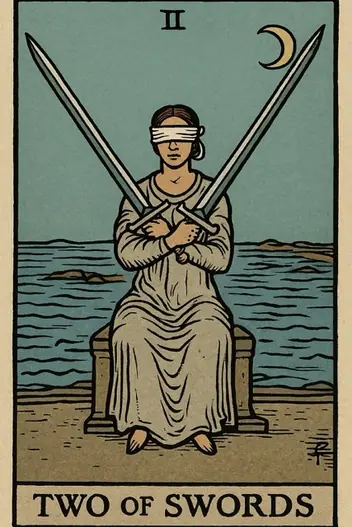
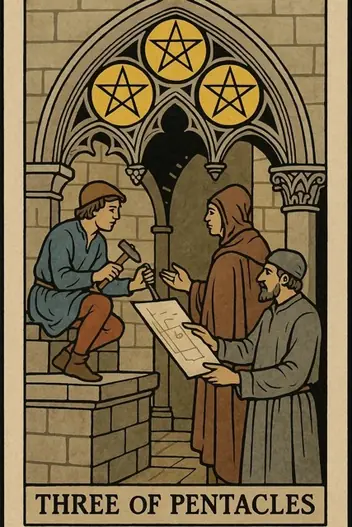
When the Two of Swords—the card of deliberate indecision, mental stalemate, and emotional defense—collides with the Three of Pentacles—the card of skilled craftsmanship, collaborative work, and tangible progress—you are facing a unique psychological tension. This pairing represents the conflict between the need to decide and the desire to perfect. In real life, this shows up as a scenario where you are highly capable, yet you remain stuck in a loop of analysis, fearing that any move will compromise the quality of your work or disrupt a delicate partnership.
The core struggle here is not a lack of skill or resources, but a blockage in executive function. You have the blueprint (Three of Pentacles) and the blindfold (Two of Swords), but you cannot see the path forward because you are too busy weighing the risks of choosing the wrong door. This combination often appears when a person is over-functioning in their mind while under-functioning in their actions, leading to a sense of professional or relational stagnation.
Core Dynamics & Interpretation
The psychological state created by the Two of Swords and Three of Pentacles is one of hyper-rationalization masking a deeper fear of failure. The Three of Pentacles represents a desire for mastery, collaboration, and recognition through skilled output. The Two of Swords, however, introduces a defensive posture—a refusal to commit to a specific direction because the seeker is afraid of making a mistake that will damage their reputation or the team’s progress. This is not laziness; it is perfectionism disguised as prudence.
The real-world implication is a bottleneck in productivity. In a team setting, this combination suggests that one member (or the seeker themselves) is holding up the workflow by refusing to sign off on a decision, constantly requesting more data, or avoiding a necessary confrontation about roles and responsibilities. The mind is working overtime to protect the ego from criticism, but the hands are idle. The key insight is that the Three of Pentacles thrives on iterative feedback, not flawless first attempts. To break the stalemate, you must accept that a good decision today is better than a perfect decision tomorrow.
This dynamic also points to a conflict between individual standards and collective goals. The seeker may be trying to maintain an impossibly high internal standard (Two of Swords’ emotional detachment) that is incompatible with the collaborative, adaptive nature of the Three of Pentacles. The psychological task is to integrate the intellect with the practical—to use your analytical skills not to avoid action, but to plan a single, high-quality next step.
Your pair is already on the table. Ask your question and draw the clarifying card
or simply focus on it
Two of Swords and Three of Pentacles in Love Tarot
If you are single:
This combination suggests you are over-analyzing a potential partner or a dating situation. You may be creating a mental checklist of requirements that is so rigid that you never actually engage. The advice is to lower the barrier to entry for a first conversation and let the collaboration of mutual interest unfold naturally.
If you are in a relationship:
You and your partner may be stuck in a cycle of planning without doing. Perhaps you are discussing a shared project, moving in together, or resolving a recurring conflict, but no one wants to make the first move. This is a call to stop debating logistics and start taking small, concrete actions.
In a relationship context, this pairing reveals a power dynamic based on intellectual control. One partner may be withholding their emotional input (Two of Swords’ blindfold) while the other is trying to build a shared life (Three of Pentacles). The danger is that the relationship becomes a project to be managed rather than a connection to be felt. Bold relationship advice: You must remove the blindfold and state your true feelings, even if they are messy. The Three of Pentacles requires honest feedback to function; you cannot build a partnership on silence and guesswork. If you are avoiding a difficult conversation because you want to keep the peace, you are actually sabotaging the long-term structure of your relationship. Focus on one small, collaborative action this week—like planning a weekend activity or tackling a household task together—to break the emotional impasse.
Get a personalized interpretation
Unlock the combined meaning of your cards in the context of your unique question — for free.
Career Meaning of Two of Swords and Three of Pentacles
Strategic Opportunities:
Delegate the decision-making process. If you are stuck on a project, ask a trusted colleague or mentor to review your options and give a deadline for your choice. This external accountability leverages the Three of Pentacles’ collaborative strength.
Strategic Opportunities:
Use a prototype or draft to gather feedback. Instead of trying to perfect a proposal in isolation, share an imperfect version with your team. This turns the Two of Swords’ paralysis into a productive feedback loop.
Calculated Risks:
Avoid over-committing to a single strategy before testing it. The risk here is that you will spend so much time analyzing market data or team dynamics that you miss a window of opportunity. A specific warning: Do not let fear of criticism from a boss or client prevent you from submitting work on time.
In a professional context, the Two of Swords and Three of Pentacles is a classic "analysis paralysis" scenario for skilled workers. You have the technical know-how (Three of Pentacles) but you are frozen by the weight of potential consequences (Two of Swords). This is especially common in creative fields, consulting, or project management where decisions have visible outcomes. The pragmatic solution is to implement a "time-boxed" decision rule. For example, give yourself exactly 30 minutes to research and decide on a vendor, then move forward. Bold financial warning: This combination can lead to lost revenue through delayed launches or missed deadlines. The cost of indecision is often higher than the cost of an imperfect choice. In financial planning, this suggests you are waiting for the "perfect" investment or the "ideal" market condition, which is a trap. Take a calculated, small step now, and adjust as you learn.
Reversed Two of Swords and Three of Pentacles Explained
If the Two of Swords is reversed:
This indicates reckless unblocking. You are making decisions too quickly, ignoring important data. Instead of analysis, there are chaotic actions. Advice: intentionally slow down for 24 hours before any important step.
If the Three of Pentacles is reversed:
Internal resistance to cooperation manifests. You are sabotaging teamwork due to pride or fear of criticism. The quality of work is declining. Advice: acknowledge that you cannot do everything alone and ask a colleague for help.
If BOTH are reversed:
This is a complete imbalance — chaos in decisions and a lack of skills. You act impulsively, lacking even basic competence. The logical way to correct this: stop completely. Return to the basics — undergo training or hire a consultant before undertaking anything.
What Are the Risks of Two of Swords and Three of Pentacles?
The shadow manifestation of this pairing is cognitive rigidity and passive-aggressive control. When blocked, the seeker may become a "silent saboteur" —agreeing to a team plan in public but secretly withholding effort or creating subtle delays in private. This is driven by a fear of being seen as incompetent (Two of Swords’ defense mechanism) combined with a perfectionist need for control (Three of Pentacles’ shadow). The cognitive bias at play is the sunk cost fallacy: the seeker may have already invested so much mental energy into analyzing a problem that they feel unable to pivot, even when the data suggests a new direction. Another pitfall is false consensus: assuming that everyone on the team agrees with your unspoken reservations, which leads to resentment and miscommunication. Self-sabotage occurs when you mistake meticulous planning for actual progress. You may feel productive because you are busy thinking, but you are not moving the needle.
What Is the Overall Message of Two of Swords and Three of Pentacles?
How can the energy of the Two of Swords be used constructively to activate the Three of Pentacles? The key lies in breaking the process into stages and embracing uncertainty. Understand that the Two of Swords is not an enemy, but your inner "quality filter." The problem is that you apply this filter at the conception stage, not the result stage. Shift your critical analysis to the finish line: first create a draft, then evaluate it.
A deep strategic tip:
Use the "Timeline" technique. Imagine yourself a month from now. What would you regret not having done today? This simple mental experiment shatters the illusion of infinite time. Then, take one action from that "future regret" and execute it right now. Don't think about the result—think about the process.
The Three of Pentacles teaches us that mastery comes through practice, not theory. The Two of Swords asks us to make a choice. Your task is to choose action, even if it is imperfect. Remember: the best decision is the one that is made. The worst decision is the one never made at all. Start small, trust the process, and you will see how the energy of analysis transforms into the energy of creation.
Where to Go From Here
The core message of the Two of Swords and Three of Pentacles is this: You cannot build a masterpiece while keeping your eyes closed. Your skills and your team are ready to work, but you must first choose a direction. The path to mastery is not about avoiding mistakes—it is about making them quickly, learning from them, and iterating. Stop trying to see the entire staircase; just take the first step and trust your ability to adjust.
To unlock the full power of this combination for your unique situation, you need more than a general interpretation. The Fortune Cards app can provide a deep, personalized reading of the Two of Swords and Three of Pentacles tailored to your specific question—whether it’s about a career move, a relationship decision, or a creative project. Use the app on the web or download it now to get your customized analysis and break through your current stalemate.
Interpretation by the Fortune Cards editorial team, based on the Rider–Waite tradition and Jungian archetypes. About our methodology · Updated: 2026-08-26
Other Combinations with Two of Swords
Other Combinations with Three of Pentacles
Explore Individual Card Meanings
Table of Contents
- Core Dynamics & Interpretation
- Two of Swords and Three of Pentacles in Love Tarot
- Career Meaning of Two of Swords and Three of Pentacles
- Reversed Two of Swords and Three of Pentacles Explained
- What Are the Risks of Two of Swords and Three of Pentacles?
- What Is the Overall Message of Two of Swords and Three of Pentacles?
- Where to Go From Here
Ready to find answers to your questions?
Start your first reading now and look at your situation with fresh clarity. The cards are ready to reveal deeper meaning.