Two of Wands and Eight of Swords Meaning in Tarot
- Arcana
- Two of Wands — Minor Arcana, Wands; Eight of Swords — Minor Arcana, Swords
- Elements
- Two of Wands — Fire; Eight of Swords — Air
- Elemental interaction
- Friendly elements — energies support each other
- Numerology
- 2 + 8 = 10 → 1
When the Two of Wands—the card of foresight, ambition, and global planning—collides with the Eight of Swords—the card of mental paralysis, restriction, and victimhood—the result is a powerful psychological paradox. You have the map, the vision, and the drive to expand your horizons, yet you feel bound by invisible constraints. This combination reveals a mind that is both expansive and imprisoned, a planner who cannot execute due to self-doubt or over-analysis.
The core conflict here is between potential and perception. You are standing at a threshold, ready to conquer new territories, but the Eight of Swords whispers that you are trapped, powerless, or lacking options. In reality, the barriers are often cognitive—patterns of negative thinking, fear of failure, or a perfectionist loop that prevents any forward movement. The pragmatic task is to distinguish between genuine external obstacles and the internal narratives that keep you circling in place.
Two of Wands and Eight of Swords Card Meaning Explained
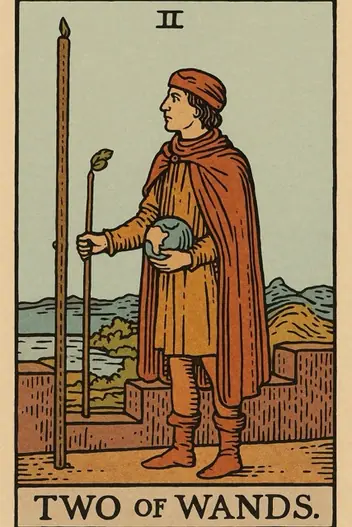
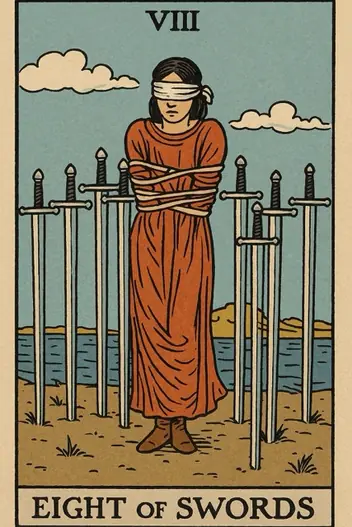
The Two of Wands represents a state of calculated ambition. You have done the groundwork, surveyed your options, and are now holding a staff of authority, looking outward toward the world. This card is about strategic expansion—choosing a path, making a plan, and committing to growth. In contrast, the Eight of Swords depicts a figure blindfolded and bound, surrounded by a row of swords. This is the archetype of the imprisoned mind: you feel restricted, but the ropes are loose enough to escape if you only remove the blindfold. The combination suggests that your grand vision is being sabotaged by your own limiting beliefs.
The psychological state here is one of high cognitive dissonance. You know you have choices (Two of Wands), yet you feel you have none (Eight of Swords). This tension often arises from perfectionism—you want the perfect plan before you act, but the Eight of Swords demands immediate, imperfect action to break the paralysis. The real-world implication is that your biggest obstacle is not the external world, but your internal filter of fear. To move forward, you must recognize that the "swords" surrounding you are largely self-constructed: outdated fears, harsh self-criticism, or a refusal to accept risk. The key insight here is that clarity comes from movement, not from more planning.
Your pair is already on the table. Ask your question and draw the clarifying card
or simply focus on it
Two of Wands and Eight of Swords as Feelings
If you are single:
This pair suggests you may be overthinking a potential connection. You see the possibility of a meaningful relationship (Two of Wands), but you are trapped by fears of rejection, inadequacy, or past hurts (Eight of Swords). Take one small, low-risk action—send a message, attend a social event—to test reality against your fears.
If you are in a relationship:
You and your partner may be stuck in a cycle of unspoken expectations. One or both of you have a vision for the future (Two of Wands), but communication is blocked by assumptions or feelings of powerlessness (Eight of Swords). Initiate a direct, vulnerable conversation to cut through the mental fog.
In relationships, this combination often points to a dynamic of silent frustration. The Two of Wands partner may be dreaming of shared adventures, career moves, or lifestyle changes, while the Eight of Swords partner feels trapped by their own anxiety or by perceived constraints in the relationship. The result is a standoff between ambition and fear. The pragmatic solution is to name the blindfold. Ask: "What specific belief is keeping me from speaking up or taking action?" Often, the answer is a fear of conflict or a need for control. Bold relationship advice: The most loving action you can take is to break the silence with honesty, even if it feels risky. The Eight of Swords only tightens when you avoid the conversation.
Two of Wands and Eight of Swords in Career Readings
Strategic Opportunities:
Reassess your risk tolerance. The Two of Wands offers a window for expansion—a new job, a side project, or a market move. Use the Eight of Swords energy to audit your mental blocks rather than your actual resources.
Strategic Opportunities:
Leverage your existing network. You may feel isolated or unsupported, but the Two of Wands indicates that your past groundwork has built connections. Reach out to one mentor or colleague for perspective.
Calculated Risks:
Avoid making major decisions while in a state of anxiety. The Eight of Swords distorts perception. If you feel trapped, delay a financial commitment or job change by 48 hours to let clarity return.
In the professional realm, this combination is a warning against analysis paralysis. You have a clear vision—perhaps a business expansion, a promotion, or a career pivot—but you are frozen by the perceived "swords" of competition, economic uncertainty, or imposter syndrome. The pragmatic truth is that most of these barriers are cognitive, not structural. For example, you might delay a negotiation because you fear rejection, when in reality the other party is waiting for your proposal. Bold financial warning: Do not let the fear of making a mistake prevent you from making any move at all. The cost of inaction (Two of Wands) often exceeds the cost of a flawed decision (Eight of Swords). Instead, take a small, reversible step—send an exploratory email, run a small test, or allocate a tiny budget to a new idea. This breaks the paralysis and provides real data to inform your next move.
Uncover hidden insights
Let our advanced Tarot system interpret these archetypes specifically for your personal path.
Two of Wands and Eight of Swords Reversed: What Changes?
When reversed cards appear in a spread, the dynamics become more complex and pathological. If the Two of Wands is reversed, it indicates blocked potential or recklessness. You either fear even dreaming about the future, or conversely, you grab at the first adventure that comes along without any plan, ignoring the consequences. Warning: do not confuse impulsiveness with determination.
If the Eight of Swords is reversed, it can mean internal resistance or weakness. You know what needs to be done, but you find a thousand reasons not to do it. This is not fear, but passive aggression towards yourself and your life. You abdicate responsibility by saying "I can't," when in reality you mean "I don't want to." Advice: acknowledge your unwillingness to act as a fact, not as an objective limitation.
If BOTH cards are reversed, we see a complete imbalance. The person simultaneously has no plan (reversed Two) and sees no way out of their state (reversed Eight). This is a deep crisis of meaning and self-efficacy. The logical way to correct this is to start from scratch. Cast aside all old expectations and fears. Focus on basic needs and simple actions that restore a sense of control over life.
Negative Meaning of Two of Wands and Eight of Swords
The shadow of this combination is passive-aggressive inaction. You may convince yourself that you are "waiting for the right moment" (a distorted Two of Wands) when you are actually avoiding discomfort (a shadow Eight of Swords). This can manifest as procrastination disguised as prudence. Another pitfall is projecting your internal prison onto others—blaming a partner, boss, or market condition for your stagnation, when the real barrier is your own fear of failure or rejection. Cognitive biases at play include confirmation bias (you only notice evidence that supports your feeling of being trapped) and catastrophizing (you imagine the worst-case outcome of any action). To avoid these traps, practice radical self-honesty. Ask: "If I had no fear, what would I do right now?" Then do that thing, even in a small way.
Two of Wands and Eight of Swords: The Combined Message
How can the energy of the Two of Wands be used constructively to balance the Eight of Swords? The answer lies in shifting the focus from "why this won't work" to "what can I do right now." The Two of Wands provides you with vision and ambition. The Eight of Swords gives you awareness of obstacles. Your task is to transform obstacles into tasks. If you fear failure, plan how you will act in the event of a setback. If you fear criticism, prepare your arguments. Fear diminishes when you translate it from the emotional plane into the plane of concrete scenarios.
Your main strategic advice is the "80/20 principle." Do not try to achieve a perfect plan (this is the trap of the Eight). Invest 20% of the effort to create an 80% effective plan, and begin to act. The first step does not need to be global. It simply needs to be the first. Send an email, sign up for a consultation, start negotiations. As soon as you take action, the illusion of "bound hands" will begin to dissipate. Clarity comes not through thinking, but through action. Use the ambition of the Two of Wands as fuel, not as a reason for self-criticism.
Where to Go From Here
The core message of Two of Wands and Eight of Swords is that your vision is real, but your prison is an illusion. You have the power to choose your next move, but only if you first remove the blindfold of self-doubt. The path forward requires a blend of bold planning and humble action—commit to a direction, but start with a single, imperfect step.
While this article provides a general archetype, the true value of Tarot lies in its application to your unique situation. The Fortune Cards app allows you to input your specific question—about a relationship, career decision, or personal challenge—and receive a deep, personalized interpretation of this exact card combination. You can use the app on the web or download it to get a reading that cuts through the noise and speaks directly to your life. Stop analyzing, start acting—let the cards guide your next move.
Interpretation by the Fortune Cards editorial team, based on the Rider–Waite tradition and Jungian archetypes. About our methodology · Updated: 2026-08-26
Other Combinations with Two of Wands
Other Combinations with Eight of Swords
Explore Individual Card Meanings
Table of Contents
- Two of Wands and Eight of Swords Card Meaning Explained
- Two of Wands and Eight of Swords as Feelings
- Two of Wands and Eight of Swords in Career Readings
- Two of Wands and Eight of Swords Reversed: What Changes?
- Negative Meaning of Two of Wands and Eight of Swords
- Two of Wands and Eight of Swords: The Combined Message
- Where to Go From Here
Ready to find answers to your questions?
Start your first reading now and look at your situation with fresh clarity. The cards are ready to reveal deeper meaning.