Two of Wands and Five of Cups Reversed in Tarot
- Arcana
- Two of Wands — Minor Arcana, Wands; Five of Cups — Minor Arcana, Cups
- Elements
- Two of Wands — Fire; Five of Cups — Water
- Elemental interaction
- Opposing elements — energies create tension
- Numerology
- 2 + 5 = 7
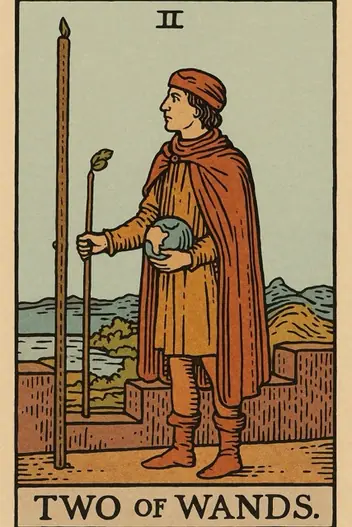
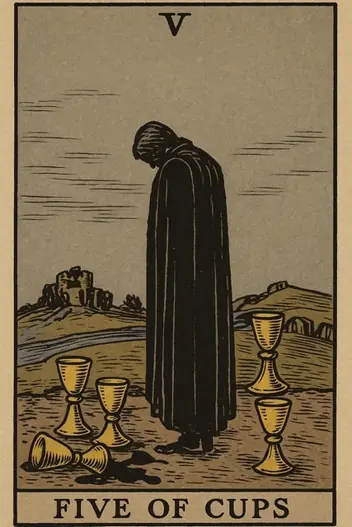
When the Two of Wands—a card of vision, expansion, and future planning—collides with the Five of Cups—a card of loss, regret, and emotional withdrawal—you face a powerful psychological paradox. The seeker is standing at a crossroads, map in hand, but their gaze is fixed on a past disappointment. This combination represents the cognitive dissonance between what could be and what has been lost. The energy of the Wands demands forward momentum, while the Cups insist on mourning. The result is a state of paralyzed ambition, where the potential for a new world is overshadowed by the ruins of the old one.
In real-world terms, this pairing often appears when someone has a clear, viable path forward but cannot emotionally detach from a recent failure or betrayal. They see the horizon (Two of Wands) but are drowning in the spilled cups of the past (Five of Cups). The core psychological task here is not to ignore the grief, but to integrate it without letting it dictate the future. This is not about toxic positivity; it is about strategic emotional management.
Two of Wands and Five of Cups Card Meaning Explained
The intersection of the Two of Wands and Five of Cups creates a psychological tug-of-war between the Explorer archetype and the Mourner archetype. The Explorer wants to survey the landscape, plan the voyage, and take calculated risks. The Mourner wants to sit with the loss, analyze what went wrong, and process the emotional fallout. When these two forces are unbalanced, the seeker becomes a strategist who cannot execute, trapped in a loop of "what if" and "if only."
The key insight here is that the Two of Wands represents a choice about the future, while the Five of Cups represents a judgment about the past. The mind cannot effectively plan for a new territory while it is still emotionally invested in the territory that has been lost. This often manifests as procrastination disguised as reflection. The seeker may believe they are "taking time to heal," but they are actually avoiding the anxiety of making a new decision. The healthy path is to compartmentalize: allocate specific time for processing grief, and separate time for active planning. Ambition without emotional closure is a leaky ship.
Furthermore, this combination often signals a powerful hidden resource. The Three remaining cups in the Five of Wands (the ones still standing) represent what was not lost. The Two of Wands asks the seeker to pivot their vision toward those remaining assets. The psychological move required is a shift from scarcity thinking to strategic reframing. Instead of asking "Why did I lose that?", the productive question becomes "What do I still have that I can build with?"
Two of Wands and Five of Cups in Love and Relationships
If you are single:
This combination suggests you are evaluating a new potential partner through the lens of a past heartbreak. You are holding a map to a new relationship, but your emotional compass is still pointing backward. Do not punish a new person for the sins of the last one. Acknowledge the grief, but keep the Two of Wands' vision for what a healthy partnership looks like.
If you are in a relationship:
You and your partner may be at a crossroads where one of you is focused on a shared future, while the other is still grieving a specific argument, betrayal, or unmet expectation. The power dynamic is skewed. The partner holding the grief holds the veto power over the future.
In relationships, this card pair indicates a critical communication breakdown. The Two of Wands partner is likely saying, "Let's plan our next step, our next adventure, our next goal." The Five of Cups partner is hearing, "You don't care about how much I'm hurting." This is not a sign of incompatibility, but a mismatch in emotional timing. The pragmatic advice is to schedule a "reality check" conversation. The grieving partner needs to articulate what specific loss is blocking them (e.g., "I lost trust when you didn't show up"). The visionary partner must validate that loss without taking responsibility for fixing it. The goal is to move from "You vs. Me" to "Us vs. The Problem." The boldest relationship move here is to agree on a deadline for processing the grief before making a major decision about the future.
Your pair is already on the table. Ask your question and draw the clarifying card
or simply focus on it
Two of Wands and Five of Cups: Career and Money
Strategic Opportunities:
Re-evaluate your assets after a setback. List what resources, skills, and relationships survived the loss. The Two of Wands says those are your new foundation.
Strategic Opportunities:
Use the grief as data. Analyze the failure (Five of Cups) to refine your business plan or career strategy (Two of Wands). The loss teaches you what not to do.
Calculated Risks:
Avoid making a major pivot purely to escape the pain of the failure. Do not quit your job or close a project solely because you are disappointed. That is an emotional decision, not a strategic one.
Professionally, this combination is a classic sign of post-project depression or a failed launch. You have invested heavily in a plan (Two of Wands) and it did not yield the expected return. The Five of Cups represents the emotional hangover of that unmet expectation. The danger here is analysis paralysis. The seeker may spend weeks or months dissecting the failure, unable to commit to the next logical step. The critical financial warning is to not let the emotional sting of the loss cause you to abandon a fundamentally sound strategy. If the fundamentals were solid, the failure was execution or timing, not vision. Separate the emotional cost from the strategic value.
The pragmatic path forward is to conduct a "lessons learned" audit with a strict time limit (e.g., 48 hours). Write down exactly what was lost, what was learned, and what remains. Then, use the Two of Wands energy to immediately draft a single, concrete next step. This could be a new sales pitch, a revised budget, or a job application. Action is the antidote to grief in the professional realm.
Negative Meaning of Two of Wands and Five of Cups
The shadow side of this pairing is a state of strategic paralysis disguised as emotional depth. The seeker may convince themselves they are being "mindful" or "processing their feelings," when in reality they are avoiding the anxiety of a new decision. This is a form of self-sabotage through rumination. The cognitive bias at play is the sunk cost fallacy—the irrational commitment to a past investment that cannot be recovered. The Five of Cups encourages the seeker to keep staring at the spilled milk, while the Two of Wands offers a fresh glass.
Another major pitfall is projection. The seeker may blame external circumstances or people for the loss (Five of Cups) to avoid taking responsibility for the poor planning or risk management (Two of Wands). This creates a victim mentality that is toxic to growth. The shadow asks: "Are you truly grieving, or are you using grief as an excuse to not try again?" The most dangerous irrational action is to burn the bridges of your future because you are angry about the past. Do not reject a viable opportunity simply because it reminds you of a previous failure.
Ask your specific question
Don't rely on generic meanings. Get a customized reading tailored specifically to your energies.
Two of Wands and Five of Cups Reversed Meaning
When cards appear reversed, the conflict intensifies or shifts its polarity.
If the Two of Wands is reversed:
The potential is blocked not by external circumstances, but by recklessness or apathy. You either throw yourself into new projects without preparation (impulsivity), or you abandon any plans altogether (passivity). Paired with the upright Five of Cups, this creates a toxic mix: you are grieving the past but have no strategy for the future. Advice: return to basic planning. Write down three simple steps for the coming week. Do not think about global goals.
If the Five of Cups is reversed:
This is an internal resistance to accepting loss. You are not mourning; you are in denial. You say, "Everything is fine," but you cannot move forward. In this case, the energy of the Two of Wands is spent maintaining the illusion that nothing has happened. Warning: this is a path to emotional exhaustion. You are spending resources on a facade rather than on genuine recovery. Allow yourself to acknowledge the loss.
If BOTH are reversed:
Complete imbalance. Chaos and self-deception. There are no plans (Two reversed), nor the ability to process pain (Five reversed). The person vacillates between impulsive actions and deep denial of reality. Logical way to correct it: a complete stop. Do not make any decisions for 3-5 days. Focus on basic needs (sleep, food, movement). Only after restoring cognitive resources can you begin to break down the situation piece by piece.
Two of Wands and Five of Cups: The Combined Message
How can the energy of the Two of Wands be used constructively to balance the Five of Cups? The answer lies in the concept of "rational pessimism." Instead of trying to artificially generate optimism (which often fails), accept your pain as part of the strategy. Acknowledge: "Yes, I have failed. Yes, it was painful. Now, with this data, where do I go?"
The Two of Wands is a card of choice. It says: "The world is vast, and you can go in any direction." The Five of Cups narrows this choice, pointing out the direction to avoid. Together, they give you a negative map of the terrain: you know exactly where not to go. This is a colossal advantage. Most people spend years stepping on the same rake. You, thanks to this combination, can sidestep it.
Strategic advice: use the "Three Scenarios" method. Instead of fixating on one ideal plan (as the Two of Wands desires) or on one failure (as the Five of Cups desires), outline three scenarios:
Optimistic:
What if everything works out? (Energy of the Two).Realistic:
What if it's average? (Balance).Pessimistic:
What if I lose what is dear to me again? (Energy of the Five).
By outlining the third scenario, you strip it of its power of fear. You will see that even in the worst case, you won't die or lose everything. Clarity comes not from certainty of success, but from understanding the price of failure. This is precisely what this combination of cards offers you—the ability to make a conscious decision, knowing all the risks.
Your Next Step: Personal Context Matters
The core message of the Two of Wands and Five of Cups is that your future cannot be built on the ruins of your past unless you first clear the rubble. You must honor the loss without letting it define your destination. The power lies in your ability to hold two truths simultaneously: something valuable was lost, and something valuable is still possible. Your next step is to objectively assess what remains, make a decisive plan, and take one small, courageous action forward.
While this analysis provides the general psychological and strategic archetype, the true power of Tarot lies in its application to your specific situation. The nuances of your question—your relationship history, your career context, your personal fears—change the entire equation. Get a deep, personalized interpretation of this exact combination for your unique question right now. Use the Fortune Cards app on the web or download it to receive a tailored reading that cuts through the generalities and speaks directly to your life.
Interpretation by the Fortune Cards editorial team, based on the Rider–Waite tradition and Jungian archetypes. About our methodology · Updated: 2026-08-26
Other Combinations with Two of Wands
Other Combinations with Five of Cups
Explore Individual Card Meanings
Table of Contents
- Two of Wands and Five of Cups Card Meaning Explained
- Two of Wands and Five of Cups in Love and Relationships
- Two of Wands and Five of Cups: Career and Money
- Negative Meaning of Two of Wands and Five of Cups
- Two of Wands and Five of Cups Reversed Meaning
- Two of Wands and Five of Cups: The Combined Message
- Your Next Step: Personal Context Matters
Ready to find answers to your questions?
Start your first reading now and look at your situation with fresh clarity. The cards are ready to reveal deeper meaning.