Love Tarot: Two of Wands and Five of Swords
- Arcana
- Two of Wands — Minor Arcana, Wands; Five of Swords — Minor Arcana, Swords
- Elements
- Two of Wands — Fire; Five of Swords — Air
- Elemental interaction
- Friendly elements — energies support each other
- Numerology
- 2 + 5 = 7
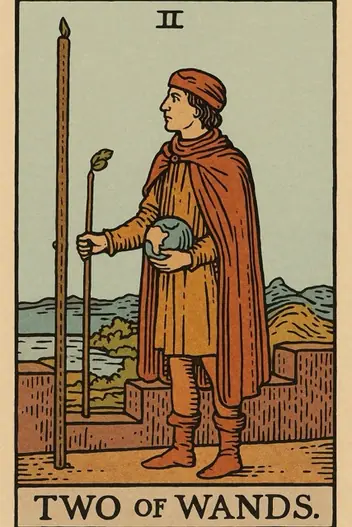
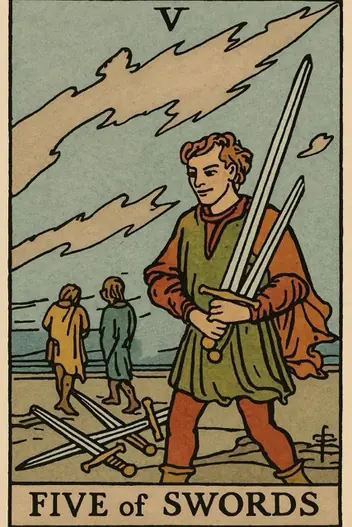
When the visionary ambition of the Two of Wands collides with the cutthroat conflict of the Five of Swords, you are not simply facing a choice; you are facing a strategic dilemma. The Two of Wands represents the moment of planning, the global perspective, and the desire to expand your influence. The Five of Swords, in contrast, represents a battle already won—but at a cost that may undermine the very victory you seek. This combination forces a hard question: Is your next move a genuine expansion, or a fight you should walk away from to preserve your resources?
Psychologically, this pairing activates the Shadow of the Strategist. You are likely in a phase of high ambition, mapping out long-term goals (Two of Wands), but you are also entangled in a conflict that feels like a zero-sum game (Five of Swords). The risk here is over-optimism about the spoils of war. You may be planning a bold expansion while simultaneously engaging in a petty or exhausting battle that will drain the energy needed for that expansion. The pragmatic insight is to audit your motivations: Are you fighting for a principle that serves your big vision, or are you fighting just to be right?
Two of Wands and Five of Swords Combination Meaning
The core dynamic of the Two of Wands and Five of Swords is the tension between long-term vision and short-term victory at a cost. This combination often appears when you are at a crossroads, holding a plan in one hand and a sword in the other, unsure which to use first. The Five of Swords warns that winning the argument or the negotiation right now may leave you isolated or with a tarnished reputation, making it harder to execute your grand plan later. The Two of Wands asks you to look beyond the immediate skirmish and see the entire campaign.
From a Jungian perspective, this is the clash between the Explorer archetype (Two of Wands) and the Warrior archetype (Five of Swords) in its shadow form. The Explorer wants to discover new lands, forge alliances, and chart a course. The Shadow Warrior wants to defeat an opponent, prove superiority, and claim a trophy. When these energies merge, the seeker may confuse conquest with progress. You might believe that defeating a rival or "winning" a dispute is a necessary step toward your goal, when in reality, it is a costly detour. The wise move is to separate strategy from ego—ask yourself if the fight is truly necessary for the vision, or if it is a distraction you are justifying.
Your pair is already on the table. Ask your question and draw the clarifying card
or simply focus on it
Two of Wands and Five of Swords in Love Tarot
If you are single:
This pair suggests you may be evaluating a potential partner through a competitive or transactional lens. You might be planning your romantic future while simultaneously "keeping score" in early interactions. Avoid turning dating into a game you need to win. Focus on whether the connection aligns with your long-term vision, not on who has the upper hand.
If you are in a relationship:
You or your partner may be planning a future together while nursing a recent conflict that was handled poorly. The Five of Swords indicates a fight where one person "won" but at the expense of trust. The relationship dynamic is now fragile, and the Two of Wands suggests you need to decide if the relationship is still worth the investment.
In relationships, the combination of Two of Wands and Five of Swords points to a power struggle disguised as future planning. You may be discussing big life decisions—moving, marriage, financial goals—while a recent argument has left one partner feeling humiliated or resentful. The most important relationship advice here is to acknowledge the cost of the last conflict before planning the next chapter. If the Five of Swords energy is dominant, the "winner" of the argument has damaged the partnership's foundation. Bold communication is required: Apologize for the cost of winning, or set a boundary that the relationship cannot move forward if conflict is being handled destructively. The Two of Wands gives you the perspective to see that a relationship built on resentment is not a viable long-term plan.
Ask your specific question
Don't rely on generic meanings. Get a customized reading tailored specifically to your energies.
Career Meaning of Two of Wands and Five of Swords
Strategic Opportunities:
Leverage your global perspective to identify new markets, partnerships, or projects. The Two of Wands gives you the foresight to see where the industry is heading.
Strategic Opportunities:
Use the Five of Swords' clarity to cut through bureaucracy or eliminate a weak competitor. This is a time for decisive action, not endless deliberation.
Calculated Risks:
Avoid engaging in petty office politics or legal battles that will drain your capital and reputation. A "win" in a dispute may cost you the goodwill needed for future expansion.
In the professional realm, this combination is a powerful but dangerous signal for entrepreneurs and leaders. You have a clear vision for growth (Two of Wands), but you are also in a competitive environment where you feel you must fight for every inch of ground. The key is to choose your battles wisely. The Five of Swords warns that a victory achieved through manipulation, aggression, or underhanded tactics will leave your network wary of you. Bold financial warning: Do not sacrifice long-term brand equity for a short-term cash win. For example, winning a client by undercutting a competitor with a loss-leading price may secure the deal but damage your market positioning. Instead, use the Two of Wands to plan a strategic retreat from a losing battle and focus your energy on a new frontier where you can lead without conflict.
Reversed Two of Wands and Five of Swords Explained
If the Two of Wands is reversed:
You are losing strategic vision. Instead of choosing your battles, you react to every threat. This is a path to burnout: your aggression (Five of Swords) is not backed by a plan. Advice: stop and reassess your priorities. Do not waste energy on petty skirmishes.
If the Five of Swords is reversed:
You are avoiding conflict, but this is not peace—it is surrender. You allow others to trample your boundaries because you fear the consequences. Warning: such behavior turns the Two of Wands into empty dreams. You want to change your life, but you are not ready to pay the price. Strategy: start small—defend one position for a week.
If BOTH are reversed:
Complete imbalance. You are simultaneously aggressive and aimless. This is pure self-sabotage: you provoke conflicts for no reason and retreat at the most inopportune moment. How to fix it: impose a "silence" period for 3 days. No decisions, no arguments. Only observation of your own behavior. Your task is to regain control through mindfulness.
Shadow Side & Pitfalls
The shadow side of this combination is the Tyranny of the Plan. When the Two of Wands' ambition is corrupted by the Five of Swords' need to dominate, the seeker becomes ruthlessly pragmatic—willing to sacrifice relationships, ethics, and well-being for a "win." The cognitive bias at play is the sunk cost fallacy: you may continue fighting a losing battle because you have already invested so much, ignoring the Two of Wands' call to look at the bigger picture and cut your losses. Another shadow manifestation is paranoid planning—you become so focused on potential threats and rivals that your vision narrows to a defensive crouch. You may start seeing allies as obstacles and interpreting neutral events as attacks. This leads to self-sabotage through isolation, as you burn bridges to protect a plan that no longer serves you. The antidote is to consciously practice humility and ask: "Am I expanding, or am I just defending my ego?"
What Is the Overall Message of Two of Wands and Five of Swords?
Constructive use of this pair requires a balance between ambition and ethics. The Two of Wands gives you the map; the Five of Swords gives you the sword. But the sword is not meant to cut down everything in its path, but rather to precisely sever what is unnecessary. Your task is not to defeat everyone, but to create space for growth.
The first step is disidentification from the "warrior" role. You are not obligated to fight in order to move forward. Use the energy of the Five of Swords to defend your boundaries, not to attack. The second step is reframing the conflict. Instead of "I must win," say "I must obtain the best possible outcome." This reduces tension and opens up new options.
A deep strategic piece of advice: use the Two of Wands to choose a "battlefield" that is advantageous to you. If you know you will lose an argument with your boss, do not enter into it. Instead, create a situation where they themselves offer you what you need. True power lies not in force, but in choosing the right moment for action. When you understand this, the Five of Swords will cease to be a threat and will become a tool.
Where to Go From Here
The core message of the Two of Wands and Five of Swords is a call to strategic wisdom over tactical victory. You have the vision to see far, but you are currently in a fight that may not matter in the long run. Pause, assess the true cost of your next move, and choose whether to advance or withdraw with intention. Your power lies not in winning every battle, but in knowing which battles to skip.
While this analysis provides the general archetype of this card combination, the true insight comes from applying it to your unique situation. The Fortune Cards app allows you to input your exact question—about a specific relationship, career decision, or personal dilemma—and receive a deep, personalized interpretation of this combination for your context. You can use the app on the web or download it to get a reading that reflects your story, not just the cards' general meaning. Discover what this pairing means for your specific path right now.
Interpretation by the Fortune Cards editorial team, based on the Rider–Waite tradition and Jungian archetypes. About our methodology · Updated: 2026-08-26
Other Combinations with Two of Wands
Other Combinations with Five of Swords
Explore Individual Card Meanings
Table of Contents
- Two of Wands and Five of Swords Combination Meaning
- Two of Wands and Five of Swords in Love Tarot
- Career Meaning of Two of Wands and Five of Swords
- Reversed Two of Wands and Five of Swords Explained
- Shadow Side & Pitfalls
- What Is the Overall Message of Two of Wands and Five of Swords?
- Where to Go From Here
Ready to find answers to your questions?
Start your first reading now and look at your situation with fresh clarity. The cards are ready to reveal deeper meaning.