Two of Wands and Nine of Swords Together in Tarot
- Arcana
- Two of Wands — Minor Arcana, Wands; Nine of Swords — Minor Arcana, Swords
- Elements
- Two of Wands — Fire; Nine of Swords — Air
- Elemental interaction
- Friendly elements — energies support each other
- Numerology
- 2 + 9 = 11 → 2
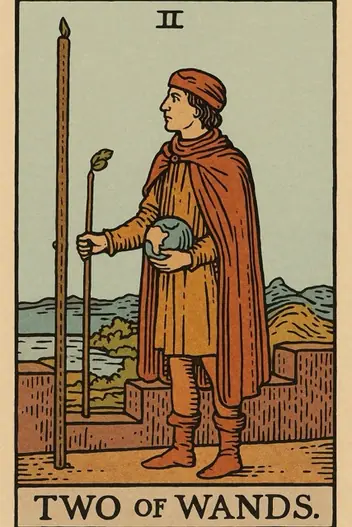
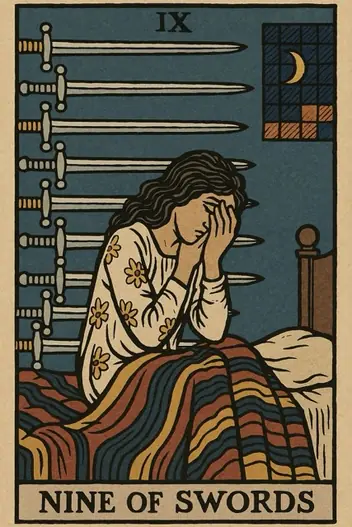
The intersection of the Two of Wands and Nine of Swords creates a powerful psychological tension between forward momentum and paralyzing fear. The Two of Wands represents a crossroads of ambition—you have laid the groundwork, and now you stand at the threshold of a significant decision or expansion. The Nine of Swords, however, introduces the shadow of overthinking: sleepless nights, catastrophic predictions, and the mental loops that turn possibilities into threats. When these cards collide, the seeker is not merely choosing a path; they are wrestling with the internalized fears that threaten to undermine their own potential. This combination asks a pragmatic question: Are your fears based on real risks, or are they projections of unprocessed anxiety?
In real-world terms, this pairing often appears when someone is poised to make a major move—starting a business, relocating, committing to a relationship—but finds themselves trapped in a cycle of worst-case-scenario thinking. The Two of Wands demands vision and courage; the Nine of Swords supplies doubt and dread. The psychological challenge here is to differentiate between useful caution (which the Two of Wands respects) and debilitating worry (which the Nine of Swords amplifies). A Jungian lens suggests that the Nine of Swords may represent the Shadow self—the part of you that fears failure, rejection, or loss of control. Integrating this shadow means acknowledging the fear without letting it dictate your choices.
Two of Wands and Nine of Swords Combination Meaning
The core dynamic of the Two of Wands and Nine of Swords is a battle between the Hero archetype (who steps into the unknown) and the Victim archetype (who feels trapped by circumstances). The Two of Wands is inherently outward-looking: it represents planning, exploration, and the willingness to leave comfort zones. The Nine of Swords is inward-turned: it fixates on internal distress, often exaggerating threats through rumination. When these energies merge, the seeker experiences a split consciousness—one part of them is ready to act, while another part is convinced that action will lead to disaster.
This combination often manifests as decision paralysis disguised as careful analysis. The seeker may spend excessive time researching, weighing pros and cons, or seeking reassurance from others, all while the window of opportunity narrows. Pragmatically, this suggests a need to set a firm deadline for the decision and to limit information intake—overthinking is a symptom, not a solution. The Nine of Swords thrives on ambiguity; the Two of Wands requires clarity. The psychological insight here is that fear of regret often masquerades as prudence. The real risk is not making the wrong choice, but making no choice at all.
**Another key dynamic is the tension between long-term vision and short-term anxiety. The Two of Wands looks outward and forward, often over a horizon of months or years. The Nine of Swords is trapped in the present moment's discomfort—tonight's sleeplessness, today's worry. This mismatch in time perspective can lead to cognitive distortion: catastrophizing a temporary setback as a permanent failure. The practical remedy is to anchor yourself in objective data. Ask: What specific evidence supports my fear? What evidence supports my ability to succeed? This combination rewards structured decision-making over emotional reactivity.
Your pair is already on the table. Ask your question and draw the clarifying card
or simply focus on it
Two of Wands and Nine of Swords in Love Tarot
If you are single:
This pairing suggests you may be idealizing a potential partner while simultaneously fearing rejection. You are standing at the edge of a new connection, but your mind is already spinning worst-case scenarios. Set a concrete timeline for moving forward—one or two dates to assess real chemistry, not fantasy.
If you are in a relationship:
The combination points to unspoken fears or resentments that are poisoning the dynamic. One partner may feel ready for a next step (moving in, marriage, a big trip), while the other is consumed by anxiety about the future. Direct, honest communication is non-negotiable here.
In relationships, the Two of Wands and Nine of Swords often signals a power imbalance in decision-making. One partner is eager to expand the relationship's scope (Two of Wands), while the other is paralyzed by fear of change (Nine of Swords). This can create a pattern where the anxious partner withdraws or becomes critical, and the ambitious partner feels frustrated or rejected. The key psychological insight is that the Nine of Swords' fear is rarely about the other person—it's about the self. Fears of inadequacy, loss of independence, or repeating past traumas are being projected onto the relationship. The most effective strategy is to separate the fear from the facts. Ask: Is my partner trustworthy? Have they given me reason to doubt? If the answer is no, the fear belongs to your inner critic, not to the relationship.
**For couples, this combination demands boundaries around worry. The anxious partner must avoid dumping every fear onto the other person; instead, they should journal, seek therapy, or practice mindfulness to process the anxiety internally. The ambitious partner must practice patience without enabling—offer reassurance, but do not delay important decisions indefinitely. Compromise is possible: set a timeline for the next step, but build in checkpoints to reassess. For example, agree to revisit the decision in three months rather than forcing an immediate yes or no.
Get a personalized interpretation
Unlock the combined meaning of your cards in the context of your unique question — for free.
What Do Two of Wands and Nine of Swords Indicate for Your Career?
Strategic Opportunities:
Leverage your planning skills to break a large goal into small, low-risk steps. The Two of Wands gives you vision; use it to create a risk-mitigation plan that addresses the Nine of Swords' specific fears (e.g., financial runway, backup options).
Strategic Opportunities:
Seek a mentor or advisor who can provide objective perspective. The Nine of Swords thrives in isolation; sharing your plan with a trusted colleague can reality-test your fears and reveal blind spots.
Calculated Risks:
Avoid making any major financial commitment while in a state of high anxiety. The Nine of Swords distorts risk perception—you may either overestimate danger (paralysis) or underestimate it (reckless escape). Wait until you can think clearly.
In career readings, this combination often appears when someone is considering a major pivot—a new job, a startup, a relocation—but is consumed by imposter syndrome or fear of failure. The Two of Wands says the opportunity is real and aligned with your long-term goals; the Nine of Swords says you are not good enough, or that the market will reject you. The pragmatic response is to gather objective evidence. Run the numbers. Talk to people who have made similar moves. The fear feels infinite, but the data is finite. Focus on what you can control: your preparation, your network, your contingency plan.
Financially, this pairing warns against speculative investments or decisions driven by fear of missing out (FOMO) . The Two of Wands can tempt you to overextend in pursuit of growth; the Nine of Swords can tempt you to hoard resources out of scarcity thinking. The healthy middle is calculated expansion—take the step, but keep a reserve. **The most important financial advice here is to separate emotional security from financial security. Your fear of poverty may not reflect your actual financial situation. Create a worst-case-scenario budget to see exactly how much risk you are truly taking. Often, the data will show that your anxiety is disproportionate to the real stakes.
What If Two of Wands or Nine of Swords Appears Reversed?
When cards appear reversed, the dynamic becomes distorted but does not disappear; rather, it shifts into a latent phase.
Two of Wands reversed:
The potential is not simply blocked, it is denied. You fail to see opportunities or deliberately sabotage them. This can manifest as recklessness — you leap headlong into the abyss without a plan. Advice: you need to stop and acknowledge that you have a choice. Pause to avoid making a foolish mistake out of desperation.
Nine of Swords reversed:
Anxiety has sunk into the subconscious. You do not feel the fear, but it controls you through psychosomatics (insomnia, fatigue) or passive resistance. Warning: this is a treacherous state because you are unaware of the problem. Keep an emotion journal to drag the fear into the light.
BOTH reversed:
Complete imbalance. You simultaneously see no future and feel no anxiety. This is a state of apathy and disorientation. The logical way to correct it is to artificially create structure. Take a planner and outline the simplest tasks for the week. Action, even mechanical action, will restore your sense of control.
What Are the Risks of Two of Wands and Nine of Swords?
The shadow side of this combination is self-sabotage through over-analysis. The seeker may unconsciously use the Nine of Swords' anxiety as an excuse to avoid the Two of Wands' challenge. They tell themselves they are being "careful" or "realistic," when in fact they are avoiding growth because it feels unsafe. This is a classic **cognitive bias known as loss aversion—the fear of losing what you have outweighs the potential gain of what you could have. The Nine of Swords magnifies this bias by painting the worst-case scenario in vivid detail, while the best-case scenario remains vague.
**Another pitfall is projecting inner fears onto external circumstances. The seeker may blame their partner, boss, or the economy for their paralysis, when the real obstacle is their own unprocessed anxiety. This can lead to resentment and blame-shifting that damages relationships and erodes trust. The Jungian shadow here is the part of the self that prefers safety to sovereignty—the inner critic that says "stay small, stay safe." Recognizing this shadow is the first step to integrating it.
Poor judgment can also manifest as impulsive action to escape the anxiety. The seeker, unable to tolerate the discomfort of indecision, may make a rash choice—quitting a job without a plan, ending a relationship prematurely, or making a large purchase to feel in control. This is the fight response to the Nine of Swords' freeze. The danger is that the action is reactive, not strategic. The antidote is to sit with the discomfort long enough to distinguish between genuine intuition and panicked impulse. A 24-hour rule for any major decision is strongly advised.
Synthesis: Strategic Conclusion
Constructive use of this combination requires a paradoxical approach: embrace anxiety as an obligatory companion to growth. The Two of Wands is about expansion, and any expansion comes with pain. Your task is not to get rid of the Nine of Swords, but to learn to act despite its whispers. Strategic advice: break your plan down into micro-steps. If the Two of Wands says "conquer the world," and the Nine of Swords screams "you will die," start with the step "leave the house." Reduce the scale of the task to a level where anxiety becomes background noise, not a siren.
The deep synthesis of these archetypes gives birth to courage. This is not the absence of fear, but the ability to act when fear is present. Use the energy of the Two of Wands to create a clear, realistic plan. Use the energy of the Nine of Swords to work through "failure scenarios"—this will give you psychological resilience. When you stop being afraid to lose, you will gain true freedom of choice. Your strength lies not in not seeing the abyss, but in knowing that you have a bridge.
Applying This to Your Situation
The core message of the Two of Wands and Nine of Swords is this: your fear is real, but it is not the whole truth. You stand at a threshold that offers genuine growth, but your mind is filling the space with imagined disasters. The path forward requires courageous self-awareness—acknowledging the anxiety without letting it drive the bus. Use structured decision-making to separate data from dread. Remember: the Two of Wands represents your potential; the Nine of Swords represents your resistance. Which one will you choose to act from?
To truly understand how this combination applies to your specific situation, you need more than a general archetype—you need a personalized reading. The Fortune Cards app offers deep, context-aware interpretations that factor in your unique question, your current life circumstances, and the positions of these cards in your spread. Whether you are facing a career crossroads, a relationship decision, or an inner crisis, the app provides the psychological and strategic insights you need to move forward with clarity. Use it on the web or download it now to get a tailored interpretation of this exact combination for your question today.
Interpretation by the Fortune Cards editorial team, based on the Rider–Waite tradition and Jungian archetypes. About our methodology · Updated: 2026-08-26
Other Combinations with Two of Wands
Other Combinations with Nine of Swords
Explore Individual Card Meanings
Table of Contents
- Two of Wands and Nine of Swords Combination Meaning
- Two of Wands and Nine of Swords in Love Tarot
- What Do Two of Wands and Nine of Swords Indicate for Your Career?
- What If Two of Wands or Nine of Swords Appears Reversed?
- What Are the Risks of Two of Wands and Nine of Swords?
- Synthesis: Strategic Conclusion
- Applying This to Your Situation
Ready to find answers to your questions?
Start your first reading now and look at your situation with fresh clarity. The cards are ready to reveal deeper meaning.