Love Tarot: Death and Five of Swords
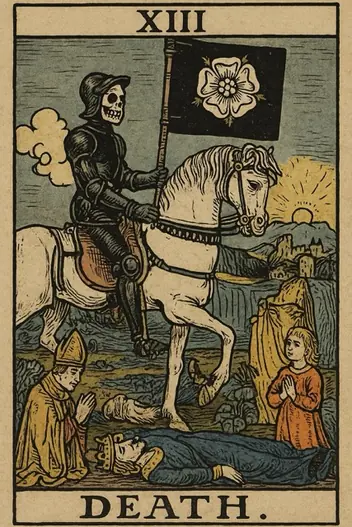

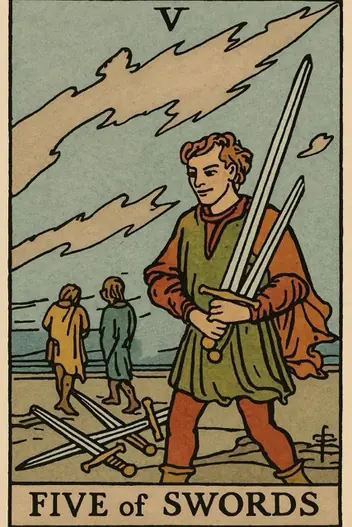
- Arcana
- Death — Major Arcana; Five of Swords — Minor Arcana, Swords
- Elements
- Death — Water; Five of Swords — Air
- Elemental interaction
- Neutral elements — energies coexist without conflict
- Numerology
- 13 + 5 = 18 → 9
The Death card represents inevitable transformation, the dismantling of old structures to make way for new growth. The Five of Swords represents conflict, defeat, and Pyrrhic victories—winning a battle at the cost of long-term relationships or integrity. When these two archetypes collide, you are facing a situation where a necessary ending is being forced through a painful, often adversarial, process.
This is not a card of random loss. It is a card of strategic surrender or calculated confrontation. The psychological state here is one of high tension: you know something must end, but the method of ending it involves a power struggle, a difficult conversation, or accepting a loss that feels like a personal failure. The key insight is to distinguish between what must be destroyed (the Death card) and what is being sacrificed (the Five of Swords). Are you fighting to preserve something that is already dead? Or are you fighting a battle you cannot win, simply to avoid the pain of change?
What Do Death and Five of Swords Mean Together?
The core dynamic of Death and Five of Swords is the clash between inevitability and ego. The Death card represents an objective, impersonal force of change—like a company restructuring, a relationship that has run its course, or a belief system that no longer fits. The Five of Swords represents the subjective, often toxic, human reaction to that change: the need to be right, the desire to blame, the impulse to fight a losing battle. This combination warns that your ego may be the primary obstacle to a necessary transformation.
Psychologically, this pairing activates the Shadow of the Victim and the Shadow of the Warrior. You may feel simultaneously like the one being attacked (Five of Swords) and the one being forced to let go (Death). The real danger is cognitive rigidity—clinging to a narrative of unfairness or betrayal rather than seeing the strategic necessity of the ending. The most pragmatic interpretation is that you are being asked to choose your battles wisely. Not every conflict is worth your energy, and not every ending is a defeat. Some endings are the cost of entry into a new phase of life.
In practical terms, this combination often appears during professional or relational transitions where a clean break is required but the process is messy. The advice is to focus on the outcome, not the argument. Ask yourself: "If I win this argument, what have I actually gained? If I lose, what have I actually lost?" The Death card ensures that the change will happen regardless of your resistance. The Five of Swords asks you to evaluate whether your resistance is worth the cost.
Your pair is already on the table. Ask your question and draw the clarifying card
or simply focus on it
Career and Finances
Strategic Opportunities:
Cutting ties with a toxic client, project, or partnership that is draining resources. This is the chance to "lose the battle to win the war."
Strategic Opportunities:
Restructuring your role or department in a way that requires letting go of a colleague or subordinate. This may feel harsh, but it is necessary for survival.
Calculated Risks:
Avoid costly legal battles or public disputes. The victory may be hollow. If you are in a negotiation, be prepared to walk away even if you "lose" the deal.
In a professional context, Death and Five of Swords is a strong signal for strategic divestment. This is not the time to fight for every inch of territory. Instead, identify what is already dead (a failing product, a broken process, a misaligned role) and accept the cost of removing it. The Five of Swords warns that you may have to take a financial hit, lose face, or accept blame for a situation that was not entirely your fault. The pragmatic move is to treat this as a transaction: what are you paying (in money, reputation, or energy) to get to the next stage?
A key financial warning:
Do not double down on a losing investment or strategy just to avoid admitting defeat. The Death card ensures that the old model will not recover. The Five of Swords warns that your pride may be the most expensive thing you hold onto. If you are in a leadership role, focus on damage control and exit strategy, not on proving you were right. The long-term health of the organization depends on your ability to cut losses cleanly.
Deepen your understanding
Find out exactly what this reading means for your current life situation with our oracle.
Love and Relationships
If you are single:
This pairing suggests you may be attracted to someone who represents a "fresh start" but who also triggers conflict or competition. Be wary of relationships that begin with a power struggle. The attraction may be real, but the dynamic may be toxic.
If you are in a relationship:
You or your partner may be forcing a painful decision. This is not a card for negotiation; it is a card for clarity. If the relationship is ending, accept that the conflict may be a symptom, not the cause.
In relationships, Death and Five of Swords often signals the end of a cycle through a painful argument or betrayal. The psychological dynamic is one of mutual blame—each partner feels they are the victim and the other is the aggressor. The key insight is that this conflict is a necessary purge. It is clearing out resentment, unspoken grievances, or incompatible expectations. The most strategic move is to stop trying to "win" the argument and instead ask: "What is this ending making room for?"
If you are the one initiating the breakup, be direct and final. The Five of Swords warns against prolonging the pain with "one last talk" or "trying to be friends too soon." If you are the one being left, accept the loss of the argument as a cost of freedom. You do not need to prove you were right; you only need to move on. Bold advice: Do not seek closure from someone who is still fighting with you. Closure is an internal decision, not an external agreement.
What Are the Risks of Death and Five of Swords?
The shadow side of Death and Five of Swords is the tendency to turn transformation into a vendetta. When this energy is blocked or expressed irrationally, the seeker may:
- Become obsessed with "winning" an argument that has no real value. This is a cognitive bias known as the sunk cost fallacy—continuing a conflict because you have already invested so much emotionally.
- Use the language of "necessary endings" to justify cruelty or manipulation. The Death card can be twisted into an excuse for harsh behavior, while the Five of Swords rationalizes the pain you cause.
- Avoid the necessary ending altogether by creating a toxic conflict. This is a form of self-sabotage—you provoke a fight so that the other person ends things, absolving you of the responsibility of making the difficult decision.
- Interpret every disagreement as a sign that the relationship or job is "dead." This is a form of all-or-nothing thinking, where any conflict is seen as proof that the entire situation must end.
The psychological trap here is confusing the pain of the process with the necessity of the outcome. Just because something is ending does not mean it must be ugly. The shadow path is to make the ending as painful as possible, either to punish yourself or others. The healthy path is to accept the ending with minimal collateral damage.
Reversed Death and Five of Swords Explained
The reversal of the cards softens external pressure but complicates internal dynamics.
If Death is Reversed:
This points to blocked potential. Change is stuck; you are clinging to dying projects or relationships. Paired with the upright Five of Swords, this looks like an agony: you continue fighting for what is already dead. Advice: Acknowledge your resistance to change and artificially create a crisis to break the deadlock.
If the Five of Swords is Reversed:
This signals internal resistance to conflict. You are afraid to strike, even when it is necessary. Paired with Death, this can mean that change is happening, but you refuse to defend your boundaries, allowing others to "finish you off." Warning: Passive aggression or an attempt to avoid a quarrel will lead to you being simply thrown out of the process.
If BOTH are Reversed:
Complete imbalance. This is a "neither here nor there" scenario. You cannot finish the old and cannot start the new. The conflict smolders but is not resolved. Method for Correction: External intervention is required—a consultant, psychologist, or arbitrator. It is almost impossible to get out of this swamp on your own, as both energies are in a passive phase.
Death and Five of Swords Combined Message
How to constructively use the energy of Death to balance the Five of Swords? The key lies in strategic distance. Death tells you: "Let go." The Five of Swords clarifies: "But not empty-handed." Your task is to exit the conflict (Five of Swords) with maximum benefit for your future (Death), rather than for the ego's immediate gratification.
In practical terms, this looks like: you acknowledge that the battle is lost or too costly, and you quickly wind down your activity. You don't waste time arguing about who is right and who is wrong. You simply register the fact: "This stage is over." Then, you use the freed energy (Death) not for a new war, but for building a new structure.
A deep strategic piece of advice: Separate emotional intelligence from tactical ruthlessness. Death is about accepting loss. The Five of Swords is about tactics. If you learn to accept losses without self-deprecation (Death) and to strike without cruelty (Five of Swords), you will gain a powerful tool for personal growth. You will not become a victim of circumstances, but the architect of your own crisis.
Your decision is not a choice between "good" and "bad." It is a choice between "alive" and "dead." Leave what is dead in the past, without trying to revive it. Take from what has been destroyed only what can be used for a new foundation, and move forward without looking back.
Applying This to Your Situation
The Death and Five of Swords combination is a powerful call to distinguish between what must end and what you are willing to lose in the process. The core message is pragmatic: let go of the need to be right, and focus on the need to move forward. Whether in love, career, or personal growth, this pairing asks you to accept that some battles are not worth fighting, and some endings are not defeats—they are simply costs.
To get a truly personalized interpretation of this exact combination for your specific situation, use the Fortune Cards app. While this article provides the general archetype, the real insight comes from applying these cards to your unique question, relationship, or career dilemma. The Fortune Cards app uses advanced AI to combine Tarot symbolism with your personal context, offering you a deep, actionable reading that accounts for your specific circumstances. Try it now on the web or download it today to discover exactly what Death and Five of Swords means for you right now.
Interpretation by the Fortune Cards editorial team, based on the Rider–Waite tradition and Jungian archetypes. About our methodology · Updated: 2026-08-26
Other Combinations with Death
Other Combinations with Five of Swords
Explore Individual Card Meanings
Ready to find answers to your questions?
Start your first reading now and look at your situation with fresh clarity. The cards are ready to reveal deeper meaning.