Death and Six of Swords Tarot as Feelings
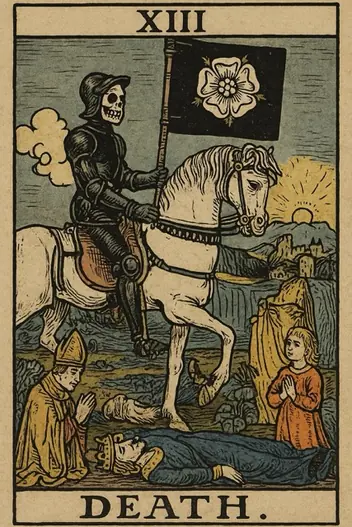

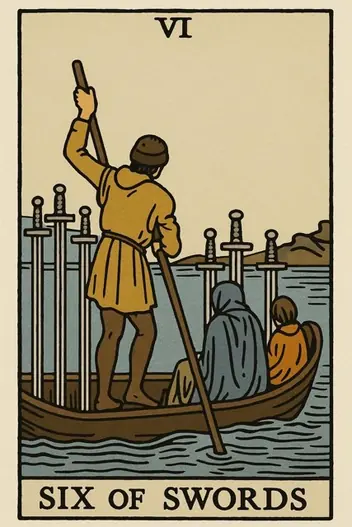
- Arcana
- Death — Major Arcana; Six of Swords — Minor Arcana, Swords
- Elements
- Death — Water; Six of Swords — Air
- Elemental interaction
- Neutral elements — energies coexist without conflict
- Numerology
- 13 + 6 = 19 → 1
When the Death card meets the Six of Swords, we are not looking at sudden catastrophe, but at a deliberate, psychologically necessary transition. Death represents an ending that is both absolute and impersonal—a natural death of a chapter, a role, or a belief system. The Six of Swords is the aftermath: the quiet, often lonely journey toward a new shore. Together, they describe a process where you must let go of what is already dead to move forward without the burden of the past. This is not about fighting fate; it is about navigating the logistics of change with clear eyes and a steady hand.
Psychologically, this pairing activates the archetype of the Guide or the Ferryman—the part of you that knows the old harbor is no longer safe. It demands a shift from clinging to memories to planning the exit strategy. The key insight here is that grief and movement can coexist. You do not need to feel ready to leave; you only need to be willing to row. This combination rewards pragmatic detachment: seeing the past as data, not identity, and viewing the future as a problem to solve rather than a mystery to fear.
Death and Six of Swords Combination Meaning
The core dynamic of Death and Six of Swords is a controlled surrender. Unlike the Tower's chaotic collapse, Death here is more like a scheduled demolition—it may be painful, but it is necessary and, crucially, it is part of a larger plan. The Six of Swords adds the element of conscious transition: the seeker is not just reacting to loss but actively moving toward a safer, more stable environment. This requires emotional compartmentalization—the ability to feel the loss while still executing the next step.
In practical terms, this combination signals a period where holding on costs more than letting go. The Six of Swords often depicts a boat crossing water, symbolizing the emotional distance required to heal. When paired with Death, it suggests that the distance is not just emotional but structural: you may need to change your location, job, or social circle to fully complete the transition. The mindset required is one of strategic grief: acknowledge what is ending, but focus your energy on the logistics of the crossing. Your primary task is to manage the transition, not to fix the past.
Career and Finances
Strategic Opportunities:
Restructuring your role or leaving a stagnant position to pursue a field that aligns with your current values. This is an ideal time to negotiate a severance, pivot industries, or launch a side project that represents your new direction.
Strategic Opportunities:
Using a setback as a forced upgrade—filing for bankruptcy, downsizing a business, or cutting unprofitable product lines. The Six of Swords rewards clean breaks over messy compromises.
Calculated Risks:
Do not burn bridges impulsively, but do not stay out of guilt or fear. The risk is staying in a role that is already dead because you are afraid of the crossing. Objectively, the greatest danger is inertia disguised as loyalty.
In career and financial contexts, this pairing is a strategic retreat rather than a failure. It signals that your current professional environment—whether a job, a market, or a business model—has reached its natural end. The Death card demands that you stop investing energy into revival; the Six of Swords tells you to redirect resources toward a new destination. Financially, this may mean cutting losses on a bad investment or accepting a short-term pay cut for long-term stability. Bold strategic insight: Treat this period like a portfolio rebalancing—sell the underperformers, even at a loss, to free up capital for better opportunities. The key is to make the move before circumstances force you to, preserving your agency and negotiating power.
Your pair is already on the table. Ask your question and draw the clarifying card
or simply focus on it
What Do Death and Six of Swords Say About Love?
If you are single:
This combination suggests you are carrying unresolved grief or attachment from a past relationship. The path forward requires actively choosing to leave that emotional harbor—not waiting for closure, but creating it by focusing on new environments and routines.
If you are in a relationship:
You and your partner may be navigating a necessary but painful transition—such as moving, changing jobs, or redefining the relationship structure. The core test is whether you can support each other's growth without clinging to the old dynamic.
In relationships, Death and Six of Swords often appears when one or both partners are outgrowing the current container. This is not a card of betrayal or sudden breakup, but of slow, conscious separation from a shared identity that no longer serves either person. The psychological work here is to differentiate—to allow each person to pursue their own healing journey without guilt or blame. Bold advice: Do not try to "fix" the relationship by returning to how it was. Instead, ask: What new form can this connection take if we both evolve? This may mean a period of distance, a renegotiation of boundaries, or even a respectful ending. The Six of Swords guarantees that if you move with intention, you will reach a place of greater peace—but only if you stop rowing backward.
Reversed Death and Six of Swords Explained
If Death is Reversed:
Blocked Transformation. You are stuck in the mire of the past, refusing to acknowledge the necessity of change. This is a state of chronic resistance that leads to protracted crises. The Six of Swords in an upright position may indicate an escape into illusion—you make plans but lack the resolve for real action. Advice: Acknowledge that resistance destroys you faster than any change ever could.
If the Six of Swords is Reversed:
Inner Resistance and Regression. You know you need to move forward, but you sabotage the process. This manifests as procrastination, a return to old habits, or an inability to make a decision. Death in an upright position here can be harsher—if you do not leave voluntarily, circumstances will force you out. Advice: Identify the specific fear that keeps you in place and develop a plan to neutralize it.
If BOTH are Reversed:
Total Imbalance and Chaos. You deny the need for change (Death) and simultaneously cannot move from your spot (Six of Swords). This is a state of paralysis, where the past will not release you and the future terrifies you. A logical way to correct this: focus on one micro-step. Do not try to change everything at once. Find one small thing you can let go of (Death) and one concrete step toward a new goal (Six of Swords).
Ask your specific question
Don't rely on generic meanings. Get a customized reading tailored specifically to your energies.
What Are the Risks of Death and Six of Swords?
The shadow of Death and Six of Swords manifests as emotional paralysis disguised as patience. The seeker may convince themselves they are "waiting for the right time" to leave, when in reality they are avoiding the pain of the crossing. This is a cognitive bias known as the sunk cost fallacy—continuing to invest in a dying situation because of what you have already given up. Another pitfall is performing the transition without actually letting go—physically moving to a new place or job while mentally still clinging to the old identity. This creates a half-life where you are neither fully present in the new nor fully released from the old. Psychologically, this can lead to chronic low-grade depression or a sense of being "stuck in the middle of the ocean." The antidote is ruthless honesty about what you are actually carrying with you in the boat. If you are bringing resentment, guilt, or a need for revenge, you have not truly left.
What Is the Overall Message of Death and Six of Swords?
Constructive use of this card pair requires a balance between the courage to accept an ending and the wisdom to plan a new path. The energy of Death must be directed not at destruction for its own sake, but at clearing space for the new. The Six of Swords, in turn, should not become an excuse for endless analysis. Movement must begin as soon as you have determined the direction.
Your strategic task is to transform the crisis into a navigational tool. Use the pain of loss (Death) as fuel for determination (Six of Swords). Ask yourself: "What exactly am I losing? Is this a necessary sacrifice for growth? Where exactly am I heading?" The answers to these questions should be as specific and pragmatic as possible.
The key takeaway: do not try to cross the ocean without jettisoning the ballast. This combination demands the courage to acknowledge that certain things, people, and projects are already dead. Your task is not to mourn them, but to conduct an efficient "funeral" and set sail. Accept the losses as the price of liberation. Only then can you harness the energy of Death as wind in the sails of your Six of Swords.
Your Next Step: Personal Context Matters
The Death and Six of Swords combination is a powerful call to end one chapter with dignity and begin the next with strategy. The core message is clear: release is not defeat; it is the first step toward a more authentic life. However, the specific meaning always depends on your unique situation—your question, your history, and the other cards in your spread. This article provides the general archetype, but the true insight comes when you apply it to your exact circumstances.
To get a deep, personalized interpretation of this exact combination for your specific question, use the Fortune Cards app. Whether you are navigating a breakup, a career change, or a personal transformation, the app can guide you through the nuances of your unique transition. You can access it on the web or download it now to receive a tailored reading that respects your intelligence and your journey.
Interpretation by the Fortune Cards editorial team, based on the Rider–Waite tradition and Jungian archetypes. About our methodology · Updated: 2026-08-26
Other Combinations with Death
Other Combinations with Six of Swords
Explore Individual Card Meanings
Table of Contents
Ready to find answers to your questions?
Start your first reading now and look at your situation with fresh clarity. The cards are ready to reveal deeper meaning.