Death and Ten of Wands Tarot as Feelings
- Arcana
- Death — Major Arcana; Ten of Wands — Minor Arcana, Wands
- Elements
- Death — Water; Ten of Wands — Fire
- Elemental interaction
- Opposing elements — energies create tension
- Numerology
- 13 + 10 = 23 → 5
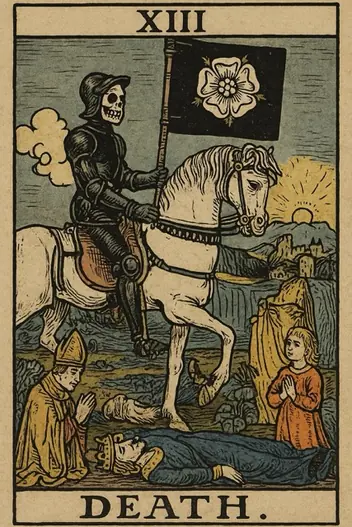
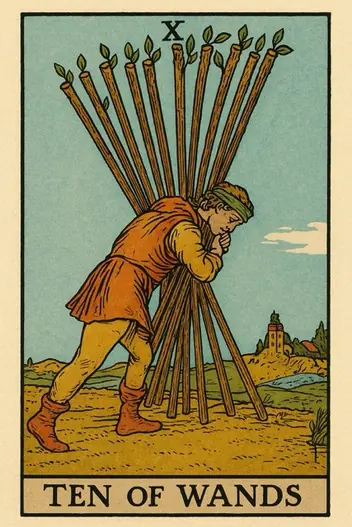
The Death card represents the end of a cycle, a necessary release, and the psychological process of letting go of outdated structures. The Ten of Wands symbolizes the burden of overcommitment, the exhaustion from carrying too many responsibilities, and the physical toll of relentless effort. When these two archetypes collide, they create a powerful crossroads: the moment when the weight of your obligations becomes so crushing that it forces a fundamental change. This is not a gentle nudge; it is a crisis that demands surrender and a strategic recalibration of your priorities.
Psychologically, this combination activates the shadow of the martyr—the part of you that believes suffering is a virtue or that quitting is failure. The Death card demands you stop clinging to what is dying, while the Ten of Wands reveals exactly what you need to put down. The real-world implication is clear: you are at a point where continued endurance without change will lead to burnout or collapse. The pragmatic move is to identify which burdens are yours to keep and which are inherited obligations you must release.
Core Dynamics & Interpretation
The core dynamic of Death and Ten of Wands is the exhaustion of will. The Ten of Wands represents the final stage of a long, uphill struggle—the point where the seeker is bent under the load, barely moving forward. Death enters to say that this struggle is no longer sustainable. The psychological state is one of cognitive dissonance: you know you cannot continue, yet you fear the emptiness that change might bring. This is the moment where the ego’s attachment to the familiar must be sacrificed for the sake of survival and growth.
In practical terms, this pairing often appears when a project, relationship, or career path has run its course but the seeker refuses to admit it. The key insight is that the burden itself is a symptom of a deeper problem: you are trying to control outcomes that are no longer aligned with your core values or capabilities. The Death card forces a symbolic death of the old identity—the version of you that said "yes" to everything, that took on others' problems, or that equated productivity with self-worth. The strategic action is to audit your commitments ruthlessly and cut anything that does not serve your long-term health or purpose.
The real-world implication is a pivot point. You must decide: will you let the burden break you, or will you use the breaking point to redesign your life? The cards suggest that the pain of change is less than the pain of staying the same. The Ten of Wands shows you the exact weight you are carrying; Death shows you the door out. The most pragmatic path is to list your top three stressors and eliminate the one that drains the most energy with the least return.
Your pair is already on the table. Ask your question and draw the clarifying card
or simply focus on it
Love and Relationships
If you are single:
This combination warns against entering a new relationship while you are already emotionally or logistically overloaded. The Death card suggests you need a period of intentional solitude to shed old patterns before seeking a partner. Focus on releasing expectations of a "savior" who will lighten your load.
If you are in a relationship:
The dynamic is likely one of imbalance and resentment. One partner is carrying the emotional, financial, or domestic weight for both. The Death card demands a honest conversation about what must end—whether that is a specific habit, a role, or the relationship itself.
In relationships, Death and Ten of Wands often signals a power struggle over responsibility. The partner carrying the Ten of Wands feels exhausted and unappreciated, while the other may be unaware or unwilling to share the load. The key relationship advice is to stop compensating for your partner’s avoidance. This combination does not suggest a healthy compromise; it suggests a necessary confrontation. You must ask: "What am I holding onto that I should not be holding? And what is my partner refusing to carry?" The Death card brings the possibility of transformation through honesty, but only if both parties are willing to let go of the old, dysfunctional contract.
Bold advice:
If you are the one burdened, set a boundary today. If you are the one causing the burden, acknowledge the imbalance and change your behavior immediately. This pairing can lead to a stronger, more equitable relationship—but only after the "death" of the current dynamic.
Career and Finances
Strategic Opportunities:
Identify the one project or role that drains you the most and develop an exit plan. This is your chance to delegate, automate, or quit with strategic timing.
Strategic Opportunities:
Use the crisis as leverage to renegotiate terms. If you are overworked, the Death card gives you permission to ask for a raise, a reduced scope, or a team reassignment. Your exhaustion is a valid data point.
Calculated Risks:
Avoid taking on new debt or additional loans to "fix" the current situation. The Ten of Wands warns against adding weight to an already overloaded structure. Do not start a new business or major project until you have cleared at least half your current obligations.
In career and finances, this combination is a red flag for burnout. The Ten of Wands shows you are likely in a high-stress role with too many deliverables and not enough support. The Death card indicates that staying in this position will lead to a forced exit—either through resignation, health issues, or termination. The pragmatic approach is to proactively manage the transition rather than waiting for a collapse. Frame your next move as a strategic retreat rather than a failure.
Important financial warning:
Do not invest more money or energy into a failing venture just because you have already invested heavily (the sunk cost fallacy). The Death card says: cut your losses and move on. If you are self-employed, consider shedding your least profitable clients or services. If you are an employee, document your workload and use it to justify a restructuring conversation with your manager. The goal is to reduce the load by 50% over the next quarter.
Ask your specific question
Don't rely on generic meanings. Get a customized reading tailored specifically to your energies.
What Are the Risks of Death and Ten of Wands?
The shadow manifestation of Death and Ten of Wands is stubborn martyrdom—the cognitive bias that equates suffering with virtue. The seeker may believe that if they just "push through" a little longer, the reward will come. This is a dangerous illusion. The cognitive distortion here is "should" thinking: "I should be able to handle this," or "I should not give up." This combination warns that pride and fear of judgment are keeping you in a destructive cycle. Another pitfall is passive aggression: you may be carrying resentment while outwardly acting like everything is fine, which leads to emotional explosion or sudden withdrawal.
The self-sabotage pattern involves taking on even more responsibilities to prove your worth, which only deepens the exhaustion. Alternatively, the seeker might avoid the necessary "death" by numbing out through overwork, substance use, or distraction. The poor judgment comes from exhaustion: when you are depleted, you make impulsive decisions or, conversely, become paralyzed by indecision. The shadow side of Death is chaotic destruction—quitting everything in a rage without a plan. The shadow side of Ten of Wands is victimhood—blaming others for the load you chose to carry. The antidote is radical self-honesty: ask yourself, "What am I afraid will happen if I let this go?" The answer reveals the cognitive bias you must confront.
What If Death or Ten of Wands Appears Reversed?
If Death is reversed, it indicates a blocked transformation. You are aware that something needs to change, but you cling to the past out of fear. In combination with the upright Ten of Wands, this creates a dangerous cocktail: you continue to bear the burden, but now without any hope of relief. Advice: Artificially create a deadline for yourself to make a decision, otherwise your health will do it for you.
If the Ten of Wands is reversed, it speaks of internal resistance and weakness. You cannot even take on the burden you are obligated to carry. Paired with upright Death, this means you abandon responsibility at the most critical moment, leaving chaos for others. Warning: This is not a strategic withdrawal, but a flight. Make sure you are not sabotaging your life by avoiding discomfort.
If BOTH cards are reversed, a complete imbalance arises. Death brings no liberation, and the Ten of Wands provides no burden—you become stuck in a state of lingering crisis. Nothing ends, but nothing begins either. Method for correction: An external trigger is required—consultation with a psychologist, a mentor, or a drastic change of scenery. You need a "push" from the outside to break this cycle.
Death and Ten of Wands Combined Message
Constructive use of this pair requires a radical redefinition of the concept of "strength." In our culture, strength is often equated with the ability to endure and withstand. Death and the Ten of Wands shatter this stereotype. True strength here lies in the ability to acknowledge the limits of your resources and retreat in time.
Your strategy is "controlled collapse." Do not try to save everything. Choose 20% of your commitments that truly matter for your future, and allow the remaining 80% to crumble. Death will grant you immunity from guilt over this. The Ten of Wands, freed from excess burden, will transform into focused effort rather than the senseless hauling of stones.
Deep strategic advice:
Imagine your life is a house on fire. You cannot carry out all the furniture. Your task is to save only the documents and what is most precious. Everything else is ash upon which you will build a new home. Death is the fire; the Ten of Wands is your resolve to save only what is truly worth saving. Do not try to extinguish the flames—let them burn out.
Your Next Step: Personal Context Matters
The core message of Death and Ten of Wands is that your current level of burden is unsustainable, and the only way forward is to release what no longer serves you. This is not about failure; it is about strategic evolution. You are being asked to trust that the space created by letting go will be filled with something more aligned with your true capacity and purpose. The path to relief is through courageous surrender—not giving up, but giving over to a new way of being.
While this analysis provides the universal archetype, the true power of Tarot lies in its application to your unique situation. The Fortune Cards app offers a deep, personalized interpretation of this exact combination for your specific question—whether about a relationship, career decision, or personal crossroads. Use it on the web or download it now to get the clarity and strategic guidance you need to navigate this transformation with confidence. Your next step is just a reading away.
Interpretation by the Fortune Cards editorial team, based on the Rider–Waite tradition and Jungian archetypes. About our methodology · Updated: 2026-08-26
Other Combinations with Death
Other Combinations with Ten of Wands
Explore Individual Card Meanings
Ready to find answers to your questions?
Start your first reading now and look at your situation with fresh clarity. The cards are ready to reveal deeper meaning.