The Devil and Five of Cups Meaning in Tarot
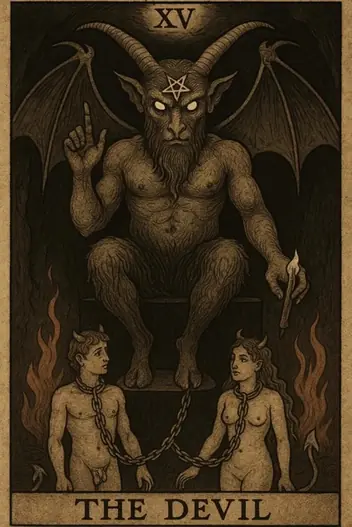

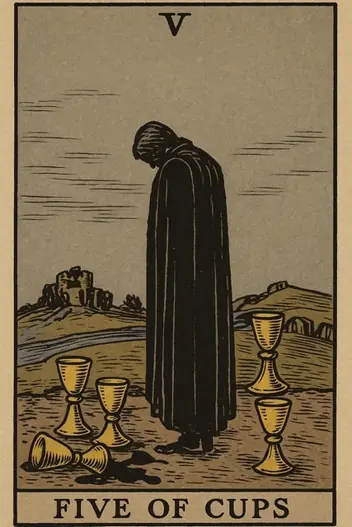
- Arcana
- The Devil — Major Arcana; Five of Cups — Minor Arcana, Cups
- Elements
- The Devil — Earth; Five of Cups — Water
- Elemental interaction
- Friendly elements — energies support each other
- Numerology
- 15 + 5 = 20 → 2
This pairing represents a psychological crisis where attachment to loss becomes a self-imposed prison. The Devil embodies addiction, obsession, and the shadow of control—whether over a person, a substance, or a belief. The Five of Cups signals grief, disappointment, and a fixation on what has been spilled. Together, they describe a state where you are actively choosing to suffer because letting go feels like losing a part of yourself.
The core conflict here is between liberation and resignation. The Devil offers chains you believe are necessary for survival; the Five of Cups shows you weeping over the broken cups while ignoring the two still standing. In real terms, this means you may be staying in a toxic job, relationship, or mindset because the familiarity of pain feels safer than the uncertainty of change. The strategic question is: What are you getting from staying stuck?
The Devil and Five of Cups Card Meaning Explained
When these cards merge, the psychological landscape is dominated by learned helplessness and confirmation bias. You have likely experienced a significant loss—a breakup, a financial setback, or a professional failure—and have interpreted it as proof that you are powerless or unworthy. The Devil amplifies this by convincing you that the source of your pain is also the only source of your security. For example, you might stay in a draining job because it pays the bills, even though it erodes your self-esteem daily.
The key insight here is that the chains are self-forged. The Devil is not an external demon but a projection of your own shadow—your unexamined desires for control, validation, or escape. The Five of Cups shows you obsessing over the past, replaying mistakes, and ignoring the two cups still full. This combination demands a ruthless inventory of your attachments. What belief are you clinging to that keeps you in grief? What habit are you refusing to break because it feels familiar? The path forward requires acknowledging that your suffering is a choice, not a sentence.
In practical terms, this pairing often manifests as a feedback loop of self-sabotage. You feel guilty about the loss, so you punish yourself with more of the same behavior that caused it. Breaking this loop requires cognitive reframing: shift from "I am a victim of this loss" to "I am responsible for how I respond to this loss." The Devil’s energy can be redirected into discipline; the Five of Cups’ grief can be channeled into learning. The antidote is radical acceptance of what is gone, paired with decisive action toward what remains.
Your pair is already on the table. Ask your question and draw the clarifying card
or simply focus on it
The Devil and Five of Cups in Career Readings
Strategic Opportunities:
Identify the one skill or asset you still have (the two standing cups) and double down on it. This is your leverage.
Strategic Opportunities:
Use the Devil’s obsessive energy to master a difficult subject or project. Channel fixation into expertise.
Calculated Risks:
Do not throw good money after bad. The Five of Cups warns against pouring resources into a failing venture out of guilt or sunk-cost fallacy.
Professionally, this combination often appears when you are staying in a role or industry that no longer serves you because you fear the loss of status or income. The Devil represents the golden handcuffs—a high salary that demands your soul, or a prestigious title that isolates you from meaningful work. The Five of Cups shows you mourning the career you wanted while ignoring the pivot you could make. The strategic move is to conduct a cost-benefit analysis of your current situation, listing both tangible (salary, benefits) and intangible (stress, growth potential) factors.
Financial warning: Avoid investments driven by fear of missing out or a need to "win back" losses. The Devil can turn you into a gambler, chasing quick fixes. Instead, focus on liquidity and debt reduction—the two cups are your emergency fund and your core competencies. If you are considering a career change, start with a side project or certification that tests the waters without burning bridges. The grief of the Five of Cups can be transformed into strategic patience: acknowledge the loss, but do not let it blind you to new opportunities that require a different skill set.
The Devil and Five of Cups as Feelings
If you are single:
This combination warns against romanticizing past hurt to avoid new vulnerability. You may be using a previous betrayal as a shield against taking emotional risks, effectively keeping yourself isolated.
If you are in a relationship:
You are likely in a codependent dynamic where one partner’s grief or addiction controls the relationship’s emotional temperature. The "spilled cups" dominate conversations, while healthy aspects are ignored.
In relationships, this pairing signals a power imbalance rooted in shared trauma. One partner may be trapped in a cycle of resentment (Five of Cups) while the other enables or controls through guilt or obligation (The Devil). For example, a partner who cheated might use the other’s grief to maintain control, while the betrayed partner stays because they fear being alone. The key relationship advice is to identify the unspoken contract you have both signed: "I will stay miserable with you if you promise to never leave me."
Break this by establishing clear boundaries around what you will no longer tolerate. If the relationship is salvageable, both partners must commit to separate therapy (to address individual shadows) and joint communication exercises (to rebuild trust). If it is not, the Devil’s chains must be cut by acknowledging that grieving the relationship’s end is healthier than preserving its toxic form. The two remaining cups are your self-respect and your capacity for future connection—do not spill them by staying.
Get a personalized interpretation
Unlock the combined meaning of your cards in the context of your unique question — for free.
Negative Meaning of The Devil and Five of Cups
The shadow of this combination is willful blindness. You may know you are in a toxic situation but rationalize it as "necessary suffering." Cognitive biases like sunk-cost fallacy (I’ve invested too much to quit) and loss aversion (I’ll lose more by leaving than staying) keep you trapped. The Devil’s shadow also manifests as addictive behavior—overworking, overdrinking, or over-gaming to numb the grief of the Five of Cups.
Another pitfall is blaming the victim. If you are the one in pain, you may internalize the Devil’s message that you deserve this suffering. This leads to learned helplessness—a state where you stop trying because you believe effort is futile. Conversely, if you are observing this dynamic in someone else, you may enable it by rescuing them, which only strengthens their chains. The shadow demands that you stop the cycle of guilt and pity. Neither self-flagellation nor external rescue will break the pattern. Only ruthless self-awareness and accountability can.
The Devil and Five of Cups Reversed: How to Read It
If The Devil is Reversed:
This indicates resistance to liberation. The person sees the door but is afraid to walk through. The addiction is acknowledged, but the willpower is suppressed. Advice: You don't need to break the addiction instantly, but rather take the first micro-step—admit that you want to change, even if you can't yet.
If the Five of Cups is Reversed:
This is denial of loss. Instead of grieving, the person pretends everything is fine and continues to invest resources in a clearly losing situation. Warning: This is the most dangerous position, as it leads to total depletion. Stop pretending that "ashes" are not ashes.
If BOTH are Reversed:
Complete imbalance. This can be a hysterical attempt to break free from the habitual cycle, leading to chaos. The person destroys everything without having a Plan B. Advice: Don't act rashly. You need a strategist (a psychologist, coach, or simply a wise friend) who can help distinguish real liberation from impulsive self-destruction.
The Devil and Five of Cups: The Combined Message
Constructive use of this combination is possible only through a radical shift of focus from the past to the present. The energy of the Devil is an immense force of will, concentration, and passion. The problem is that it is directed at holding onto what has already died. Your task is to redirect this power toward creating something new. The Five of Cups symbolizes sorrow, but it always contains a hidden resource—the two standing cups (a symbol that not all is lost). Instead of weeping over the three broken ones, take the remaining two and begin to rebuild.
Strategic advice:
Use your pain as a lie detector. Everything that causes you suffering is what you need to let go of. Do not try to "fix" the past. The Devil gives you the illusion of control, saying, "You can fix everything." The truth is that you cannot fix it; you can only create something new. Your task is to shift the energy from "holding onto the past" mode to "creating the future" mode. This requires the courage to acknowledge your powerlessness in the face of loss, but it is precisely this acknowledgment that grants you real strength. You are not a victim of circumstances, but a person who has chosen to suffer. Make a different choice—choose to act, not to react.
Applying This to Your Situation
The core message of The Devil and Five of Cups is that your greatest prison is your attachment to a story of loss. The chains are not real; they are habits of thought and emotion you have mistaken for identity. To break free, you must grieve what is gone without letting it define your future, and reclaim the power you have surrendered to fear or comfort. This is not a gentle process—it requires cutting ties with what no longer serves you, even if it hurts.
For a truly personalized interpretation of this combination, you need to apply it to your specific life context. The Fortune Cards app can help you do exactly that. While this article gives you the archetypal framework, the app uses your unique question and situation to deliver a deep, actionable analysis. Whether you are navigating a painful breakup, a career crossroads, or a pattern of self-sabotage, the app will guide you through the exact steps to turn shadow into strength. Use it on the web or download it now to get your personalized reading and start breaking your own chains.
Interpretation by the Fortune Cards editorial team, based on the Rider–Waite tradition and Jungian archetypes. About our methodology · Updated: 2026-08-26
Other Combinations with The Devil
Other Combinations with Five of Cups
Explore Individual Card Meanings
Table of Contents
- The Devil and Five of Cups Card Meaning Explained
- The Devil and Five of Cups in Career Readings
- The Devil and Five of Cups as Feelings
- Negative Meaning of The Devil and Five of Cups
- The Devil and Five of Cups Reversed: How to Read It
- The Devil and Five of Cups: The Combined Message
- Applying This to Your Situation
Ready to find answers to your questions?
Start your first reading now and look at your situation with fresh clarity. The cards are ready to reveal deeper meaning.