The Devil and Nine of Swords Tarot as Feelings
- Arcana
- The Devil — Major Arcana; Nine of Swords — Minor Arcana, Swords
- Elements
- The Devil — Earth; Nine of Swords — Air
- Elemental interaction
- Opposing elements — energies create tension
- Numerology
- 15 + 9 = 24 → 6
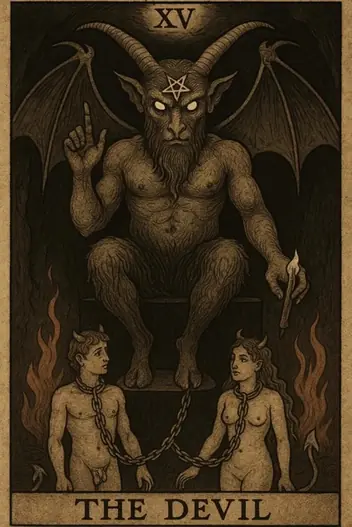
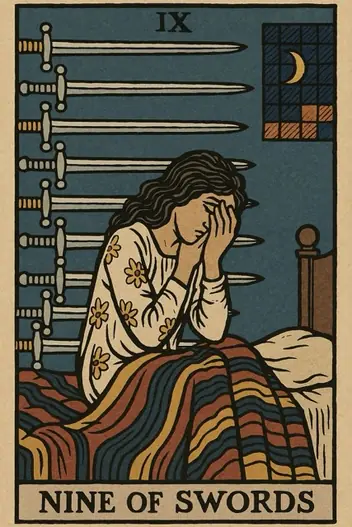
When the Devil’s chains of addiction meet the Nine of Swords’ torment of insomnia, you get a potent psychological cocktail of self-imposed suffering. The Devil represents the shadow archetype—the parts of ourselves we deny, repress, or project onto others. The Nine of Swords is the cognitive consequence: the anxious loop, the 3 AM panic attack, and the story we tell ourselves that we are trapped. Together, they reveal a feedback loop of shame and control where external circumstances (a job, a relationship, a habit) are internalized as a personal failure, breeding more paralysis. The strategic question is not “why is this happening to me?” but “how am I participating in my own imprisonment?”
The Devil and Nine of Swords Combination Meaning
The core dynamic here is a closed system of negative reinforcement. The Devil’s energy is about attachment—to a person, a substance, a status, or a belief system that feels inescapable. The Nine of Swords then amplifies this by adding catastrophic thinking: every small misstep becomes evidence of doom. Psychologically, this mirrors cognitive dissonance—you know the situation is unhealthy, but the fear of change (Devil’s “comfortable cage”) outweighs the pain of staying. The result is learned helplessness, where you stop trying because you believe any effort is futile.
Bold insight: The combination signals that your worst fears are not prophecies—they are projections of your own shadow. The Devil’s chains are often self-forged through unexamined beliefs. For example, staying in a toxic job because you believe you’re unemployable elsewhere. The Nine of Swords’ nightmares are the mental rehearsal of worst-case scenarios that keep you from taking the first step. The path out requires radical self-awareness: naming the attachment (is it money? control? security?) and then challenging the anxiety narrative with objective data.
Bold takeaway: This is not a card of external doom, but of internal misalignment. The real prison is your interpretation of events. When you stop seeing the Devil as a demon and start seeing him as a shadow teacher, the Nine of Swords’ panic transforms into a signal to act—not react.
What Do The Devil and Nine of Swords Indicate for Your Career?
Strategic Opportunities:
Use the anxiety as a diagnostic tool. What specific fear is keeping you from a career change, a raise negotiation, or starting a side project? The fear points to the very area you need to grow.
Strategic Opportunities:
Re-evaluate your relationship with money. This combination often indicates financial stress tied to a specific source (a debt, a dependent, a high-cost lifestyle). Create an objective budget to separate fact from fear.
Calculated Risks:
Avoid making major financial decisions while in a state of panic. The Devil’s impulsivity + the Nine of Swords’ despair = poor judgment. Delay large purchases or investments for 72 hours to let the cognitive fog clear.
Professionally, this pair signals a trap of your own making. You may be overworking to avoid a deeper fear (e.g., “If I slow down, I’ll get fired”) or staying in a role that drains you because you believe you have no other options. Bold financial warning: The Devil often manifests as golden handcuffs—a high salary that ties you to a soul-crushing job. The Nine of Swords is the Sunday night dread and the Monday morning panic. The strategic move is to quantify the trade-off: What is your mental health costing you? If you spent one year in a lower-paying but healthier role, what would that be worth?
Bold strategic tip: Treat your career like a portfolio, not a prison. Diversify your income streams or skills to reduce the feeling of being trapped. The Devil’s illusion is that you have no choice; the Nine of Swords’ reality is that you have many choices, but fear blinds you to them.
Your pair is already on the table. Ask your question and draw the clarifying card
or simply focus on it
What Do The Devil and Nine of Swords Say About Love?
If you are single:
Evaluate whether your attraction is based on genuine connection or a pattern of seeking intensity over stability. This combination warns of being drawn to “fixer-uppers” or unavailable partners, where the thrill of the chase masks deep insecurity.
If you are in a relationship:
Identify if you or your partner are using guilt, obligation, or fear to maintain the status quo. This pair often signals a codependent dynamic where one person feels trapped and the other feels responsible for their happiness.
The relationship dynamic here is a cycle of blame and guilt. The Devil represents the shadow of control—one partner may manipulate through withdrawal, criticism, or emotional blackmail. The Nine of Swords is the anxiety response from the other, who internalizes the conflict as their fault. Key relationship advice: Break the cycle by naming the pattern aloud. Use “I” statements: “I feel anxious when I sense you pulling away” rather than “You’re making me feel trapped.” Bold insight: The only way out is through radical honesty about your own attachment fears. Are you staying because you love them, or because you’re afraid of being alone? If the latter, the Nine of Swords will only grow louder.
Prioritize emotional boundaries over emotional rescue. The Devil’s grip loosens when you stop trying to fix your partner and instead focus on your own self-worth. The Nine of Swords’ insomnia will quiet when you stop ruminating on what they should do and start acting on what you need.
What If The Devil or Nine of Swords Appears Reversed?
Reversed cards do not cancel the problem, but change its form. They indicate resistance to the process or misdirected energy.
If The Devil is reversed:
This can mean blocked potential. You are afraid of your own power and ambition. Instead of using "devilish" charisma for career growth, you suppress it, leading to apathy. Advice: allow yourself to be "uncomfortable" and ambitious. In a healthy form, this is leadership.
If the Nine of Swords is reversed:
This is not relief, but internal resistance and denial. The person refuses to acknowledge their fear or anxiety, repressing it into the subconscious. This leads to psychosomatic issues or sudden, irrational breakdowns. Warning: ignoring the problem will worsen it. Start keeping an anxiety journal.
If BOTH are reversed:
This is a complete imbalance. The person is in a state of "nothing makes sense." They see neither the trap (The Devil) nor the way out (Nine of Swords). This is a state of existential crisis. Advice: return to the basics. Focus on the physical body: exercise, sleep, food. By restoring basic needs, you will be able to see the picture more clearly.
Your unique Tarot reading
See how these cards interact with your destiny. Start a free personal reading now.
The Devil and Nine of Swords: Warning Signs
The shadow side of this combination is self-destructive rationalization. You may convince yourself that the pain is necessary for growth, or that suffering is noble. This is a cognitive bias called “sunk cost fallacy” —you stay in a bad situation because you’ve already invested so much time, money, or emotion. The Devil feeds this by making you believe you’re “too far gone.” The Nine of Swords then provides the mental soundtrack: “You deserve this” or “It’s too late to change.”
Another pitfall is projection: blaming an external person or institution for your misery, when the real source is your own unexamined beliefs. For example, blaming a partner for your unhappiness, when the truth is you’re avoiding your own ambition. Bold warning: If you find yourself playing the victim, you are in the shadow. The Nine of Swords’ nightmares are often a mirror of your own self-judgment. The antidote is self-compassion—acknowledging the fear without letting it define you.
Avoid the trap of “rescuing” others. If you see this combination in a reading for someone else, beware of the urge to save them. The Devil’s chains are only broken by the person wearing them. Your role is to hold a mirror, not to carry the weight.
What Is the Overall Message of The Devil and Nine of Swords?
How to constructively use the energy of the Devil to balance the Nine of Swords? The key lies in redirecting focus. The Devil represents immense energy, willpower, and discipline. The Nine of Swords is a sharp, piercing mind capable of seeing risks. Their union can become a powerful tool if you stop fearing and begin to use your fear.
Your strategy: acknowledge the fear, but do not let it paralyze you. Use the "devilish" discipline to create a concrete, step-by-step plan for exiting the situation. For example, if you fear being fired (Nine of Swords), harness the Devil's energy to aggressively learn new skills and build a network of contacts. Fear becomes not an enemy, but fuel.
A deep strategic counsel: "Separate facts from interpretations." The Nine of Swords paints terrifying pictures of the future. The Devil says you are attached to them. Your task is to write down your fears on paper and verify them against reality. In 90% of cases, you will discover that you fear not a real threat, but your own fantasy about it. Once you realize this, the chain (the Devil) crumbles to dust.
Where to Go From Here
The Devil and Nine of Swords is not a verdict—it’s a diagnosis of a psychological pattern. The core message is that your suffering is not random; it’s a signal that your shadow is demanding integration. The fear you feel is not a wall—it’s a doorway. The question is: Are you ready to walk through it, or will you stay in the familiar pain? The answer depends entirely on your unique context: your history, your values, and your current resources.
To get a truly personalized interpretation of this combination for your specific situation, use the Fortune Cards app. While this article provides the general archetype, the real magic happens when Tarot is applied to your exact question—your relationship, your career crossroads, your inner conflict. Download the app or use it on the web to get a deep, tailored reading that cuts through the noise and shows you your next step.
Interpretation by the Fortune Cards editorial team, based on the Rider–Waite tradition and Jungian archetypes. About our methodology · Updated: 2026-08-26
Other Combinations with The Devil
Other Combinations with Nine of Swords
Explore Individual Card Meanings
Table of Contents
- The Devil and Nine of Swords Combination Meaning
- What Do The Devil and Nine of Swords Indicate for Your Career?
- What Do The Devil and Nine of Swords Say About Love?
- What If The Devil or Nine of Swords Appears Reversed?
- The Devil and Nine of Swords: Warning Signs
- What Is the Overall Message of The Devil and Nine of Swords?
- Where to Go From Here
Ready to find answers to your questions?
Start your first reading now and look at your situation with fresh clarity. The cards are ready to reveal deeper meaning.