Eight of Swords and Nine of Swords Together in Tarot

- Arcana
- Eight of Swords — Minor Arcana, Swords; Nine of Swords — Minor Arcana, Swords
- Elements
- Eight of Swords — Air; Nine of Swords — Air
- Elemental interaction
- Same element — energies intensify each other
- Numerology
- 8 + 9 = 17 → 8
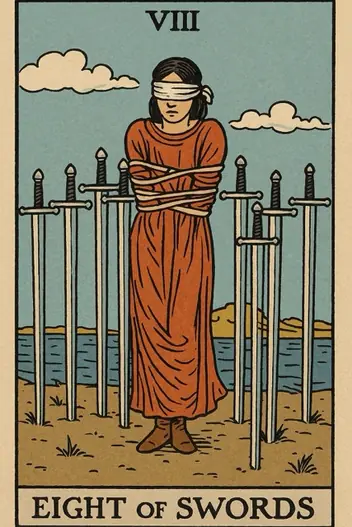
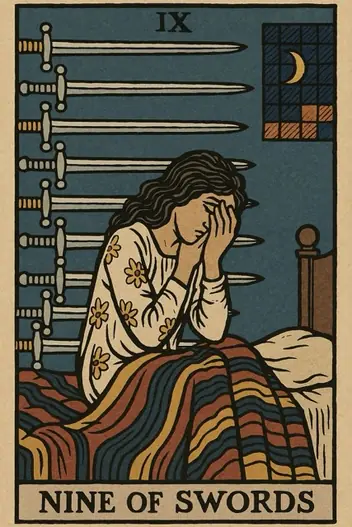
These two cards together represent a powerful psychological feedback loop. The Eight of Swords is the archetype of perceived entrapment—you feel blindfolded, bound, and surrounded by obstacles that are largely mental constructs. The Nine of Swords is the archetype of acute anxiety, the "worst nightmare" that keeps you awake at 3 AM, replaying every fear. When they collide, you are not trapped by external reality, but by the stories you tell yourself about it. The danger is not the situation itself, but the spiral of catastrophizing that prevents clear action.
This combination demands a shift from passive suffering to active observation. The core conflict here is between learned helplessness (Eight of Swords) and ruminative dread (Nine of Swords). The path forward is not to fight the anxiety, but to identify the specific, distorted beliefs that are causing the paralysis. Pragmatically, this pair signals a moment where you must distinguish between real threats and imagined ones.
What Do Eight of Swords and Nine of Swords Mean Together?
The psychological state created by the Eight of Swords and Nine of Swords is a cognitive trap. You are likely experiencing a high degree of negative self-talk and a strong confirmation bias—you only look for evidence that supports your worst fears. The Eight of Swords shows the blindfold; you cannot see the exits because you are not looking for them. The Nine of Swords shows the torment; you are punishing yourself for failures that may not be real or may be far less catastrophic than you imagine.
This is a crisis of agency. The cards suggest you have handed over your power to a narrative of victimhood. The key insight is that the "swords" here are not external weapons, but your own thoughts. To break the cycle, you must externalize your anxiety: write down the specific fear, then ask, "What is the evidence for this? What is the evidence against it?" This is a cognitive-behavioral approach applied to Tarot. The combination often appears when you are overthinking a decision to the point of inaction, creating a self-fulfilling prophecy of failure.
Career and Finances
Strategic Opportunities:
Use this period to conduct a risk audit of your current projects. Identify one specific anxiety and create a contingency plan for it. This turns vague dread into manageable action.
Strategic Opportunities:
The combination can signal a need to delegate. You may be trying to control too many variables alone. Ask for a second opinion or a mentor's perspective to break your mental blindfold.
Calculated Risks:
Avoid making major financial commitments while in this anxious state. The Nine of Swords distorts your perception of risk, making you either overly cautious or impulsively desperate. Do not sign contracts or invest until you have slept on it and consulted a trusted advisor.
Professionally, this pair often appears when you are stuck in a perfectionist loop. You might be delaying a proposal, a presentation, or a negotiation because you are imagining every worst-case scenario. The Eight of Swords suggests you have more options than you think—you just cannot see them. The Nine of Swords warns that anxiety is a poor decision-making fuel. Financially, the combination points to stress about debt or income, but the root cause is often a lack of a clear, written plan. Bold financial advice: Create a simple spreadsheet of your income, expenses, and worst-case scenario cash flow. The act of writing it down will reduce the anxiety by 50% because you replace vague fear with concrete numbers.
Your pair is already on the table. Ask your question and draw the clarifying card
or simply focus on it
Love and Relationships
If you are single:
This pair suggests you are projecting past relationship traumas onto new potential partners. You may be assuming rejection or betrayal before giving the connection a fair chance. The real barrier is your fear of vulnerability, not the other person's behavior.
If you are in a relationship:
You and your partner may be stuck in a cycle of mutual blame or silent resentment. One or both of you are likely avoiding a difficult conversation, imagining the worst possible outcome. The relationship is being strangled by unspoken fears.
In relationships, this combination signals a breakdown in communication driven by anxiety. The Eight of Swords partner feels silenced or trapped; the Nine of Swords partner feels overwhelmed by worry. The dynamic is often one of emotional co-dependence where each person's anxiety feeds the other's. The pragmatic advice is to schedule a structured conversation with a specific agenda—not to solve everything, but to air one concrete fear at a time. The goal is to break the spiral by introducing objective reality checks: "Is this fear based on something they said or did, or on my internal narrative?" Bold action here means naming the fear out loud, which immediately reduces its power.
Shadow Side & Pitfalls
The shadow manifestation of this combination is paralytic self-sabotage. You may be unconsciously creating the very crisis you fear. The Eight of Swords becomes a self-fulfilling prophecy: you feel trapped, so you stop trying, which makes the trap real. The Nine of Swords becomes rumination without resolution: you replay the same worry loop for hours, achieving nothing but exhaustion. The cognitive biases at play include catastrophizing (assuming the worst possible outcome) and mind reading (believing you know what others think of you without evidence). The darkest pitfall is learned helplessness—you stop believing you have any agency, which leads to depression and withdrawal. If you see yourself here, the first step is to interrupt the pattern with a physical action: stand up, walk outside, or call a friend. Do not try to "think your way out" of this trap; you must act your way out.
Uncover hidden insights
Let our advanced Tarot system interpret these archetypes specifically for your personal path.
Reversed Positions: What Changes?
The Reversed Eight of Swords indicates that self-limitation is beginning to loosen, but there is a risk of recklessness. You have removed the blindfold, but have not yet learned to see reality. Sharp, thoughtless actions are possible, taken to prove your freedom to yourself. Advice: do not confuse impulsiveness with liberation. Act, but with deliberation.
The Reversed Nine of Swords represents an internal resistance to acknowledging the problem. You deny your anxiety, suppress your fear, which can lead to psychosomatic issues. Instead of nightmares, there may be insomnia or apathy. Warning: suppressed anxiety does not disappear; it transforms. Engage in physical activity to lower your cortisol levels.
When both cards are reversed, the situation becomes paradoxical. You feel that the restrictions have been lifted, but the anxiety remains. This creates a cognitive imbalance: you know you can act, but you do not want to. Advice: this state requires external structuring. You need a coach, a mentor, or a clear plan with deadlines. It is nearly impossible to break out of this cycle on your own.
What Is the Overall Message of Eight of Swords and Nine of Swords?
How to constructively harness the energy of this pair? The Eight of Swords teaches us to recognize the boundaries we have created ourselves. The Nine of Swords shows the price we pay for inaction. The strategically correct approach is not to fight anxiety, but to use it as fuel for action.
Imagine your anxiety is an alarm. It blares, warning of danger. But if you sit and listen to the alarm, you change nothing. Your task is to check if there is a real threat, and if not—turn off the alarm with action. Every small action lowers the level of anxiety because it proves to your psyche that you are in control of the situation.
A deep strategic piece of advice:
start with the most frightening, yet simplest step. If you are afraid of failing a project—make the first phone call. If you fear loneliness—write one message. Action breaks the cycle of catastrophizing. You cannot control the outcome, but you absolutely can control the very fact of taking action. It is precisely this distinction between passive suffering and active overcoming that is the key to escaping this combination.
Where to Go From Here
The Eight of Swords and Nine of Swords together deliver a clear message: Your worst enemy is your own mind, and your greatest tool is objective action. The blindfold is self-imposed, and the nightmare is a story you can rewrite. The path forward requires you to stop analyzing and start doing—one small, concrete step at a time.
While this article provides a general archetype, the true power of Tarot lies in its application to your unique situation. The specific context of your question—whether it's about a particular relationship, a career decision, or a personal fear—changes the meaning dramatically. To get a deep, personalized interpretation of this exact combination for your specific question right now, use the Fortune Cards app. You can access it on the web or download it to receive a reading tailored to your life, not just a generic archetype.
Interpretation by the Fortune Cards editorial team, based on the Rider–Waite tradition and Jungian archetypes. About our methodology · Updated: 2026-08-26
Other Combinations with Eight of Swords
Other Combinations with Nine of Swords
Explore Individual Card Meanings
Ready to find answers to your questions?
Start your first reading now and look at your situation with fresh clarity. The cards are ready to reveal deeper meaning.