Eight of Swords and Ten of Swords Meaning in Tarot

- Arcana
- Eight of Swords — Minor Arcana, Swords; Ten of Swords — Minor Arcana, Swords
- Elements
- Eight of Swords — Air; Ten of Swords — Air
- Elemental interaction
- Same element — energies intensify each other
- Numerology
- 8 + 10 = 18 → 9
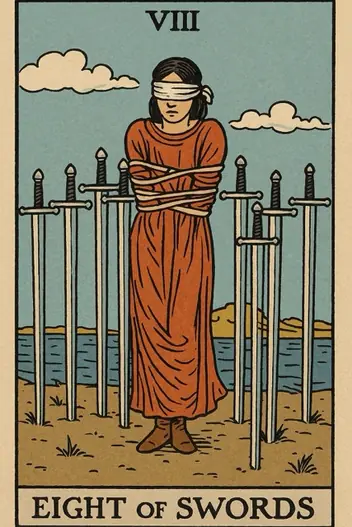
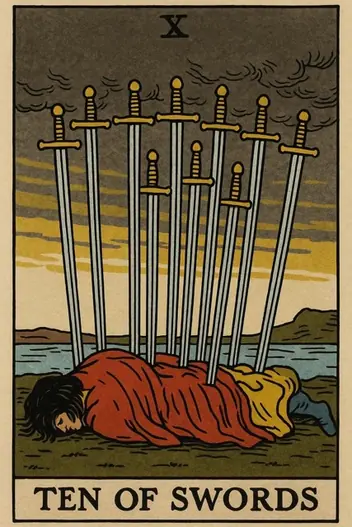
In the landscape of Tarot, the Eight of Swords represents a state of mental paralysis—feeling trapped by your own thoughts, beliefs, or perceived constraints. The Ten of Swords, meanwhile, signals a brutal ending, a point of no return where the old paradigm collapses. When these two cards appear together, they depict a psychological crisis where self-imposed limitations lead to a necessary, albeit painful, conclusion.
This combination is not about external fate but about the internal architecture of fear. The Eight of Swords binds you with cognitive distortions—overthinking, catastrophizing, and learned helplessness. The Ten of Swords then delivers the final blow: the reality check that forces you to stop resisting and accept the end of a cycle. The strategic insight here is that the pain of the Ten of Swords is often the price of freedom from the Eight of Swords' prison. You must hit rock bottom to realize the cage was never locked.
Eight of Swords and Ten of Swords Together: Meaning
The psychological state created by this pairing is one of acute cognitive dissonance. The seeker feels victimized by circumstances (Eight of Swords) yet is simultaneously being forced to confront the consequences of their own inaction or flawed thinking (Ten of Swords). This is not a random tragedy; it is the logical outcome of a mind trapped in a feedback loop of fear and avoidance. The key dynamic is the transition from passive suffering to active reckoning.
In practical terms, this combination signals that the seeker has been avoiding a difficult decision or truth for too long. The Eight of Swords represents the excuses—"I can't," "I'm not ready," "It's too risky"—while the Ten of Swords represents the inevitable collapse of that fragile narrative. The real-world implication is clear: you must stop treating your limitations as permanent realities. The Ten of Swords is not a punishment; it is a reset button. The pain is the price of clarity, and the clarity is the path to genuine agency.
The most important psychological insight here is the difference between learned helplessness and genuine powerlessness. The Eight of Swords often fools the seeker into believing they have no choices, when in fact they have many—they are simply afraid to make them. The Ten of Swords exposes this illusion by forcing the seeker to experience the worst-case scenario. And in that moment, they often discover they can survive it. This is the Jungian shadow work of confronting the inner critic that keeps you small.
Eight of Swords and Ten of Swords: Career and Money
Strategic Opportunities:
Identify one specific constraint you believe is holding you back and test it. The Eight of Swords often exaggerates obstacles. The Ten of Swords forces you to see that the "worst case" may actually be a clean slate.
Strategic Opportunities:
Use the Ten of Swords' energy to close a failing project, job, or investment decisively. The clarity of an ending is more valuable than the ambiguity of a dying venture.
Calculated Risks:
Avoid making any major financial decisions while in a state of panic or victimhood. The Eight of Swords distorts risk perception. Wait 48 hours before acting on any "final" career move.
In your professional life, this combination is a powerful signal to stop bleeding resources into a lost cause. The Eight of Swords represents the mental trap of sunk-cost fallacy—believing you must continue because you've already invested so much. The Ten of Swords is the market, the boss, or the client delivering the final verdict. The strategic action is to treat this as a surgical termination, not a personal defeat.
Financially, this pairing warns against debt denial or ignoring cash flow problems. The Eight of Swords may convince you that you have no options, but the Ten of Swords reveals that the only way out is through bankruptcy—whether literal or metaphorical. The key financial advice is to prioritize liquidity over pride. Sell the asset, quit the job, or restructure the debt. The Ten of Swords is not a death sentence; it is a strategic retreat that allows you to rebuild from a position of strength. Do not let the Eight of Swords' fear of humiliation keep you in a losing position.
Your pair is already on the table. Ask your question and draw the clarifying card
or simply focus on it
Eight of Swords and Ten of Swords Love Outcome
If you are single:
This combination warns against romanticizing unavailable or toxic partners. You may feel "trapped" by your own standards or past rejections, but the Ten of Swords suggests that a clear, painful ending is necessary to break this cycle. Focus on releasing the fantasy, not the person.
If you are in a relationship:
You are likely in a dynamic where one partner feels mentally paralyzed (Eight of Swords) while the other is delivering a harsh truth or ultimatum (Ten of Swords). The relationship cannot survive unless both parties stop blaming and start taking responsibility for their own fears.
In relationships, this pairing reveals a power struggle between fear and truth. The Eight of Swords partner may feel "stuck" in a situation they believe they cannot change—perhaps a partner who is emotionally unavailable, or a pattern of self-sabotage. The Ten of Swords partner, or the relationship itself, then delivers a decisive blow: a breakup, a betrayal, or a painful confrontation. The key relationship advice is to stop waiting for the other person to change. The Ten of Swords is telling you that the ending is already here, and your resistance is only prolonging your suffering.
Emotional intelligence demands that you ask:
Are you the one holding the sword, or are you the one tied up? If you are the Eight of Swords, your task is to untie yourself by speaking your truth. If you are the Ten of Swords, your task is to deliver that truth with clarity, not cruelty. The boundary here is not about protecting the relationship but about protecting your own integrity. The conflict resolution lies in accepting that some endings are not failures—they are necessary completions.
Eight of Swords and Ten of Swords Reversed: What Changes?
Reversed cards in this pair indicate denial and a prolongation of the process. If the Eight of Swords is reversed, it means the person has repressed their fears into the unconscious. They do not feel anxiety, but their actions are chaotic and reckless. Instead of paralysis, there are impulsive, ill-considered actions that will highly likely lead to the same Ten of Swords, but with more severe consequences. Advice: return to basic reflection — ignoring the problem does not make it less real.
If the Ten of Swords is reversed, this is resistance to an inevitable ending. The person "lingers" in a state of agony, refusing to acknowledge that the project/relationship is dead. They continue to invest resources in a hopeless cause, leading to chronic stress and burnout. Warning: this position is dangerous for your health. Your task is to perform "euthanasia" on the old scenario to make room for a new one.
If BOTH cards are reversed, this is a complete imbalance. The person simultaneously has irrational fears (reversed Eight) and clings to the past (reversed Ten). This is a state of cognitive collapse, where the person is incapable of adequately assessing reality. The only logical way to rectify the situation is through external, harsh feedback. It is necessary to delegate decision-making to a trusted person (partner, consultant) who can objectively "cut the swords" and point out the way out.
Deepen your understanding
Find out exactly what this reading means for your current life situation with our oracle.
When Eight of Swords and Ten of Swords Signal Trouble
The shadow manifestation of this combination is catastrophic thinking masquerading as realism. The seeker may convince themselves that their situation is hopeless, using the Eight of Swords' "limitations" as a justification for inaction, then using the Ten of Swords' "ending" as proof that they were right all along. This is a classic self-fulfilling prophecy driven by the cognitive bias of confirmation bias—you only see evidence that supports your belief that you are trapped.
Another shadow pitfall is martyrdom. The seeker may derive a perverse sense of identity from their suffering, using the Ten of Swords' dramatic ending to play the victim. This blocks the actual lesson of the cards: the ending is not about you being wronged; it is about you being freed. Poor judgment here manifests as passive-aggressive behavior—you "give up" on a relationship or career but secretly resent the other party, rather than taking ownership of your choice to walk away.
Self-sabotage is the ultimate shadow risk. The seeker may unconsciously engineer a Ten of Swords scenario—picking a fight, quitting impulsively, or sabotaging a project—to escape the anxiety of the Eight of Swords. The psychological work is to recognize that the desire for an ending is valid, but the method must be conscious. Do not create a crisis to solve a problem you could have addressed with a conversation.
Eight of Swords and Ten of Swords: The Combined Message
Constructive use of this combination requires a shift from a reactive to a proactive stance. The energy of the Eight of Swords is a vast, yet blocked intellectual resource. Your task is to channel this potential not into self-analysis, but into strategic planning for an exit. In this context, the Ten of Swords becomes not a death sentence, but a tool for a "clean slate." It destroys what no longer works, clearing space for something new.
A deep strategic piece of advice: use the "STOP" protocol (Stop, Think, Observe, Proceed). When you feel the paralysis of the Eight, stop. Do not try to solve the problem in that state. Instead, write down three worst-case scenarios (this allows the Ten to spill onto paper, not into life). Then, write down three of the simplest, physical actions you can take right now (go outside, drink water, write one letter). This transition from abstract terror to concrete action breaks the vicious cycle.
Remember: the Eight of Swords is an illusion. The Ten of Swords is the real outcome that only occurs when you believe in the illusion. Your freedom begins the moment you acknowledge: "I tied my own blindfold. I can remove it myself." Surrender to the inevitable in the Ten is not defeat. It is the wisdom of a warrior who knows when to retreat in order to win the next battle. Use this crisis as an opportunity for a radical reassessment of values and for letting go of everything that limits you.
Applying This to Your Situation
The core message of Eight of Swords and Ten of Swords is that your mind is the prison, and the pain of the ending is the key. You are not a victim of fate; you are a participant in a psychological drama that has reached its final act. The clarity you seek is on the other side of acceptance. The question is not "Why is this happening to me?" but "What am I finally ready to release?"
To unlock the full power of this reading, you need a personalized interpretation that accounts for your specific question, history, and emotional state. The Fortune Cards app offers a deep, AI-driven Tarot analysis tailored to your unique situation. Whether you use it on the web or download it, you can get an instant, nuanced breakdown of this exact combination for your love life, career, or personal growth. Stop guessing—get the clarity you deserve and transform this crisis into a strategic rebirth.
Interpretation by the Fortune Cards editorial team, based on the Rider–Waite tradition and Jungian archetypes. About our methodology · Updated: 2026-08-26
Other Combinations with Eight of Swords
Other Combinations with Ten of Swords
Explore Individual Card Meanings
Table of Contents
- Eight of Swords and Ten of Swords Together: Meaning
- Eight of Swords and Ten of Swords: Career and Money
- Eight of Swords and Ten of Swords Love Outcome
- Eight of Swords and Ten of Swords Reversed: What Changes?
- When Eight of Swords and Ten of Swords Signal Trouble
- Eight of Swords and Ten of Swords: The Combined Message
- Applying This to Your Situation
Ready to find answers to your questions?
Start your first reading now and look at your situation with fresh clarity. The cards are ready to reveal deeper meaning.