Five of Cups and Six of Cups Meaning in Tarot

- Arcana
- Five of Cups — Minor Arcana, Cups; Six of Cups — Minor Arcana, Cups
- Elements
- Five of Cups — Water; Six of Cups — Water
- Elemental interaction
- Same element — energies intensify each other
- Numerology
- 5 + 6 = 11 → 2
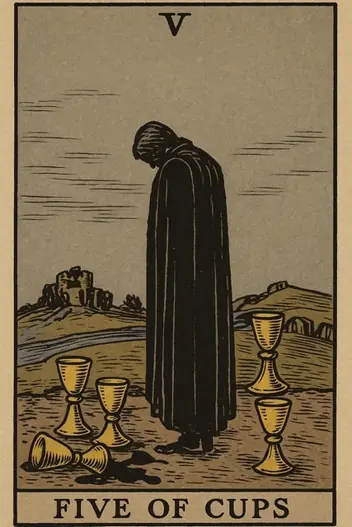
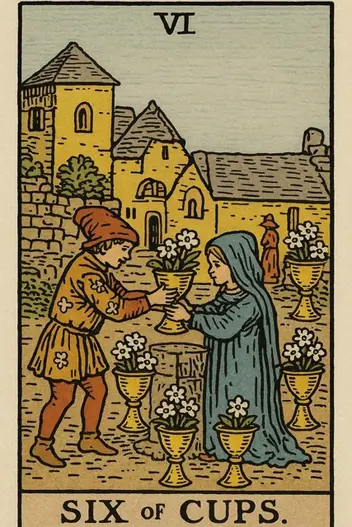
The intersection of the Five of Cups and Six of Cups creates a potent psychological tension between mourning a loss and romanticizing the past. The Five of Cups represents the raw, often isolating experience of disappointment—focusing on what has been spilled or broken. In contrast, the Six of Cups offers a lens of nostalgia, childhood innocence, or a return to a simpler time. When these cards appear together, the seeker is likely caught in a loop: grieving a specific outcome while simultaneously idealizing a previous state of being that can no longer be reclaimed. This is not merely about sadness; it is a strategic crossroads about how we allocate our emotional energy—whether we remain prisoners of our own history or use it as a compass for future action.
Five of Cups and Six of Cups Together: Meaning
The core dynamic here is a cognitive bias toward the past. The Five of Cups triggers the brain’s natural negativity bias, causing the seeker to overweight recent losses while underestimating remaining resources. The Six of Cups then adds a layer of selective memory, where only the pleasant, safe, or innocent moments are recalled, filtering out the painful truths that led to the current situation. This combination often indicates a person who is paralyzed by regret—not for what they did, but for the version of themselves they believe they’ve lost. The psychological task is to distinguish between healthy grief (acknowledging a real loss) and rumination (replaying a past that cannot be changed).
Practically, this pair suggests a blockage in forward momentum. The seeker may be returning to an ex-partner, a former job, or an old habit not because it is healthy, but because it feels familiar. The warning here is clear: nostalgia is not a strategy. While the Six of Cups can offer comfort, in this context it often acts as a seductive escape from the difficult emotional work of the Five of Cups. The real integration requires accepting the loss (Five of Cups) while honoring the lesson from the past (Six of Cups) without trying to recreate it. The path forward is not backward.
Five of Cups and Six of Cups Love Outcome
If you are single:
This combination suggests you may be comparing new prospects to an idealized ex or a past relationship. Be honest about whether your standards are based on reality or a selective memory. Avoid making decisions from a place of grief.
If you are in a relationship:
You or your partner may be holding onto a past grievance (Five of Cups) while simultaneously romanticizing how things used to be (Six of Cups). This creates a toxic cycle of resentment and nostalgia. The relationship cannot heal if you are not fully present.
In a relationship reading, this pair often signals a power struggle rooted in history. One partner may feel they have given up too much (Five of Cups), while the other longs for the “easier” days of the past (Six of Cups). The key relationship advice is to stop using the past as a weapon or a shield. Instead, both parties should ask: “What specific behaviors do we need to mourn, and what patterns do we need to leave behind?” Boldly name the loss—whether it’s lost trust, lost time, or a lost sense of safety—and then consciously choose to build something new rather than trying to rebuild a shrine to what was. This is a moment for radical honesty about what you are willing to let go of for the sake of the present.
Your pair is already on the table. Ask your question and draw the clarifying card
or simply focus on it
Five of Cups and Six of Cups in Career Readings
Strategic Opportunities:
Revisit old networks or contacts from a past role or project. The Six of Cups indicates a potential for reconnection that can yield new opportunities—but only if you approach it with a clear, forward-looking pitch, not a plea for a return to the past.
Strategic Opportunities:
Use past failures as data. The Five of Cups can be reframed as a post-mortem analysis of what went wrong. Document the lessons learned and apply them to a new venture or strategy. This turns grief into a competitive advantage.
Calculated Risks:
Avoid “returning to the well” —going back to a former employer, industry, or financial strategy simply because it feels safe. The nostalgia of the Six of Cups can mask a lack of innovation. If you are considering a restart, ensure it is a calculated pivot, not a regression.
In a career or financial context, this combination warns against making decisions based on emotional loss rather than rational analysis. The Five of Cups might represent a missed promotion, a failed project, or a financial setback. The Six of Cups can tempt you to cling to a previous job title, salary, or business model that is no longer viable. The strategic move is to grieve the loss quickly—acknowledge the disappointment, extract the key insight, and then redirect your energy toward a new, more adaptive plan. Do not let past success become a trap. Financially, this pair suggests a need to audit your spending on nostalgia—are you spending money to recreate a past experience (e.g., buying items from your childhood, paying for a vacation to a place that no longer exists)? Cut those costs and invest in creating new memories.
Ask your specific question
Don't rely on generic meanings. Get a customized reading tailored specifically to your energies.
The Shadow Side of Five of Cups and Six of Cups
The shadow side of this pair is a dangerous cycle of victimhood and escapism. The seeker may unconsciously use the grief of the Five of Cups as a justification for inaction, while the Six of Cups provides a fantasy of rescue—the belief that if they just return to the right place or person, everything will be fixed. This leads to self-sabotage through passivity. A common cognitive bias here is the sunk cost fallacy: the idea that because you have already invested so much emotional energy in a past situation, you must continue to mourn it. In reality, this combination often masks a fear of the unknown. The past, even when painful, is known and predictable. The future is not. To break the shadow, the seeker must stop romanticizing the past as a safe harbor and recognize it for what it is: a graveyard of decisions that already have their own lessons. The pitfall is mistaking memory for meaning.
Five of Cups and Six of Cups Reversed Meaning
When cards appear reversed, the emotional cocktail becomes even more toxic, but a potential for breakthrough also emerges.
If the Five of Cups is reversed (and the Six is upright):
This signifies a refusal to grieve. The person has not processed the loss but has suppressed it. They are artificially cheerful or busy, but their "refuge" in the past (the Six) becomes obsessive. Warning: This approach leads to neurosis and sudden emotional breakdowns. Advice: Find a safe space (therapy, journal) to give vent to suppressed tears and anger; otherwise, the past will return in the form of psychosomatic symptoms.
If the Six of Cups is reversed (and the Five is upright):
The past is perceived as a source of trauma, not comfort. The person is stuck in grief (the Five) and cannot find a single bright memory to lean on. This is a state of deep depression. Advice: It is necessary to artificially create "anchors" in the present. Take up a new hobby that is not connected to past experiences. Focus on micro-achievements to break the vicious cycle of negativity.
If BOTH are reversed:
The most difficult scenario. This is a complete denial of both the past and the future. The person is cut off from their roots (no experience to rely on) and refuses to learn from mistakes (no acknowledgment of losses). This is a state of chaos and self-destruction. Strategy for correction: Start with "grounding." Return to basic facts: what exists in your life right now (shelter, food, work). Only after stabilizing the present can memories be safely "thawed."
Overall Meaning of Five of Cups and Six of Cups
Constructive use of this dynamic requires rigorous reflection. Your task is to transform the Five of Cups from a source of pain into an instrument of differentiation (separating the valuable from the toxic), and the Six of Cups from a refuge into a resource base. Not "return to the past," but "use the skills and wisdom gained in the past to create something new."
The strategic algorithm for action is as follows. First: conduct an "inventory of losses." Write down exactly what you are mourning. Then, next to each item, write what this loss taught you. This will shift the Five from emotional mode to analytical mode. Second: redefine the meaning of the Six. What exactly from the past was truly valuable? Not people and places, but qualities: a sense of security, drive, creativity. Find a way to reproduce these qualities in your current life, without copying old circumstances.
Third and most importantly: accept the asymmetry of time. You will never return to the past, but you can use it as fuel. The energy of regret (Five of Cups) is a powerful engine if directed toward action to "prevent repeating the mistake." The energy of nostalgia (Six of Cups) is a compass pointing to your true values. Combine them: "I lost X, and it was painful, but I remember feeling Y when I was in Z, so now I will do A to experience Y again." This is the synthesis of past and future in the present.
Applying This to Your Situation
The core message of the Five of Cups and Six of Cups is that you cannot move forward by living in the rearview mirror. Grief is valid, and nostalgia can be a teacher, but neither should be your permanent residence. The path to clarity lies in accepting the loss, extracting the lesson, and consciously choosing a new direction—not a return to the old one. This is a moment for emotional discipline, not emotional indulgence.
While this article provides a deep analysis of the archetypal energies at play, the true power of Tarot lies in its application to your specific life. The Fortune Cards app allows you to input your exact question—whether about love, career, or a personal dilemma—and receive a personalized interpretation of this exact combination tailored to your unique situation. Don’t settle for generic advice. Download Fortune Cards on the web or via the app store now to get the insight you need to break the cycle and take your next step with clarity and purpose.
Interpretation by the Fortune Cards editorial team, based on the Rider–Waite tradition and Jungian archetypes. About our methodology · Updated: 2026-08-26
Other Combinations with Five of Cups
Other Combinations with Six of Cups
Explore Individual Card Meanings
Table of Contents
- Five of Cups and Six of Cups Together: Meaning
- Five of Cups and Six of Cups Love Outcome
- Five of Cups and Six of Cups in Career Readings
- The Shadow Side of Five of Cups and Six of Cups
- Five of Cups and Six of Cups Reversed Meaning
- Overall Meaning of Five of Cups and Six of Cups
- Applying This to Your Situation
Ready to find answers to your questions?
Start your first reading now and look at your situation with fresh clarity. The cards are ready to reveal deeper meaning.