Five of Cups and Six of Swords Together in Tarot
- Arcana
- Five of Cups — Minor Arcana, Cups; Six of Swords — Minor Arcana, Swords
- Elements
- Five of Cups — Water; Six of Swords — Air
- Elemental interaction
- Neutral elements — energies coexist without conflict
- Numerology
- 5 + 6 = 11 → 2
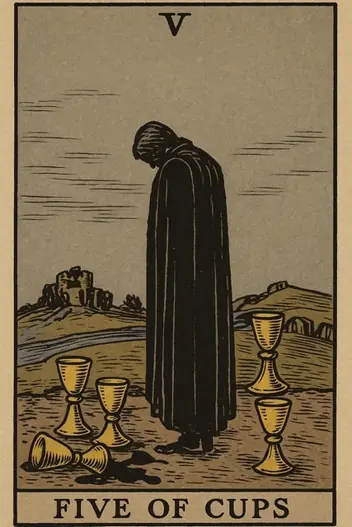
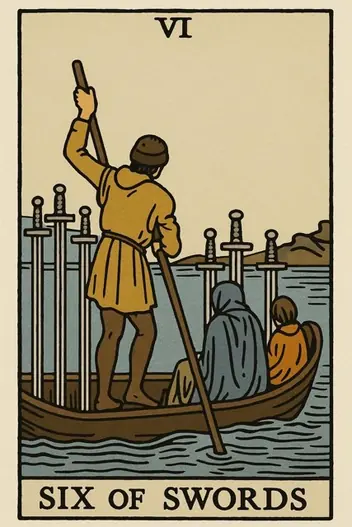
When the Five of Cups meets the Six of Swords, we encounter a psychological paradox: the simultaneous experience of loss and the imperative to move forward. The Five of Cups represents the archetype of the Mourner—fixated on spilled emotions, regret, and what has been irrevocably lost. The Six of Swords embodies the Ferryman—a figure of calculated passage, navigating toward a calmer, albeit unknown, shore. The collision of these energies creates a state of transitional grief: you are not asked to forget your pain, but you are required to make a pragmatic decision about whether to remain anchored in the past or to board the boat toward recovery.
This combination signals a critical juncture where emotional processing must become strategic action. The Five of Cups warns against cognitive distortions like rumination (replaying past mistakes) and the sunk cost fallacy (clinging to what is gone because you invested heavily). The Six of Swords offers a counterbalance: a structured, almost clinical method for leaving a difficult situation behind. The core question here is not “Can I heal?” but “Will I choose to navigate through this pain, or will I let it define my destination? ”
What Do Five of Cups and Six of Swords Mean Together?
The psychological state created by this pairing is one of controlled decompression. You are acutely aware of a significant emotional deficit—a relationship ended, a project failed, a trust broken. The Five of Cups pulls your attention downward, toward the three spilled cups of sorrow. However, the Six of Swords insists that two cups remain upright. This is not a call to toxic positivity; it is a directive to audit your resources. What specifically is salvageable? What knowledge, relationships, or skills survived the loss? The ferryman does not ask you to stop grieving; he asks you to bring your luggage and step into the boat.
In real-world terms, this dynamic manifests as making a difficult, rational decision while still in emotional turmoil. You might be finalizing a divorce while still mourning the marriage, or accepting a severance package while grieving the career you envisioned. The key insight is that movement does not require closure. The Six of Swords provides the vessel of forward momentum, but the Five of Cups provides the necessary gravity of reflection. The danger is paralysis—staying on the shore, staring at the wreckage, while the boat departs without you. The opportunity is structured grief: allowing yourself a defined period to process, then committing to the passage.
Your pair is already on the table. Ask your question and draw the clarifying card
or simply focus on it
Five of Cups and Six of Swords in Love Tarot
If you are single:
This combination suggests you are carrying emotional baggage from a past relationship (Five of Cups) that is actively preventing you from seeing a new, healthier connection (Six of Swords). Your next step is not to find a new partner, but to complete a psychological transition—acknowledge the loss, then consciously shift your focus from what went wrong to what you need going forward.
If you are in a relationship:
You and your partner are likely navigating a significant transition—perhaps a move, a breakup, or a fundamental shift in trust. The relationship itself is the boat, and you must decide if you are both rowing in the same direction. One partner may be stuck in the past, while the other is ready to leave the troubled waters behind.
In a relationship reading, the Five of Cups and Six of Swords indicate a pivotal moment of emotional triage. The dynamic is often unbalanced: one person is deep in grief, blaming themselves or their partner for the spilled cups, while the other is already planning the logistics of departure or recovery. The healthiest interpretation requires both partners to acknowledge the loss without letting it become the sole identity of the relationship. Practical advice includes setting a time-bound period for processing (e.g., “We will discuss the past issue for one hour, then plan our next step”) and using external support (couples therapy, a mediator) to prevent the grief from capsizing the boat. If the relationship is ending, this combination confirms it is a necessary, albeit painful, crossing—the water is rough, but staying docked is no longer an option.
What Do Five of Cups and Six of Swords Indicate for Your Career?
Strategic Opportunities:
Restructuring your professional identity after a failure or layoff. Use the Five of Cups’ insight to identify what you lost, then leverage the Six of Swords to pivot toward a new industry or role that aligns with your surviving strengths.
Strategic Opportunities:
Exiting a toxic work environment with your reputation intact. The Six of Swords encourages a quiet, dignified departure—do not burn bridges, but do not stay to fix what cannot be fixed.
Calculated Risks:
Avoid making major financial decisions while in the acute phase of grief. The Five of Cups can cloud judgment, leading to impulsive spending (to numb the pain) or hoarding (from fear of future loss). Delay any significant investment or contract signing for at least one week.
In a professional context, this pairing is a powerful indicator of strategic retreat. You have likely experienced a tangible loss—a failed project, a missed promotion, a business partnership dissolving. The Five of Cups warns against the sunk cost fallacy: pouring more time or money into a venture that is already dead. The Six of Swords provides the exit strategy. Financially, this combination suggests you are moving from a period of emotional spending (compensating for loss with retail therapy or risky investments) to a phase of conservative planning. The ferryman does not gamble with the boat’s integrity. Your best career move is to accept the loss as data, not as identity. Update your resume, network with intention, and focus on roles that offer stability and clear forward momentum. Beware of the cognitive bias of “over-optimism” —the Six of Swords can sometimes lull you into believing the new shore is problem-free. It is not; it is simply different and calmer.
Uncover hidden insights
Let our advanced Tarot system interpret these archetypes specifically for your personal path.
What If Five of Cups or Six of Swords Appears Reversed?
When the Five of Cups appears reversed, it can indicate blocked healing potential or, conversely, a reckless denial of pain. Instead of processing the loss, the person pushes it into the subconscious, leading to passive-aggressive behavior. A warning: if you feel you're "already fine" but there's irritation simmering inside, you are deceiving yourself. Advice: find a safe way to express anger or sadness before moving forward.
If the Six of Swords is reversed, it signals internal resistance to change. You know you need to leave, change jobs, or finish a project, but fear paralyzes your will. This is a weakness masquerading as "prudence." Advice: break the "journey" into micro-steps. You don't need to cross the river all at once—just take one step toward the shore today.
When BOTH cards are reversed, it creates a complete imbalance in dynamics. The person gets stuck in a toxic cycle: they neither mourn their losses (Five of Cups reversed) nor can they move forward (Six of Swords reversed). This is a state of chronic frustration. A logical way to correct this: activate "emergency reflection mode." Write a list of three things you have lost and three things you deny having lost. Then, identify one action you have been postponing. Take that action today.
What Are the Risks of Five of Cups and Six of Swords?
When the energy of this combination is blocked or distorted, the seeker falls into a shadow state of victimhood. Instead of using the Five of Cups’ grief as a compass, they weaponize their pain to avoid taking responsibility for the transition. This manifests as passive-aggressive behavior (“I can’t move on because you hurt me so much”) or emotional blackmail. The Six of Swords, in its shadow form, becomes escapism—physically leaving a situation (ending a relationship, quitting a job) without doing the psychological work of processing the loss. This leads to the same pattern repeating on the next shore. Another pitfall is premature closure: rushing through the grief to avoid discomfort, which results in unresolved trauma that surfaces later in explosive ways. The cognitive bias of “all-or-nothing thinking” is particularly dangerous here—either you are completely stuck in the past, or you must completely forget it. The truth is far more nuanced: you can honor the loss while still choosing to move forward.
Five of Cups and Six of Swords Combined Message
How can the energy of the Five of Cups be used constructively to balance the Six of Swords? The answer lies in the ritualization of transition. The Five of Cups gives you depth and sensitivity—do not discard them, but channel them. Instead of endlessly ruminating on loss, create a concrete "farewell ritual." This could be a letter you write and burn, or the symbolic sale of an object tied to the past. This act translates emotional energy into a physical action that the Six of Swords can use as fuel for forward movement.
The Six of Swords, in turn, demands discipline of the route from you. Do not try to "heal" before you set out. Healing happens in the process of moving. Your task is to create a realistic plan for the next 90 days. What will you do to physically, mentally, and financially distance yourself from the source of pain? Strategic advice: use the "one boat" principle. You cannot row with two oars simultaneously—one oar (emotion) and the other (rationality). Take the oar of rationality, but let your emotions be your compass.
The deep conclusion: this combination teaches us that true forward movement begins not with denying the past, but with integrating it. You take with you not only scars, but also wisdom. You do not forget who or what you lost, but you cease to be a slave to that loss. Your new identity is built on the foundation of lived experience, not on the ruins of an old life.
Your Next Step: Personal Context Matters
The Five of Cups and Six of Swords together deliver a clear, sobering message: you are in a period of necessary transition, and your willingness to grieve without getting stuck will determine the quality of your next chapter. This is not a time for dramatic gestures or impulsive decisions. It is a time for quiet, deliberate movement—packing only what serves you, leaving the rest on the shore, and trusting the ferryman’s course. The pain is real, but so is the passage.
While this article outlines the universal archetypes of these cards, the true power of Tarot lies in its application to your specific life. The Fortune Cards app allows you to input your exact question—about a relationship, career move, or personal crossroads—and receive a deep, personalized interpretation of this combination for your unique situation. Don’t navigate these waters alone. Use the app on the web or download it now to get your custom reading and discover exactly how the Five of Cups and Six of Swords are guiding your next step.
Interpretation by the Fortune Cards editorial team, based on the Rider–Waite tradition and Jungian archetypes. About our methodology · Updated: 2026-08-26
Other Combinations with Five of Cups
Other Combinations with Six of Swords
Explore Individual Card Meanings
Table of Contents
- What Do Five of Cups and Six of Swords Mean Together?
- Five of Cups and Six of Swords in Love Tarot
- What Do Five of Cups and Six of Swords Indicate for Your Career?
- What If Five of Cups or Six of Swords Appears Reversed?
- What Are the Risks of Five of Cups and Six of Swords?
- Five of Cups and Six of Swords Combined Message
- Your Next Step: Personal Context Matters
Ready to find answers to your questions?
Start your first reading now and look at your situation with fresh clarity. The cards are ready to reveal deeper meaning.