Five of Cups and Three of Swords Together in Tarot
- Arcana
- Five of Cups — Minor Arcana, Cups; Three of Swords — Minor Arcana, Swords
- Elements
- Five of Cups — Water; Three of Swords — Air
- Elemental interaction
- Neutral elements — energies coexist without conflict
- Numerology
- 5 + 3 = 8
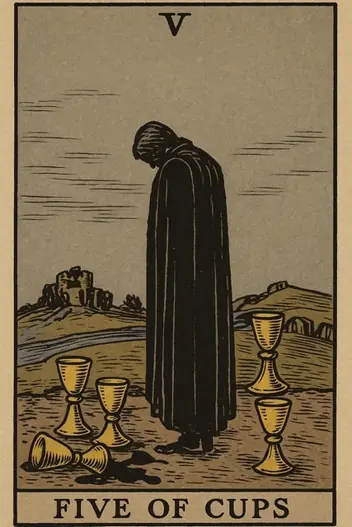
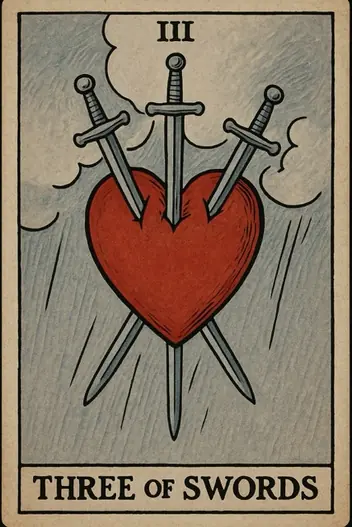
When the Five of Cups—a card of focused sorrow and selective memory—collides with the Three of Swords—the archetype of piercing truth and cognitive dissonance—you are not simply experiencing sadness. You are confronting a psychological feedback loop where emotional pain is reinforced by rigid thinking. The Five of Cups fixates on what has been lost (the spilled cups), while the Three of Swords delivers the mental clarity that shatters the illusion that things could have been otherwise. Together, they form a crisis of acceptance, where the mind and heart are locked in a stalemate.
In practical terms, this combination signals a moment where grief is being intellectualized rather than processed. The seeker may be replaying a betrayal or failure, mistaking rumination for reflection. The core dynamic here is not about external events—it is about the internal narrative that keeps the wound open. The cards demand a shift from "Why did this happen?" to "What am I refusing to see about my own role in this story?"
Core Dynamics & Interpretation
The psychological state created by this pair is one of compounded suffering. The Five of Cups represents the emotional aftermath—a lingering focus on the two spilled cups while ignoring the two remaining upright cups behind the figure. The Three of Swords adds a cognitive layer of self-criticism, where the mind dissects the loss with surgical precision. This is not passive sadness; it is an active, analytical grief that can easily spiral into self-blame or resentment.
The real-world implication is a block in decision-making. The seeker is caught between the desire to mourn and the pressure to understand. This is the archetype of the "wounded analyst" —someone who tries to solve emotional problems with logic, only to find that logic deepens the pain. The key insight here is that healing requires a temporary suspension of analysis. You cannot dissect a heartbreak into manageable pieces and expect it to heal faster. The cards suggest that the most strategic action is to stop trying to "fix" the feeling and instead allow the grief to exist without justification.
From a Jungian perspective, this combination activates the shadow of the martyr—the part of the psyche that believes suffering is noble or necessary for growth. The Three of Swords cuts through this delusion, revealing that prolonged grief is often a choice, not a fate. The work here is to distinguish between necessary mourning and unnecessary self-punishment.
Love and Relationships
If you are single:
This combination warns against projecting past betrayals onto a new connection. You may be filtering a potential partner through the lens of a previous wound, seeing swords where there are only shadows. Your next step is to separate the memory of pain from the reality of the present.
If you are in a relationship:
This pair signals a communication crisis where one or both partners are holding onto a specific hurt while ignoring the larger pattern of the relationship. The Three of Swords demands a truthful conversation, but the Five of Cups warns that this truth may be used as a weapon rather than a tool for repair.
In relationship dynamics, the Five of Cups and Three of Swords often appear when a couple is trapped in a cycle of blame and regret. One partner may be fixated on a past mistake (the spilled cups), while the other is cutting with sharp words (the swords). The psychological trap here is the belief that revisiting the wound will eventually heal it. In reality, this combination suggests that repeated analysis of the same event only deepens the scar. The most pragmatic advice is to set a time limit on discussing the past event and then commit to forward-focused action. Bold key relationship advice: Do not mistake emotional autopsy for intimacy. True connection requires vulnerability, not dissection.
Your pair is already on the table. Ask your question and draw the clarifying card
or simply focus on it
What Do Five of Cups and Three of Swords Indicate for Your Career?
Strategic Opportunities:
Use the analytical energy of the Three of Swords to conduct a ruthlessly honest audit of what went wrong in a project or deal. The Five of Cups' focus on loss can be redirected into identifying what assets or relationships remain intact (the two upright cups).
Strategic Opportunities:
This is an ideal time to cut ties with a toxic client or partnership that has been draining resources. The pain of the split is temporary, but the clarity is permanent.
Calculated Risks:
Avoid making major financial decisions while in a grief state. The combination of emotional pain and sharp logic can lead to punitive spending (buying to numb) or reckless divestment (selling to escape). Do not confuse decisiveness with desperation.
In professional life, this pair often indicates a post-mortem phase—a period after a failure or layoff where the seeker is dissecting every decision. The practical danger is analysis paralysis. The Five of Cups keeps you looking backward, while the Three of Swords provides the tools to analyze, but not the permission to move on. The strategic move is to set a hard deadline for the post-mortem (e.g., "I will review this for one week, then take one decisive action"). Bold important financial warning: Do not use self-criticism as a substitute for strategic planning. The truth of the Three of Swords should illuminate the path forward, not keep you stuck in the wreckage.
What If Five of Cups or Three of Swords Appears Reversed?
When cards appear in a reversed position, the dynamic shifts from acute and obvious to chronic and hidden.
If the Five of Cups is reversed:
This indicates blocked grief. The person denies the loss, pretends nothing happened, or tries to "skip" the mourning stage. Risk: suppressed pain will manifest as psychosomatic symptoms or a sudden outburst of aggression. Advice: give yourself permission for a farewell ritual. You cannot build something new on ruins you refuse to see.
If the Three of Swords is reversed:
The key factor is internal resistance to the truth. You know the truth but refuse to accept it. This is the ostrich position, hiding your head in the sand. It manifests as passive aggression, sarcasm, or intellectualization ("I understand everything, but it doesn't work"). Advice: write down the three most unpleasant facts about your situation and read them aloud. Visualizing the pain reduces its power.
If BOTH are reversed:
Complete imbalance — "frozen grief" . The person is in a state of apathy, with neither tears nor clarity. They can neither mourn the past nor learn lessons. This is the clinical picture of depression. Logical method of correction: external intervention is required. It is extremely difficult to break out of this cycle on your own. Therapy or a drastic change of environment (moving, quitting a job, breaking off contact) is necessary. Warning: do not try to "wait for it to pass on its own" — this is the most dangerous scenario.
Uncover hidden insights
Let our advanced Tarot system interpret these archetypes specifically for your personal path.
What Are the Risks of Five of Cups and Three of Swords?
The shadow manifestation of this combination is masochistic rumination—the unconscious choice to stay in pain because it feels more authentic than moving on. The cognitive bias at play is confirmation bias: the seeker only remembers evidence that supports their narrative of loss, ignoring any data that suggests resilience or opportunity. This is the shadow of the "truth-seeker" who uses honesty as a weapon against themselves.
Another pitfall is emotional perfectionism. The Five of Cups and Three of Swords together can create a belief that if you analyze the pain enough, you will find a "perfect" solution that erases the loss. This is a fantasy. The shadow side leads to chronic indecision—the seeker becomes so focused on the "right" way to grieve or resolve that they never take any action at all. The greatest risk is mistaking emotional intensity for depth. Just because something hurts does not mean it is meaningful. The cards warn against romanticizing suffering as a path to wisdom.
Five of Cups and Three of Swords Combined Message
The energy of this pair is not a curse, but an instrument of surgical precision. The Five of Cups supplies you with fuel—the emotional energy triggered by loss. The Three of Swords gives you the scalpel—the ability to direct that energy toward dissecting illusions. Your task is to become the surgeon, not the patient.
How to constructively use this union? First: accept pain as a signal, not a sentence. Every time you feel the sting of regret (Five of Cups), ask yourself: "What exactly am I saying goodbye to?" and "What have I learned from this experience?" (Three of Swords). This transforms passive suffering into active learning.
Second: use the principle of "inventorying values." The Five of Cups speaks to what you valued. The Three of Swords speaks to the fact that this value was false or unattainable. Make a list of three things you have lost, and next to each, write down which false need they fulfilled. For example: "Lost a partner—fulfilled a need for security through control." This gives you a map of your true, neurotic needs that can be met in a healthy way.
Third: the strategy of "dosed grief." Do not try to suppress the Five of Cups. Set aside 15 minutes a day for conscious grieving. During this time, you have the right to cry, feel sorry for yourself, and remember the past. As soon as the timer goes off, you switch into Three of Swords mode—analyze, write conclusions, plan actions. This ritual will prevent emotions from spilling over and flooding your life, but it will also not allow you to run from reality.
A deep strategic piece of advice: do not be afraid to be ruthless toward your illusions, but be gentle with yourself. The Three of Swords must cut false beliefs, not your self-esteem. The synthesis of these cards is a path from "why me?" to "what's next?" It is a transition from reactive existence to proactive creation of your life, where the past is not a prison, but a foundation.
Where to Go From Here
The Five of Cups and Three of Swords ultimately deliver a single, stark message: You cannot think your way out of a feeling. The analytical power of the Three of Swords is valuable, but it must be paired with the emotional permission to let go that the Five of Cups resists. Your next step is to stop trying to understand the pain and start allowing it to transform. The two upright cups in the Five of Cups are still there—but you cannot see them until you stop staring at the spilled ones.
Ready to apply this insight to your specific situation? While this article explains the general archetype, the true power of Tarot lies in how these cards interact with your unique question. The Fortune Cards app gives you a personalized, AI-driven interpretation of this exact combination for your relationship, career, or life challenge. You can use it on the web or download it now to get a deep, tailored reading that moves beyond theory and into actionable guidance for your life. Stop analyzing the pain—start transforming it.
Interpretation by the Fortune Cards editorial team, based on the Rider–Waite tradition and Jungian archetypes. About our methodology · Updated: 2026-08-26
Other Combinations with Five of Cups
Other Combinations with Three of Swords
Explore Individual Card Meanings
Table of Contents
- Core Dynamics & Interpretation
- Love and Relationships
- What Do Five of Cups and Three of Swords Indicate for Your Career?
- What If Five of Cups or Three of Swords Appears Reversed?
- What Are the Risks of Five of Cups and Three of Swords?
- Five of Cups and Three of Swords Combined Message
- Where to Go From Here
Ready to find answers to your questions?
Start your first reading now and look at your situation with fresh clarity. The cards are ready to reveal deeper meaning.