Five of Wands and Nine of Wands Tarot Combination

- Arcana
- Five of Wands — Minor Arcana, Wands; Nine of Wands — Minor Arcana, Wands
- Elements
- Five of Wands — Fire; Nine of Wands — Fire
- Elemental interaction
- Same element — energies intensify each other
- Numerology
- 5 + 9 = 14 → 5
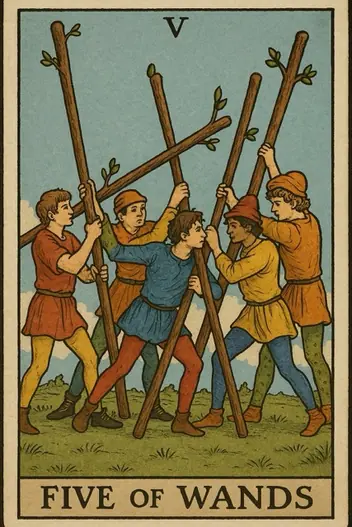
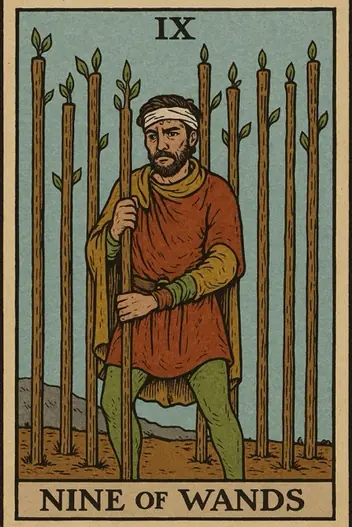
When the Five of Wands—the card of rivalry, competition, and scattered conflict—collides with the Nine of Wands—the card of resilience, defensiveness, and last stands—you get a psychological portrait of someone fighting for survival in a crowded arena. This is not a peaceful retreat; it is a battle-hardened stance where every new challenge feels like a personal attack. The key insight here is that while the Five of Wands represents external friction, the Nine of Wands shows how you internalize that friction into a protective, often exhausted, posture.
In practical terms, this combination signals a period where you are constantly tested by others’ agendas, yet you refuse to back down. The archetype at play is the Wounded Warrior—someone who has been through enough skirmishes to know the cost of engagement, but still feels compelled to hold the line. The psychological task is to distinguish between necessary battles and self-destructive resistance.
Five of Wands and Nine of Wands Card Meaning Explained
The core dynamic of this pairing is defensive competition. You are not just competing for a prize; you are competing to protect your position, your identity, or your hard-won achievements. The Five of Wands stirs up chaotic energy—arguments, misunderstandings, or outright rivalry from multiple fronts. The Nine of Wands then responds by raising psychological walls, increasing vigilance, and adopting a scarcity mindset where every interaction feels like a threat.
What makes this combination particularly challenging is the cognitive bias of hypervigilance. You may see enemies where there are only obstacles, or interpret neutral feedback as an attack. This can lead to a self-fulfilling prophecy: your defensive behavior provokes more conflict, which confirms your belief that you must stay on guard. The psychological state is one of chronic low-grade stress, where the nervous system stays in "fight or flight" mode, eroding your capacity for creative problem-solving.
To break this loop, you must recognize that the competition in the Five of Wands is often diffuse and impersonal—it’s about differing opinions or limited resources, not personal vendettas. The Nine of Wands asks you to conserve energy by choosing which fights to accept and which to let go. The most strategic move is to shift from reactive defense to proactive boundary-setting.
Five of Wands and Nine of Wands as Feelings
If you are single:
This pair suggests you may be attracting partners who challenge your ego or test your patience. It’s not about finding a perfect match, but about learning what you truly want to defend in a relationship versus what you need to release.
If you are in a relationship:
Expect a period of power struggles or petty disagreements that escalate because both partners feel cornered. The risk is that you treat your partner as an opponent rather than an ally.
In relationships, the Five of Wands and Nine of Wands often indicate a communication breakdown fueled by defensiveness. You or your partner may be bringing unresolved external stress—work conflicts, family tensions, or financial pressure—into the relationship, turning minor disagreements into major battles. The psychological pattern is projection: you attribute your own exhaustion or frustration to your partner’s actions.
The key relationship advice here is to create a “pause button” before reacting. When you feel the urge to defend yourself, ask: “Is this about us, or about something else I’m carrying?” Boldly state your boundaries without accusation—for example, “I need a few minutes to think before I respond.” This prevents the Five of Wands’ chaotic energy from triggering the Nine of Wands’ defensive shutdown. Remember, intimacy requires vulnerability, and constant defensiveness erodes trust.
Your pair is already on the table. Ask your question and draw the clarifying card
or simply focus on it
Five of Wands and Nine of Wands in Career Readings
Strategic Opportunities:
Use the competitive energy of the Five of Wands to sharpen your skills—this is a time for high-stakes negotiations or public presentations where you can prove your value.
Strategic Opportunities:
The Nine of Wands’ resilience means you are well-positioned to handle objections or pushback in meetings. Your experience is your asset.
Calculated Risks:
Avoid taking on more projects or clients just to prove you can handle them. This combination warns against overcommitment leading to burnout.
In a career context, this combination suggests a workplace environment of intense rivalry—perhaps a toxic team, a competitive promotion cycle, or a project where everyone is jockeying for credit. The Nine of Wands energy can make you feel like the last line of defense for a failing initiative. Financially, this is not a time for high-risk investments or speculative ventures. The psychological temptation is to “double down” on a losing position out of pride.
The strategic financial advice is to audit your resources. Are you spending more energy defending your current position than it’s worth? Boldly consider whether a strategic retreat or delegation could free you up for higher-value work. Protect your cash flow by avoiding unnecessary expenses tied to status competition (e.g., buying a new car to match a colleague). Instead, invest in systems that reduce friction—automation, support staff, or time-management tools.
Five of Wands and Nine of Wands Reversed Meaning
If the Five of Wands is reversed:
Chaos subsides, but passive aggression and hidden resistance remain. You are not fighting openly, but you are sabotaging processes from within. Advice: voice your dissatisfaction out loud, otherwise it will destroy the system from the inside.
If the Nine of Wands is reversed:
The defense has collapsed. This is a state of extreme vulnerability and exhaustion. You can no longer hold the line and are ready to surrender. Warning: do not confuse capitulation with wisdom. Make sure you are retreating consciously, not out of apathy.
If BOTH are reversed:
Complete imbalance. The conflict (Five) is suppressed, and the defense (Nine) is broken. This is a "victim of circumstances" scenario. The person feels helpless and paralyzed. Corrective advice: urgently restore a basic sense of safety. Start small—tidy up your desk, get a good night's sleep, re-establish a daily routine. Only after this can you attempt to analyze the conflict.
Ask your specific question
Don't rely on generic meanings. Get a customized reading tailored specifically to your energies.
When Five of Wands and Nine of Wands Signal Trouble
The shadow side of this combination is paranoid defensiveness—a state where you see threats everywhere and respond with aggression or withdrawal. This manifests as cognitive rigidity: you reject feedback, refuse collaboration, and isolate yourself. Another pitfall is exhaustion from over-engagement—you fight every battle, big or small, draining your emotional reserves.
Psychologically, this can trigger a victimhood narrative (“Everyone is against me”) that justifies passive-aggressive behavior or martyrdom. In extreme cases, it leads to burnout or depression, as the constant state of alertness depletes your dopamine and serotonin levels. The biggest cognitive bias here is the “hostile attribution bias”—interpreting neutral events as intentionally harmful. You may also fall into sunk cost fallacy, continuing to defend a position simply because you’ve invested so much in it.
To avoid these pitfalls, practice emotional differentiation: separate the external conflict from your internal identity. Your worth is not determined by winning every argument. Set a hard limit on how many hours per week you spend in “defense mode.” Use journaling to track when you feel attacked and objectively assess whether the threat is real or imagined.
Five of Wands and Nine of Wands: The Combined Message
The energy of the Five of Wands (conflict) should be used not for attack, but for "stress-testing" your defenses (Nine of Wands). Instead of wasting energy on endless skirmishes, use challenges as a diagnostic tool: where exactly is your defense weak? Which aspect of your life requires immediate reinforcement?
Your strategy is a paradigm shift from "defense" to "resilience." Defense is passive and draining. Resilience is an active process of adaptation. Instead of building walls, learn to "respond flexibly to pressure." This means you can yield on small matters to win the main objective. For example, agree to a temporary inconvenience at work to preserve a strategically important project.
A deep strategic counsel: choose one battle you are willing to win at any cost, and ignore the rest. Spreading your forces thin to defend all fronts is a sure path to defeat. Focus on the core value (relationships, career, health) and sacrifice the secondary. Only then can you emerge from this crisis not broken, but tempered.
Your Next Step: Personal Context Matters
The Five of Wands and Nine of Wands combination is a call to strategic resilience—not blind stubbornness. Your core task is to discern which battles are worth your energy and which are distractions. This is a time to protect your mental health by setting clear boundaries and practicing selective engagement. The message is not to avoid conflict, but to fight with purpose, not reflex.
However, these general insights are just a starting point. The true meaning of this combination shifts dramatically based on your specific question, the positions of the cards, and the surrounding spread. To get a deep, personalized interpretation of how the Five of Wands and Nine of Wands apply to your unique situation—whether in love, career, or personal growth—use the Fortune Cards app. You can access it on the web or download it to receive an in-depth reading tailored to your exact query. Discover the precise psychological pattern you need to break and the strategic move that will turn this conflict into progress.
Interpretation by the Fortune Cards editorial team, based on the Rider–Waite tradition and Jungian archetypes. About our methodology · Updated: 2026-09-17
Other Combinations with Five of Wands
Other Combinations with Nine of Wands
Explore Individual Card Meanings
Table of Contents
- Five of Wands and Nine of Wands Card Meaning Explained
- Five of Wands and Nine of Wands as Feelings
- Five of Wands and Nine of Wands in Career Readings
- Five of Wands and Nine of Wands Reversed Meaning
- When Five of Wands and Nine of Wands Signal Trouble
- Five of Wands and Nine of Wands: The Combined Message
- Your Next Step: Personal Context Matters
Ready to find answers to your questions?
Start your first reading now and look at your situation with fresh clarity. The cards are ready to reveal deeper meaning.