Five of Wands and Queen of Cups Meaning in Tarot
- Arcana
- Five of Wands — Minor Arcana, Wands; Queen of Cups — Minor Arcana, Cups
- Elements
- Five of Wands — Fire; Queen of Cups — Water
- Elemental interaction
- Opposing elements — energies create tension
- Numerology
- 5 + 13 = 18 → 9
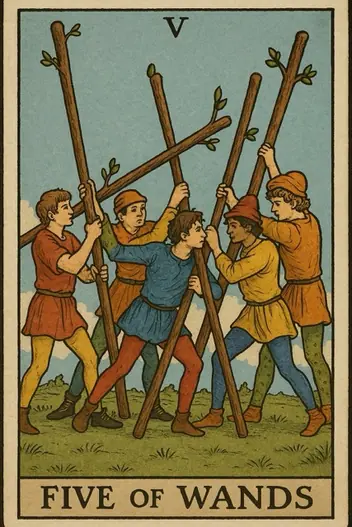
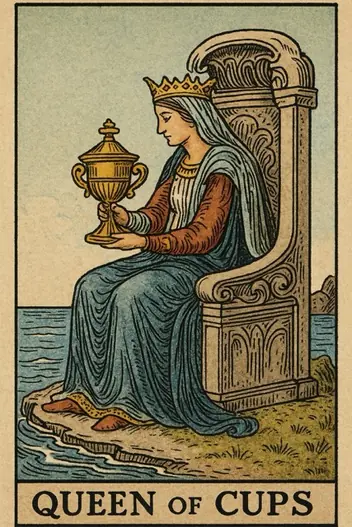
When the chaotic, competitive energy of the Five of Wands meets the calm, intuitive depth of the Queen of Cups, you are looking at a powerful psychological paradox. On one hand, you have a drive to clash, prove yourself, and navigate a crowded field of conflicting agendas. On the other, you possess a deep well of empathy, emotional intelligence, and a need for a peaceful inner sanctuary. The core challenge here is managing external friction without sacrificing your internal peace. This combination often appears when you must defend your emotional boundaries, not with aggression, but with quiet, unshakeable certainty. It asks: Can you hold your ground in a conflict without losing your compassionate center?
The practical intersection of these two cards is a test of emotional agility. The Five of Wands represents the noise of the world—arguments, competition, and the pressure to react. The Queen of Cups represents your internal compass—your feelings, intuition, and capacity for care. When they collide, you are being asked to use your emotional intelligence as a strategic tool, not a liability. This is not about avoiding conflict, but about navigating it with grace. It suggests that the most powerful move you can make in a tense situation is to remain calm, listen deeply, and then act from a place of conscious choice rather than reactive impulse.
Five of Wands and Queen of Cups Together: Meaning
The psychological state created by this pairing is one of high tension held within a calm exterior. You may feel a strong urge to fight—to defend your ideas, your role, or your emotional territory—yet your deeper self knows that outright aggression will only muddy the waters. The key insight here is that the Queen of Cups does not eliminate the conflict; she transforms how you engage with it. Instead of throwing punches, you are encouraged to use empathy and observation to understand the motivations of those around you. This allows you to de-escalate situations that would otherwise spiral into useless drama.
From a Jungian perspective, this is the integration of the Warrior and the Nurturer archetypes. The Five of Wands represents the Shadow of competitive ego—the part of you that feels threatened and wants to prove superiority. The Queen of Cups represents the Anima—the receptive, relational side that seeks harmony. Your task is to let the Queen lead the charge. This means asking: "What is this conflict really about, beneath the surface?" The answer is often a wounded feeling or a need for validation. By addressing that need directly, you can resolve the external battle from the inside out. This is a highly sophisticated strategy: winning the war by healing the wound.
The real-world implication is a shift from reaction to observation. When you see the Five of Wands energy (arguments, competition, clashing egos), the Queen of Cups advises you to pause and breathe. Do not immediately join the fray. Instead, step back, feel what is happening in your body, and assess the emotional landscape. This gives you a critical advantage: you can see the patterns of conflict that others are blind to. The combination suggests you have the power to become a mediator, a diplomat, or a strategic peacemaker, turning a chaotic situation into an opportunity for deeper understanding and connection.
Your pair is already on the table. Ask your question and draw the clarifying card
or simply focus on it
Five of Wands and Queen of Cups Love Outcome
If you are single:
This pairing warns against getting entangled in a "rescue fantasy." You may be drawn to someone who is emotionally turbulent or in a chaotic life stage. Your job is not to fix them, but to maintain your own emotional stability. Use your intuition to discern if their drama is a genuine cry for help or a pattern of self-sabotage. Do not confuse intensity with intimacy.
If you are in a relationship:
You are likely navigating a period of constant small disagreements or power struggles. The core issue is not the topic of the fight, but the underlying emotional dynamic. One of you may be acting out (Five of Wands) while the other is absorbing it (Queen of Cups). The goal is to stop the cycle of emotional caretaking and instead establish a new, more direct form of communication.
In a relationship context, this combination highlights a critical power dynamic. The Five of Wands partner may be expressing frustration, competitiveness, or a need for autonomy through argument. The Queen of Cups partner, in turn, may become the emotional sponge, absorbing all the tension and trying to soothe it away. This is unsustainable. The psychological advice here is clear: the Queen must set a boundary. You can be compassionate without being a doormat. The most loving act you can perform is to name the pattern out loud: "I see we are in a conflict cycle. I want to understand your perspective, but I need to do it without feeling attacked." This reframes the conflict from a battle to a collaborative problem-solving session.
Bold key relationship advice:
Your emotional intelligence is your greatest weapon here. Use it to de-escalate, not to absorb. Stop managing their feelings; start expressing your own. The relationship will only grow stronger when both partners can hold their own emotional ground while still being open to the other. If you are single, focus on finding someone who is already emotionally stable, rather than someone who needs you to be their anchor in a storm.
Ask your specific question
Don't rely on generic meanings. Get a customized reading tailored specifically to your energies.
Five of Wands and Queen of Cups: Career and Money
Strategic Opportunities:
Use your intuition to spot hidden alliances. In a competitive work environment, your ability to read people's true motivations is a superpower. Network quietly and build bridges with those who share your values.
Strategic Opportunities:
Mediate a conflict to gain leadership credibility. If there is a team dispute, step in as a calm, empathetic facilitator. This will position you as a natural leader without you having to fight for the title.
Calculated Risks:
Avoid getting drawn into gossip or office politics. The Five of Wands energy can be toxic if you engage on its level. Your risk is emotional burnout from trying to please everyone or fix every problem. Do not sacrifice your professional boundaries for the sake of harmony.
In a professional setting, this card pairing is a powerful signal for a strategic pivot. You may be in a highly competitive environment—a startup, a sales team, or a creative field where everyone is vying for recognition. The Five of Wands says: "The fight is real." The Queen of Cups says: "But you don't have to fight dirty." Your path to success lies in emotional differentiation. You can stand out not by being louder, but by being more perceptive, more empathetic, and more composed under pressure. This is a form of high-stakes emotional labor that pays off in trust and respect.
Financially, this combination warns against impulsive decisions driven by fear or competition. Do not buy something you can't afford just to keep up with a colleague (Five of Wands). Do not lend money or invest based on a gut feeling alone (Queen of Cups). The best financial strategy here is a blend of intuition and hard data. Trust your gut about people, but verify with spreadsheets. Bold important financial warning: Do not let your empathy override your logic in a negotiation. You can be kind and still ask for what you are worth. The Queen of Cups knows her own value; she does not need to fight for it, but she will not undersell it.
Five of Wands and Queen of Cups Reversed Meaning
If the Five of Wands is reversed, the energy of conflict turns inward. You are not openly quarreling, but you experience chronic irritation and a sense of injustice. This blocks the potential of the Queen of Cups, as you cannot show empathy while being consumed by an internal struggle. Advice: do not suppress the aggression, but channel it into physical activity or clear argumentation.
If the Queen of Cups is reversed, the emotional sphere becomes a source of problems. This can manifest as emotional coldness, an inability to empathize, or conversely, as hysteria and manipulativeness. In combination with the upright Five of Wands, this creates a toxic cocktail: the aggressive imposition of one's feelings and demands. Advice: check yourself for burnout. You need a pause to restore your capacity for empathy.
If BOTH cards are reversed, the dynamic is completely broken. This is a state of emotional chaos and passive aggression, where a conflict exists, but it can neither be resolved nor concluded. The person is stuck in the role of a victim who is simultaneously angry at the whole world. A logical way to correct this: temporarily distance yourself from all significant relationships and focus on basic self-discipline (sleep schedule, nutrition, physical activity) to restore your mental tone.
Negative Meaning of Five of Wands and Queen of Cups
The shadow side of this combination is emotional martyrdom. When the Queen of Cups energy is blocked or distorted, it can manifest as passive-aggression. Instead of directly addressing the conflict of the Five of Wands, you might internalize the tension, becoming resentful, withdrawn, or overly self-sacrificing. The cognitive bias at play is "toxic positivity" —the belief that you must always be calm and kind, even when you are being treated unfairly. This leads to emotional suppression, which eventually erupts in a way that is far more destructive than the original conflict.
Another significant pitfall is losing yourself in the drama. The Queen of Cups, when ungrounded, can become a "rescuer" who is addicted to the chaos of the Five of Wands. You might subconsciously seek out turbulent relationships or high-conflict workplaces because they make you feel needed. This is a form of self-sabotage. You are using your empathy not as a tool for growth, but as a shield against your own unresolved issues. Ask yourself honestly: Are you solving problems, or are you just addicted to the adrenaline of the fight? The shadow path here is burnout disguised as compassion.
Five of Wands and Queen of Cups: Tarot Advice
How can this dynamic be used constructively? Your task is to transform conflict from destructive into creative. The Five of Wands is the energy needed to defend your boundaries. The Queen of Cups is the wisdom that tells you when and how to do so without causing pain.
Begin by practicing "empathetic confrontation." Before entering an argument, pause and ask yourself: "What am I feeling right now? What is the other person feeling?" Then formulate your grievance not as an accusation ("You're pissing me off!"), but as a description of your feelings and needs ("I feel irritated when this happens because it's important to me that..."). This is not weakness—it is the highest form of emotional intelligence.
Strategic advice:
Use the Five of Wands to set goals, and the Queen of Cups to choose your means. You can be ambitious and competitive, but do so with respect for others' feelings. Remember, a victory achieved at the cost of broken relationships is a defeat. Your true strength lies in your ability to remain human in the midst of the fiercest competition.
Your Next Step: Personal Context Matters
The core message of the Five of Wands and Queen of Cups is this: You can be both strong and soft. The chaos around you is not a threat to your peace; it is an invitation to practice a higher form of mastery. By staying grounded in your emotional intelligence, you can navigate conflict without becoming the conflict. Your greatest power right now is your ability to see the whole picture—the surface clash and the hidden feelings beneath it. Use that vision wisely.
Call to Action:
This article gives you the general archetype, but the true magic happens when Tarot is applied to your unique situation. What does this combination mean for your specific relationship, your career dilemma, or your personal block? The Fortune Cards app provides a deep, personalized interpretation of this exact combination for your exact question, right now. Use the app on the web or download it today to get the clarity you need to move forward with both strength and compassion. Your next step is just a click away.
Interpretation by the Fortune Cards editorial team, based on the Rider–Waite tradition and Jungian archetypes. About our methodology · Updated: 2026-08-26
Other Combinations with Five of Wands
Other Combinations with Queen of Cups
Explore Individual Card Meanings
Table of Contents
- Five of Wands and Queen of Cups Together: Meaning
- Five of Wands and Queen of Cups Love Outcome
- Five of Wands and Queen of Cups: Career and Money
- Five of Wands and Queen of Cups Reversed Meaning
- Negative Meaning of Five of Wands and Queen of Cups
- Five of Wands and Queen of Cups: Tarot Advice
- Your Next Step: Personal Context Matters
Ready to find answers to your questions?
Start your first reading now and look at your situation with fresh clarity. The cards are ready to reveal deeper meaning.