Five of Wands and Seven of Cups Together in Tarot

- Arcana
- Five of Wands — Minor Arcana, Wands; Seven of Cups — Minor Arcana, Cups
- Elements
- Five of Wands — Fire; Seven of Cups — Water
- Elemental interaction
- Opposing elements — energies create tension
- Numerology
- 5 + 7 = 12 → 3
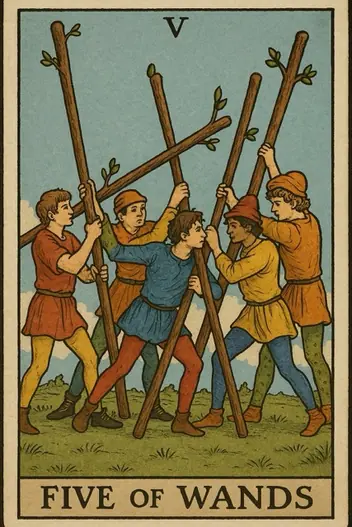
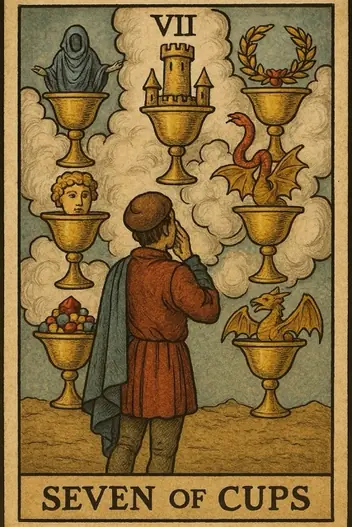
The intersection of the Five of Wands and the Seven of Cups presents a compelling psychological paradox. The Five of Wands represents competitive friction, conflict, and the scramble for resources—a raw, externalized struggle where multiple wills collide. In contrast, the Seven of Cups depicts internal fragmentation, wishful thinking, and the allure of multiple illusions—a seductive but paralyzing state of fantasy.
When these two archetypes merge, you are likely experiencing a situation where external pressures (conflict) are amplified by internal confusion (too many choices) . You may be fighting battles on multiple fronts while simultaneously being unable to commit to a single, clear path forward. This combination warns against reacting impulsively to chaos without first grounding your desires. The core challenge is to move from reactive combat to strategic discernment, turning scattered energy into focused action.
Five of Wands and Seven of Cups Combination Meaning
At its core, this combination reveals a cognitive bottleneck between desire and execution. The Seven of Cups floods your mind with possibilities—dreams of success, alternate paths, and idealized outcomes. Meanwhile, the Five of Wands forces you into a defensive or competitive posture where you must defend your position or fight for what you want. The psychological tension here is palpable: you are trying to build a castle in the sky while someone is knocking down your scaffolding.
The key insight is that conflict (Five of Wands) often arises from a lack of clarity (Seven of Cups) . When your goals are vague or contradictory, you attract opposition because others perceive your indecision as weakness or opportunity. This pairing frequently appears in readings where the seeker is overcommitting to multiple projects, relationships, or ideas without a coherent strategy. The result is burnout, scattered energy, and a feeling of being overwhelmed by both external competitors and internal doubt.
To navigate this, you must prioritize. The Five of Wands demands that you pick a hill to die on; the Seven of Cups demands that you choose one cup to drink from. Without this discernment, you risk becoming a passive participant in your own life, reacting to every skirmish while never advancing toward a meaningful goal. The psychological remedy is reality-testing your fantasies—ask yourself: "Which of these options is actually achievable, and which is a distraction?"
Your pair is already on the table. Ask your question and draw the clarifying card
or simply focus on it
What Do Five of Wands and Seven of Cups Say About Love?
If you are single:
This pairing suggests you may be attracted to multiple people or situations simultaneously, but these attractions are likely based on fantasy rather than compatibility. You are advised to stop comparing potential partners in your head and instead engage with one person authentically to see if the reality matches the fantasy.
If you are in a relationship:
Expect heated disagreements over priorities or future plans. One or both partners may be holding onto idealized versions of the other or the relationship, leading to arguments about what is "real" versus what is "imagined."
In relationships, this combination often points to a power struggle fueled by unrealistic expectations. The Five of Wands brings out competitive dynamics—perhaps you are fighting over who makes more money, who does more work, or whose vision for the future is correct. The Seven of Cups adds a layer of emotional fantasy, where each partner clings to a perfect image of how things "should be" rather than addressing the messy, imperfect reality.
The critical relationship advice here is to ground your conversations in observable facts. Instead of arguing about feelings or hypotheticals, focus on specific behaviors and shared decisions. Boldly acknowledge that no partner can fulfill every fantasy from the Seven of Cups. You must choose which aspects of the relationship are non-negotiable and which are illusions you are willing to release. Conflict resolution requires you to differentiate between genuine needs and ego-driven fantasies.
Deepen your understanding
Find out exactly what this reading means for your current life situation with our oracle.
Career and Finances
Strategic Opportunities:
Identify your core competitive advantage and double down on it, rather than spreading yourself thin across multiple projects.
Strategic Opportunities:
Use conflict as a filter to eliminate distractions. The Five of Wands reveals which battles are worth fighting and which are energy drains.
Calculated Risks:
Avoid making financial decisions based on wishful thinking. The Seven of Cups warns against investments or job offers that seem "too good to be true" or lack concrete data.
In your professional life, this combination signals a period of intense competition and decision fatigue. You may be facing multiple offers, job interviews, or project proposals, but the Five of Wands indicates that others are actively vying for the same resources. The danger is that you will chase shiny objects (Seven of Cups) while neglecting the core work that builds sustainable success.
To manage this, adopt a ruthless prioritization framework. Boldly ask yourself: "Which opportunity has the highest probability of success with the resources I have?" The Five of Wands suggests that your competitors will exploit your indecision. If you waver, they will move faster. Financial stability requires you to commit to one path and defend it, rather than hedging your bets across multiple uncertain ventures. Avoid speculative investments or partnerships based on vague promises. Instead, demand clear metrics, timelines, and accountability before committing resources.
What Are the Risks of Five of Wands and Seven of Cups?
The shadow manifestation of this pairing is self-sabotage through overanalysis and conflict avoidance. The Seven of Cups can lead to decision paralysis, where you become so overwhelmed by possibilities that you take no action at all. Meanwhile, the Five of Wands can trigger a defensive, combative mindset where you attack others for your own lack of clarity. This is a classic cognitive bias: projecting your internal confusion onto external opponents.
Another common pitfall is fantasy-driven competition—you may be fighting for something you don't actually want, simply because others are pursuing it. This is the "keeping up with the Joneses" trap, amplified by the Seven of Cups' illusion that the grass is greener. Beware of comparing your real, messy life to the curated highlights of others. The shadow side also includes addictive behaviors (Seven of Cups) used to cope with stress (Five of Wands), such as overindulgence in escapism, shopping, or social media scrolling to avoid making hard choices.
To avoid these pitfalls, practice radical self-honesty. Ask: "Am I fighting for this because I truly want it, or because I'm afraid of missing out?" Limit your options to three or fewer to reduce cognitive load. Seek external feedback from a trusted mentor or therapist to reality-test your perceptions.
Reversed Positions: What Changes?
When cards appear in a reversed position, the dynamic becomes distorted, but does not disappear.
If the Five of Wands is reversed:
The conflict goes underground. This is passive aggression, sabotage, and internal tension. Your struggle is no longer open, which is far more dangerous. Advice: you need to bring the conflict to the surface, otherwise it will destroy you from within.
If the Seven of Cups is reversed:
This points to internal resistance and a rejection of the dream. You are not just seeing illusions—you are actively denying any possibilities, focusing on negative scenarios. Warning: you risk falling into cynicism and apathy, losing the ability to see perspectives.
If BOTH are reversed:
Complete imbalance. This is a state of "learned helplessness." You feel that struggle is pointless and all options are bad. Method of correction: it is necessary to artificially create a small, controlled conflict (for example, an argument about evening plans) and win it. This will restore your sense of control over reality.
Five of Wands and Seven of Cups Combined Message
Constructive use of this pair requires rigid internal discipline. Your energy from the Five of Wands is a powerful fuel resource. But without the steering wheel of the Seven of Cups, this engine will burn itself out. Your key task is to transform chaotic struggle into strategic competition.
To achieve this, you need to conduct an "audit of illusions." Take a sheet of paper and write down all your fears, doubts, and "possible scenarios" (the Seven of Cups). Then, opposite each item, write one concrete, measurable step you can take right now (the Five of Wands). For example, instead of "I'm afraid of being fired," write "I will schedule a meeting with my manager to clarify this month's KPIs." Strategic advice: Use the energy of competition not against other people, but against your own uncertainty. Set up a competition with yourself: "How many hypotheses from my list can I test in a week?" This way, you will channel aggression toward solving problems rather than creating new ones.
Your Next Step: Personal Context Matters
The core message of the Five of Wands and Seven of Cups is this: chaos without clarity is a recipe for burnout. You must choose your battles wisely and ground your fantasies in reality. This combination is a call to stop juggling illusions and start fighting for something real. The key is to reduce the number of variables in your life and commit to a single, focused direction.
However, a general interpretation can only take you so far. Your specific situation—your relationship history, career stage, and personal psychology—radically changes how these cards apply. To get a deep, personalized interpretation of this exact combination for your unique question, use the Fortune Cards app. Available on the web and for download, it uses advanced psychological frameworks to tailor the meaning of the Five of Wands and Seven of Cups to your life right now. Don't guess—get clarity. Click here to start your personalized reading.
Interpretation by the Fortune Cards editorial team, based on the Rider–Waite tradition and Jungian archetypes. About our methodology · Updated: 2026-08-26
Other Combinations with Five of Wands
Other Combinations with Seven of Cups
Explore Individual Card Meanings
Table of Contents
- Five of Wands and Seven of Cups Combination Meaning
- What Do Five of Wands and Seven of Cups Say About Love?
- Career and Finances
- What Are the Risks of Five of Wands and Seven of Cups?
- Reversed Positions: What Changes?
- Five of Wands and Seven of Cups Combined Message
- Your Next Step: Personal Context Matters
Ready to find answers to your questions?
Start your first reading now and look at your situation with fresh clarity. The cards are ready to reveal deeper meaning.