Five of Wands and Seven of Wands Tarot as Feelings

- Arcana
- Five of Wands — Minor Arcana, Wands; Seven of Wands — Minor Arcana, Wands
- Elements
- Five of Wands — Fire; Seven of Wands — Fire
- Elemental interaction
- Same element — energies intensify each other
- Numerology
- 5 + 7 = 12 → 3
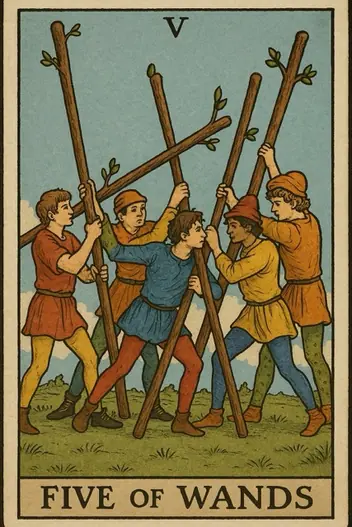
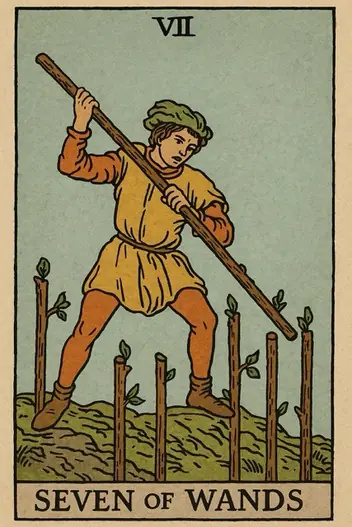
When the Five of Wands—the archetype of chaotic competition, friction, and scattered energy—collides with the Seven of Wands—the card of defensive persistence, holding your ground, and proving your worth—you get a psychological snapshot of a person fighting on multiple fronts. This is not a passive conflict; it is a dynamic state of active resistance against internal and external pressures. The key insight here is that the seeker is not just battling others; they are wrestling with their own unresolved need for validation and clarity of purpose.
The Five of Wands represents the initial spark of friction—a clash of ideas, egos, or agendas that creates noise and confusion. The Seven of Wands then demands that you choose which battles are worth your energy and which are simply distractions. Together, they form a powerful call to filter chaos through strategic defiance. The psychological task is to move from reactive scrapping to deliberate positioning—to stop swinging at every opponent and instead fortify the one hill that matters most to your long-term identity.
What Do Five of Wands and Seven of Wands Mean Together?
The core dynamic of the Five of Wands and Seven of Wands is a psychological tug-of-war between diffusion and focus. The Five of Wands scatters your attention across multiple conflicts, often driven by ego inflation or a fear of being overlooked. It tempts you to prove yourself in every arena, leading to burnout and diluted efforts. The Seven of Wands then acts as a reality check: you cannot hold every position, so you must consolidate your defenses around what you truly value. This combination reveals a person who is simultaneously overstimulated and under-resourced—their energy is high, but their strategy is weak.
From a Jungian perspective, this pairing often points to a shadow conflict with the "Puer Aeternus" (eternal youth) archetype—the part of us that wants to fight for novelty and excitement without committing to a single path. The Seven of Wands forces you to confront the pain of commitment: choosing one stance means disappointing others and risking failure. The healthy resolution is to channel the Five of Wands' raw competitive drive into the Seven of Wands' disciplined defense. In practice, this means identifying your non-negotiables—the beliefs, boundaries, or projects you will defend—and letting the rest fall away. The psychological reward is a clearer sense of self and a reduction in the anxiety that comes from trying to win everywhere at once.
Career and Finances
Strategic Opportunities:
This is a prime time to clarify your professional niche or unique value proposition. The friction of the Five of Wands can reveal gaps in the market that you can exploit if you focus your defense.
Strategic Opportunities:
Use the Seven of Wands energy to strengthen your boundaries around your time and energy. Say "no" to projects that don't align with your core skills, even if they seem lucrative.
Calculated Risks:
Avoid engaging in public disputes or office politics unless you have a clear, defensible position. The risk of reputational damage is high if you fight without a strategy.
In a career context, this card pair often appears when you are competing for a promotion, a client, or a creative project in a crowded field. The Five of Wands highlights the noise and rivalry in your industry, while the Seven of Wands demands that you hold your ground against critics or naysayers. The psychological trap is overextending yourself—trying to prove your worth by taking on too many battles. The strategic advice is to focus on a single, high-impact initiative and defend it with evidence of your past success. Financially, avoid speculative investments that rely on short-term wins; instead, fortify your existing assets and focus on steady growth. A critical warning: if you feel a compulsive need to "win" every negotiation, you risk alienating allies who could become long-term collaborators. The pragmatic move is to frame your defense as a value proposition: "I am protecting this project because it generates X revenue," rather than "I am right and you are wrong."
Your pair is already on the table. Ask your question and draw the clarifying card
or simply focus on it
Five of Wands and Seven of Wands in Love Tarot
If you are single:
This combination suggests you may be attracted to drama or high-stakes dynamics that feel exciting but are ultimately draining. The real challenge is to distinguish between a worthy competitor and a toxic provocateur.
If you are in a relationship:
The dynamic here often involves power struggles over control or autonomy. One or both partners may feel the need to "win" arguments, creating a cycle of defense and counterattack.
In relationships, the Five of Wands and Seven of Wands together signal a period of heightened tension where every interaction feels like a minor battle. The psychological root is often unexpressed vulnerability: instead of stating a need for reassurance or space, partners fight over trivial issues. The Seven of Wands aspect can manifest as rigid defensiveness—a refusal to compromise that masks a deeper fear of being dominated or dismissed. The key relationship advice here is to separate the conflict from the person. Recognize that the "enemy" is not your partner but the unresolved pattern of competition you have both fallen into. Pragmatic steps include setting a "time-out" signal when arguments escalate, and explicitly stating your emotional goal before discussing a sensitive topic. For example, say: "I need to feel heard, not win this point." This reframes the battle as a collaborative effort to protect the relationship, rather than a zero-sum game.
Deepen your understanding
Find out exactly what this reading means for your current life situation with our oracle.
What If Five of Wands or Seven of Wands Appears Reversed?
When the Five of Wands is reversed, the internal struggle goes underground. Instead of open competition, you encounter passive aggression and sabotage. Your potential is blocked not by external enemies, but by your own fear of conflict. Advice: conduct an "inventory" of your suppressed ambitions — what are you afraid to stand up for?
If the Seven of Wands is reversed, it signals a surrender without a fight. You give up your position without even trying to hold it. This could be either a wise retreat or cowardice. Warning: check whether you are confusing strategic flexibility with self-destruction.
When BOTH cards are reversed, the dynamic is completely unbalanced. You are simultaneously the aggressor and the victim, leading to emotional exhaustion and paralysis of will. The only way to correct the situation is to step out of the game. Temporarily abandon any struggle, restore your resources, and only then decide whether it's worth returning to the battlefield.
What Are the Risks of Five of Wands and Seven of Wands?
The shadow side of this combination emerges when the seeker becomes trapped in a cycle of perpetual conflict—fighting for the sake of fighting, mistaking aggression for strength. This often stems from a cognitive bias known as "hostile attribution bias," where neutral situations are misread as personal attacks. The Five of Wands' chaotic energy can fuel paranoia and hyper-vigilance, making it impossible to trust collaborators or partners. Meanwhile, the Seven of Wands' defense mechanism can harden into rigid stubbornness, where the seeker refuses to adapt even when the ground has shifted beneath them. This leads to self-sabotage: burning bridges, exhausting resources, and alienating support. The psychological root is often unresolved shame or a fragile ego that cannot tolerate being wrong or vulnerable. If you find yourself constantly "defending your position" in conversations, ask yourself: Am I protecting my values, or am I protecting my pride? The shadow path is a lonely, draining battle where you win small skirmishes but lose the war for peace and connection.
What Is the Overall Message of Five of Wands and Seven of Wands?
Constructive use of this pair requires redirecting energy from defense to offense, but with a clear strategy. The Five of Wands gives you drive and readiness for competition. The Seven of Wands provides focus and discipline. Your task is to combine these qualities to achieve a specific goal, rather than endlessly holding your position.
The key strategic advice: use your mobilization as a springboard, not a trench. Determine which "height" you want to take, and channel all your energy toward it. If you feel stuck in defense, ask yourself: "What will I gain if I stop defending and start attacking?" Often the answer is freedom and growth. Don't be afraid to temporarily lower your guard to make a leap forward. Remember: the best defense is a good offense, but only if it leads to your goal, not to a new conflict.
Your Next Step: Personal Context Matters
The Five of Wands and Seven of Wands together deliver a clear message: stop fighting every battle and start fortifying the ones that define you. This is a call to strategic discernment—to use the raw energy of competition to sharpen your focus, not scatter your efforts. The psychological payoff is a stronger sense of identity and the confidence that comes from knowing what you stand for. But this general interpretation is only the starting point. The true power of Tarot lies in its ability to speak directly to your unique situation—your specific question, your personal history, and your current emotional state.
For a deep, personalized interpretation of this exact combination tailored to your question, use the Fortune Cards app. Whether you're navigating a tricky career decision, a relationship conflict, or a moment of self-doubt, the app applies these archetypes to your context with precision. You can use it on the web or download it to get the clarity you need—right now.
Interpretation by the Fortune Cards editorial team, based on the Rider–Waite tradition and Jungian archetypes. About our methodology · Updated: 2026-08-26
Other Combinations with Five of Wands
Other Combinations with Seven of Wands
Explore Individual Card Meanings
Table of Contents
- What Do Five of Wands and Seven of Wands Mean Together?
- Career and Finances
- Five of Wands and Seven of Wands in Love Tarot
- What If Five of Wands or Seven of Wands Appears Reversed?
- What Are the Risks of Five of Wands and Seven of Wands?
- What Is the Overall Message of Five of Wands and Seven of Wands?
- Your Next Step: Personal Context Matters
Ready to find answers to your questions?
Start your first reading now and look at your situation with fresh clarity. The cards are ready to reveal deeper meaning.