Five of Wands and Three of Cups Tarot Combination

- Arcana
- Five of Wands — Minor Arcana, Wands; Three of Cups — Minor Arcana, Cups
- Elements
- Five of Wands — Fire; Three of Cups — Water
- Elemental interaction
- Opposing elements — energies create tension
- Numerology
- 5 + 3 = 8
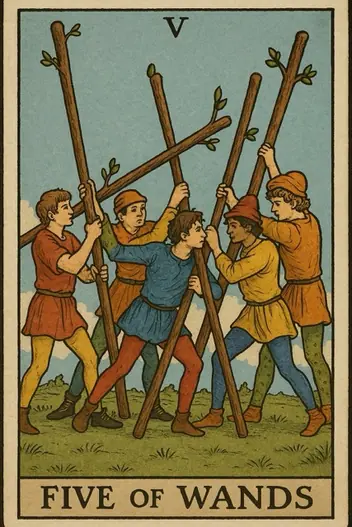
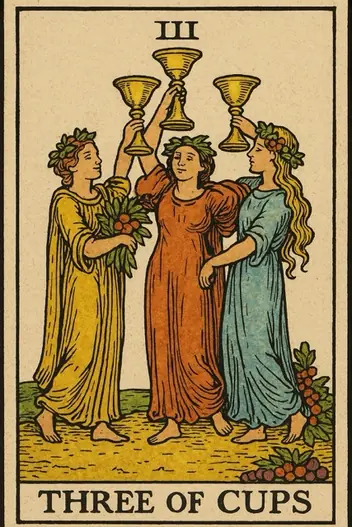
When the Five of Wands collides with the Three of Cups, you face a psychological paradox: the drive to compete versus the need to connect. The Five of Wands represents conflict, rivalry, and the friction of diverse agendas clashing. The Three of Cups, conversely, embodies celebration, friendship, and emotional solidarity. Together, they signal a situation where you must navigate competitive dynamics within a social or collaborative context—whether that’s a team project, a friend group, or a romantic relationship where both partners have strong individual ambitions.
This combination demands emotional agility: the ability to assert your own position without destroying the bonds that hold the group together. It’s not about avoiding conflict but about channeling competitive energy into productive, shared outcomes. The key psychological insight here is that healthy competition can strengthen relationships when managed with clear communication and mutual respect.
Five of Wands and Three of Cups Together: Meaning
The core dynamic of the Five of Wands and Three of Cups is structured friction within a supportive framework. You are likely in a situation where multiple people are vying for recognition, resources, or leadership, yet there is an underlying expectation of camaraderie and shared success. This creates a tension between individual achievement and group harmony.
Psychologically, this pairing activates the archetype of the "Golden Rival"—someone who pushes you to grow through challenge, not hostility. The shadow side is the risk of turning collaboration into a zero-sum game, where winning becomes more important than the relationship. The healthy expression is a team that debates fiercely but celebrates together afterwards. You must distinguish between productive disagreement and personal attacks.
The Three of Cups as the anchor suggests that the social bond is strong enough to withstand the heat of the Five of Wands. However, this is not a guarantee. Without active emotional intelligence, the conflict can erode trust. The strategic approach is to set explicit boundaries around how disagreements are handled and to schedule time for collective celebration after difficult discussions. This ensures that the competitive energy serves the group’s goals rather than fracturing it.
Your pair is already on the table. Ask your question and draw the clarifying card
or simply focus on it
Five of Wands and Three of Cups in Career Readings
Strategic Opportunities:
Use this energy to lead a team through a challenging project where healthy debate can improve outcomes. Your ability to mediate conflict will be noticed.
Strategic Opportunities:
This is an ideal time to network within competitive industries—conferences, pitch events, or industry meetups where you can showcase your skills while building alliances.
Calculated Risks:
Avoid taking sides in office politics or engaging in gossip. The Three of Cups warns that social bonds are fragile; a misstep can isolate you.
Professionally, this combination signals a high-stakes collaboration. You may be part of a team where roles are unclear or where multiple people want the same promotion. The winning strategy is to differentiate yourself through contribution, not confrontation. Bold important financial warning: Do not sacrifice long-term professional relationships for short-term gains. The Five of Wands can tempt you to cut corners or undermine others, but the Three of Cups reminds you that reputation and network are your most valuable assets. For financial planning, this is a time to negotiate terms clearly and document agreements to prevent misunderstandings. Seek compensation structures that reward both individual performance and team success.
Five of Wands and Three of Cups as Feelings
If you are single:
This pairing suggests you may meet someone through a competitive or group setting—a shared hobby, a work project, or a friend’s gathering. The challenge is to distinguish between playful rivalry and genuine connection; don’t mistake the excitement of competition for romantic chemistry.
If you are in a relationship:
You and your partner may be navigating differing ambitions or social circles that create friction. The core task is to support each other’s individual goals without feeling threatened by the other’s success.
In relationships, the Five of Wands and Three of Cups point to a dynamic where both partners have strong personalities and competing priorities. This is not inherently negative—it can be the engine of a vibrant, growth-oriented partnership. The critical factor is how you manage disagreements. Bold key relationship advice: Schedule regular "alignment meetings" where you discuss goals and conflicts without blame, and prioritize shared rituals of celebration (date nights, shared hobbies) to reinforce your bond. Avoid the pitfall of keeping score; instead, focus on co-creating a win-win scenario where both partners feel heard and valued.
Get a personalized interpretation
Unlock the combined meaning of your cards in the context of your unique question — for free.
Negative Meaning of Five of Wands and Three of Cups
The shadow manifestation of this pairing is toxic competition disguised as camaraderie. You may find yourself in a "frenemy" dynamic where rivals smile to your face while working against you behind your back. The cognitive bias at play is the "false consensus effect" —assuming that because everyone is celebrating together, there is no underlying conflict. This leads to poor judgment: trusting the wrong people, over-sharing strategic information, or being blindsided by betrayal.
Another pitfall is over-identifying with the role of the "peacemaker" to the point of suppressing your own needs. The Three of Cups can tempt you to avoid necessary conflict to maintain a pleasant social atmosphere, while the Five of Wands energy builds resentment underneath. Self-sabotage occurs when you prioritize being liked over being effective. You must recognize when "keeping the peace" is actually enabling dysfunction. The psychological defense mechanism here is "reaction formation" —acting overly friendly to mask competitive hostility. The solution is radical honesty with yourself and others about your true intentions.
Five of Wands and Three of Cups Reversed Meaning
Five of Wands Reversed:
Competition becomes passive-aggressive. Instead of open argument — sabotage, gossip, and intrigue. Advice: channel the conflict into an open outlet. If you sense hidden tension, initiate a direct conversation, otherwise the energy will destroy the team from within.
Three of Cups Reversed:
Social isolation. You may win the battle, but end up alone. This is the state of "the winner whom nobody loves." Warning: your perfectionism and desire to be the best push people away. Lower the bar and allow yourself to be vulnerable.
BOTH Reversed:
Complete imbalance. This is chaos where there are neither rules of the game nor joy. A person fights with everyone without purpose and derives no pleasure from it. The logical way to correct this is a complete stop. Take a time-out, withdraw from all conflicts and social groups for 1-2 days. Re-establish contact with yourself before attempting to compete or befriend others.
Overall Meaning of Five of Wands and Three of Cups
How to constructively use this energy? The key lies in conscious mode-switching. The Five of Wands is the "Focus and Drive" mode. The Three of Cups is the "Recovery and Connection" mode. Your task is to become the director who switches between scenes. You cannot be a warrior 24/7, nor can you celebrate constantly.
Strategic advice: adopt the "80/20" rule. Dedicate 80% of your time in any group (team, family) to achieving goals, competition, and problem-solving (Five). The remaining 20% of time must be devoted to rituals unrelated to outcomes: shared meals, celebrations, informal communication (Three). This prevents burnout and transforms the collective into a resilient ecosystem.
If you feel stuck in conflict, ask yourself: "What am I defending? My status or my idea?" The Five of Wands often fights for the ego, while the Three of Cups reminds us that ideas only live within a community. Your strength lies not in defeating others, but in your ability to create value with them. Use competition as fuel for growth, and friendship as a safety net. Only then will you achieve sustainable success that is not only visible but also enjoyable.
Where to Go From Here
The Five of Wands and Three of Cups together deliver a clear message: you can win without losing your connections, but only if you maintain self-awareness and strategic discipline. The core lesson is to embrace competition as a catalyst for growth, not a threat to relationships. Whether in love, career, or personal development, this pairing asks you to hold two truths simultaneously: your ambition matters, and so do the bonds you share with others.
Your unique situation requires a tailored interpretation. While this article provides the general archetype, the true power of Tarot comes from applying it to your specific question. Use the Fortune Cards app to get a deep, personalized reading of this exact combination for your relationship, career, or personal challenge. The app analyzes your context and delivers actionable insights—not generic meanings. Download Fortune Cards now or use it on the web to transform this archetypal knowledge into a concrete plan for your next step.
Interpretation by the Fortune Cards editorial team, based on the Rider–Waite tradition and Jungian archetypes. About our methodology · Updated: 2026-09-17
Other Combinations with Five of Wands
Other Combinations with Three of Cups
Explore Individual Card Meanings
Table of Contents
- Five of Wands and Three of Cups Together: Meaning
- Five of Wands and Three of Cups in Career Readings
- Five of Wands and Three of Cups as Feelings
- Negative Meaning of Five of Wands and Three of Cups
- Five of Wands and Three of Cups Reversed Meaning
- Overall Meaning of Five of Wands and Three of Cups
- Where to Go From Here
Ready to find answers to your questions?
Start your first reading now and look at your situation with fresh clarity. The cards are ready to reveal deeper meaning.