Five of Wands and Two of Cups Reversed in Tarot
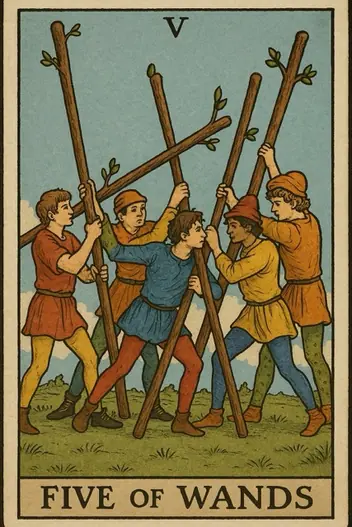

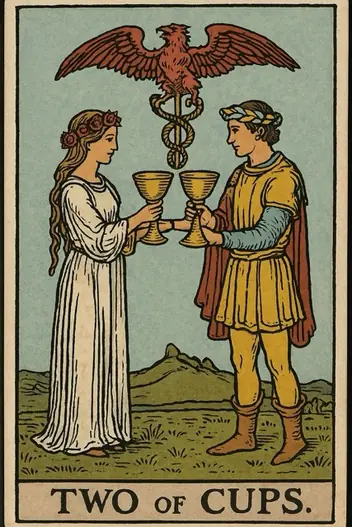
- Arcana
- Five of Wands — Minor Arcana, Wands; Two of Cups — Minor Arcana, Cups
- Elements
- Five of Wands — Fire; Two of Cups — Water
- Elemental interaction
- Opposing elements — energies create tension
- Numerology
- 5 + 2 = 7
This card pair presents a fascinating psychological tension: the raw, competitive drive of the Five of Wands colliding with the harmonious, emotional bond of the Two of Cups. At first glance, they seem like opposites—one thrives on conflict, the other on unity. Yet, in real life, this combination often appears when you are navigating a relationship that is both a source of support and a battleground for differing agendas.
The core question here is not whether to fight or to love, but how to integrate these drives. You may feel a powerful pull toward someone—romantically or professionally—while simultaneously experiencing friction, rivalry, or a clash of egos. The key is to recognize that healthy conflict can strengthen a bond, provided both parties maintain mutual respect and a shared goal.
Five of Wands and Two of Cups Together: Meaning
When the Five of Wands and Two of Cups appear together, the psychological state is one of creative tension. You are not dealing with pure opposition or pure harmony; rather, you are in a dynamic where competition and collaboration coexist. This is common in high-stakes environments where people must work closely together yet have competing interests—think co-founders, creative partners, or romantic rivals.
The Five of Wands represents the ego's need to assert itself, to win, or to prove superiority. The Two of Cups represents the heart's desire for connection, reciprocity, and emotional safety. The conflict arises when these two drives point in different directions. For example, you may want to win an argument (Five of Wands) but also want to preserve the relationship (Two of Cups). The mature response is to channel competitive energy into constructive collaboration. Instead of fighting against each other, you fight for a shared outcome.
This combination often signals a power struggle disguised as a partnership. The key insight is that the tension is not inherently destructive—it can fuel innovation, passion, and mutual growth. The danger lies in letting the Five of Wands dominate, turning the relationship into a zero-sum game. Psychological maturity here means recognizing when to step back from the fight and re-establish the connection.
Five of Wands and Two of Cups: Career and Money
Strategic Opportunities:
Leverage internal competition for innovation. If you are in a team, use friendly rivalry to push performance. Frame challenges as a race to improve, not a fight for survival.
Strategic Opportunities:
Negotiate from a place of partnership. The Two of Cups suggests that a potential collaborator or client is open to a mutual win. Use the Five of Wands' assertiveness to make your case, but always propose solutions that benefit both sides.
Calculated Risks:
Avoid zero-sum thinking. If you view every negotiation as a battle to be won, you may damage a valuable long-term relationship. Do not let ego override economic sense.
Professionally, this combination often appears during team conflicts, negotiations, or competitive bids. The energy is high, and the stakes are personal. The Five of Wands can drive you to fight for a promotion or a deal, but the Two of Cups reminds you that reputation and relationships matter. A key strategic insight: use the conflict to clarify terms, not to destroy trust. If you are negotiating a contract, for example, the Five of Wands energy helps you push for better terms, while the Two of Cups energy ensures you maintain a collaborative tone.
Bold important financial warning: Beware of "frenemy" dynamics in business—partners who appear supportive but are secretly competing. Verify loyalty through actions, not words.
Your pair is already on the table. Ask your question and draw the clarifying card
or simply focus on it
Five of Wands and Two of Cups as Feelings
If you are single:
This pair suggests you may be attracted to someone who is also a rival—a person who challenges you intellectually or socially. Evaluate whether the friction is exciting or draining. Do not mistake adrenaline for chemistry.
If you are in a relationship:
You and your partner may be in a cycle of arguing and reconciling. The underlying issue is often a disagreement over power or priorities rather than a lack of love.
In a committed relationship, the Five of Wands and Two of Cups indicate a need for emotional intelligence and conflict resolution skills. The passion is there, but it is being expressed through heated debates, jealousy, or competition for attention. The most important advice is to separate the issue from the person. Attack the problem, not your partner. Use the competitive energy of the Five of Wands to solve external challenges together—like planning a move, managing finances, or competing in a hobby—rather than turning on each other.
Bold key relationship advice: Establish clear boundaries for fair fighting. Agree on rules—no name-calling, no bringing up past grievances. Channel the Five of Wands' fire into a shared project that benefits both of you.
When Five of Wands and Two of Cups Signal Trouble
When the energy of this combination is blocked or handled poorly, it manifests as toxic competition or codependency. The shadow of the Five of Wands is a need to win at all costs, turning every relationship into a power struggle. The shadow of the Two of Cups is an over-idealization of connection, where you tolerate dysfunction because you fear losing the bond. Together, they can create a cycle of love-bombing and fighting—intense highs followed by destructive lows.
Cognitive biases to watch for:
Confirmation bias (you interpret your partner's actions as hostile because you expect conflict) and the "sunk cost" fallacy (you stay in an unhealthy dynamic because you have invested so much emotionally). The biggest pitfall is mistaking drama for passion. If the relationship feels like a battlefield more than a partnership, step back and ask: Is this truly mutual growth, or just mutual exhaustion?
Uncover hidden insights
Let our advanced Tarot system interpret these archetypes specifically for your personal path.
Five of Wands and Two of Cups Reversed: How to Read It
If the Five of Wands is reversed:
The conflict becomes passive-aggressive. Instead of open argument, there are underhanded games and sabotage. This blocks the possibility of a healthy partnership. Advice: start small — voice one disagreement out loud to break the cycle of silent confrontation.
If the Two of Cups is reversed:
Internal resistance to intimacy. You may avoid connection, even when it is clearly beneficial. The reason is a fear of losing autonomy. Conduct an audit: what exactly are you afraid of in partnership? This will help separate real risks from illusory ones.
If BOTH are reversed:
Complete imbalance. Conflict destroys any possibility of dialogue, and the desire for connection leads to codependency. This is a "toxic seesaw" scenario. A logical way to correct it: introduce a "third party" — a mediator, coach, or therapist who can help structure the interaction. It is extremely difficult to break out of this cycle on your own.
Five of Wands and Two of Cups: Tarot Advice
Constructive use of this pair's energy requires a conscious switching between "warrior" and "ally" modes. The Five of Wands gives you the energy to assert your interests, but without the Two of Cups, it turns into endless warfare. The Two of Cups gives you the capacity for empathy and cooperation, but without the Five of Wands, it leads to loss of self.
Strategic advice: use the principle of "arguing for closeness." Instead of avoiding disagreements, initiate them with a clear goal — to find the best solution, not to prove you are right. Ask the question: "How can this conflict strengthen our bond?" This channels the energy from a destructive course into a constructive one.
Your main resource is the ability to withstand tension and transform it into trust. Every resolved argument is an investment in the relationship's capital. The more you prove your reliability in moments of disagreement, the stronger the union becomes. Do not fear conflicts — fear their absence, which signifies stagnation. Use the Five of Wands as fuel, and the Two of Cups as the route map.
Where to Go From Here
The Five of Wands and Two of Cups together tell a story of passionate tension—the kind that can either forge a stronger bond or break it. The outcome depends entirely on your ability to balance assertiveness with empathy, and competition with collaboration. This is not a card pair that offers easy answers; it demands that you act with both courage and heart.
Ready to apply this insight to your specific situation? The Fortune Cards app can give you a personalized, deep-dive reading of this exact combination based on your unique question—whether it's about a relationship, a career move, or a personal conflict. Stop guessing how the archetypes apply to you. Use the app on the web or download it now to get a tailored interpretation that cuts through the noise and gives you a clear, actionable next step.
Interpretation by the Fortune Cards editorial team, based on the Rider–Waite tradition and Jungian archetypes. About our methodology · Updated: 2026-09-17
Other Combinations with Five of Wands
Other Combinations with Two of Cups
Explore Individual Card Meanings
Table of Contents
- Five of Wands and Two of Cups Together: Meaning
- Five of Wands and Two of Cups: Career and Money
- Five of Wands and Two of Cups as Feelings
- When Five of Wands and Two of Cups Signal Trouble
- Five of Wands and Two of Cups Reversed: How to Read It
- Five of Wands and Two of Cups: Tarot Advice
- Where to Go From Here
Ready to find answers to your questions?
Start your first reading now and look at your situation with fresh clarity. The cards are ready to reveal deeper meaning.