The Fool and Eight of Swords Meaning in Tarot

- Arcana
- The Fool — Major Arcana; Eight of Swords — Minor Arcana, Swords
- Elements
- The Fool — Air; Eight of Swords — Air
- Elemental interaction
- Same element — energies intensify each other
- Numerology
- 0 + 8 = 8
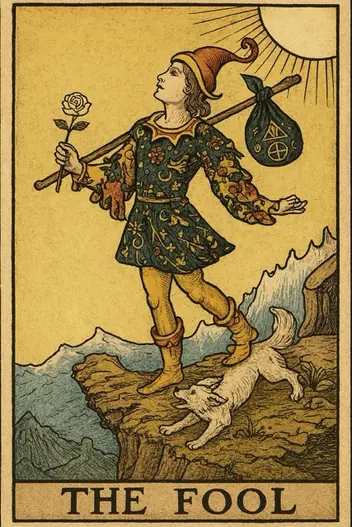
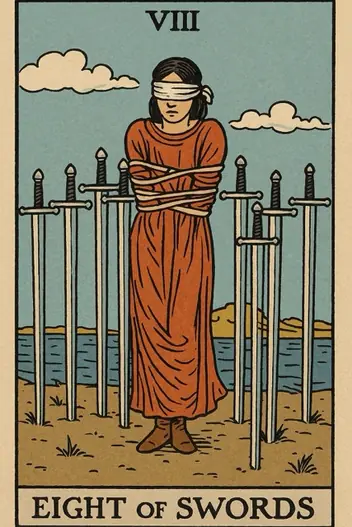
When The Fool—the archetype of blind optimism, new beginnings, and reckless trust—meets the Eight of Swords—the card of mental entrapment, self-imposed limits, and anxious paralysis—you get a powerful tension between impulsive action and frozen fear. This pairing often signals a moment where the seeker stands at a precipice, ready to leap into the unknown, but their own thoughts have tied them up in knots. Pragmatically, this is not about fate or external obstacles; it is about the internal war between your desire for freedom and your fear of making a mistake. The core question becomes: Are you truly trapped, or have you convinced yourself that you are?
In real-world terms, this combination shows up when someone has a brilliant, risky idea—a career change, a relationship leap, a creative venture—but is paralyzed by over-analysis. The Fool says "just go," while the Eight of Swords whispers "but look at all the dangers." The psychological collision here is between the ego's need for safety and the self's need for growth. To navigate this, you must separate genuine risks from imagined ones, and decide whether the leap is a courageous step forward or a naive stumble backward.
The Fool and Eight of Swords Together: Meaning
The core dynamic of The Fool and Eight of Swords is a cognitive dissonance between potential and perception. The Fool represents untapped potential, a clean slate, and the willingness to be a beginner. The Eight of Swords represents a mind that has built a prison of "what ifs," "shoulds," and "can'ts." Together, they reveal that the seeker's greatest obstacle is not the external world, but their own internal narrative. You may feel bound by ropes of doubt, but in reality, those ropes are made of thought patterns you can untie.
Psychologically, this is a classic approach-avoidance conflict: you want to move forward (The Fool), but you're terrified of the consequences (Eight of Swords). The key insight is that the Eight of Swords' blindness is self-inflicted. The blindfold on the figure in the card symbolizes a refusal to see the truth that the path is open. When combined with The Fool's naivety, this can lead to one of two outcomes: either you break free by challenging your limiting beliefs, or you leap without seeing the real risks. The strategic move is to identify which fears are rational and which are echoes of past trauma or social conditioning. Write down your fears, then ask: "Is this a real, tangible threat, or an imagined worst-case scenario?" This simple act of cognitive reframing can turn paralysis into informed action.
Your pair is already on the table. Ask your question and draw the clarifying card
or simply focus on it
The Fool and Eight of Swords in Love and Relationships
If you are single:
This combination suggests you are either idealizing a new connection (The Fool) while ignoring red flags, or you are so afraid of rejection that you avoid making the first move. The pragmatic advice: take a small, calculated risk—send a message or ask a question—but keep your eyes open for patterns of avoidance in the other person.
If you are in a relationship:
You may be trapped in a dynamic where one partner wants to "shake things up" (The Fool) while the other is stuck in fear of change (Eight of Swords). This often manifests as one person feeling suffocated by the other's anxiety, or one partner making impulsive decisions without consulting the other.
In a relationship context, The Fool and Eight of Swords points to a power imbalance in risk tolerance. One partner may feel the relationship is stagnant and wants to inject novelty—travel, a new commitment, a difficult conversation. The other partner may be paralyzed by fear of losing what they have, leading to defensive withdrawal or passive-aggressive control. The psychological trap here is projection: the fearful partner may accuse the other of being reckless, while the impulsive partner may dismiss the other's fears as irrational. Healthy resolution requires both partners to validate each other's perspectives. The fearful partner must acknowledge that growth requires some risk, while the impulsive partner must respect that change should be negotiated, not imposed. Set a boundary: agree on one small change to try for a week, then evaluate together. This turns the leap into a step.
Deepen your understanding
Find out exactly what this reading means for your current life situation with our oracle.
The Fool and Eight of Swords: Career and Money
Strategic Opportunities:
Use your beginner's mind (The Fool) to question outdated processes. Your naivety is an asset—ask "why do we do it this way?" to uncover inefficiencies others have accepted.
Strategic Opportunities:
Identify one limiting belief about your career (e.g., "I'm not qualified for that promotion") and test it with objective evidence. You may find the cage is locked only in your mind.
Calculated Risks:
Avoid making a major financial move (quitting a job, investing heavily) while you feel panicked or trapped. The Eight of Swords clouds judgment. Wait until you can see the path clearly.
In your professional life, this combination often appears when you are considering a bold career pivot but feel stuck in your current role. The Fool encourages you to trust your instincts, but the Eight of Swords warns that your anxiety is distorting your perception of risk. A pragmatic approach is to conduct a "fear audit": list the worst realistic outcomes of making a change, then list the worst outcomes of staying stuck. Often, the fear of change is greater than the actual risk. For financial planning, this pair suggests you may be ignoring a simple solution because it feels "too easy" or "too risky." For example, you might be overcomplicating a side hustle idea because you're afraid of failing. The strategic move is to take one small, reversible step—research a market, talk to a mentor, save a specific amount—rather than leaping blindly. Remember: the Eight of Swords' blindfold comes off when you stop looking at the ground and start looking at the horizon.
The Shadow Side of The Fool and Eight of Swords
The shadow side of The Fool and Eight of Swords is reckless naivety disguised as liberation, or paralyzing fear disguised as caution. When these energies are blocked, the seeker may leap into a situation without any preparation, ignoring real red flags because they are "following their heart." This can lead to avoidable disasters—quitting a job without savings, entering a toxic relationship, or making a major purchase on impulse. Conversely, the shadow can manifest as intellectualizing fear: convincing yourself that you are "being strategic" when you are actually just avoiding growth. This is a classic cognitive bias known as "analysis paralysis," where the seeker gathers endless data to avoid making a decision. The pitfall is that both extremes—blind action and frozen inaction—lead to the same place: regret. The Fool's shadow is immaturity; the Eight of Swords' shadow is victimhood. Together, they can create a cycle where you either act out of fear of missing out, or you stay stuck out of fear of failure. The antidote is radical self-honesty: ask yourself, "Am I being brave or being foolish? Am I being careful or being cowardly?"
The Fool and Eight of Swords Reversed: How to Read It
If The Fool is Reversed:
The potential is blocked not by fear, but by apathy and recklessness. The person isn't "afraid to start," but rather "starts and quits." The Eight of Swords in its upright position here indicates that fear is an excuse for laziness. Advice: focus on discipline, not inspiration.
If the Eight of Swords is Reversed:
Internal resistance weakens, but external pressure appears. You may feel ready to take the leap (The Fool), but circumstances (work, family) objectively hinder you. Key advice: don't fight the system head-on; look for workarounds.
If BOTH are Reversed:
Complete imbalance and chaos. This is a state of "learned helplessness," where a person sees neither opportunities (The Fool) nor ways out (Eight of Swords). The most dangerous scenario, requiring intervention from a coach or psychologist. Immediate strategy: focus on gaining control over one micro-area of life (cleaning, exercise, sleep schedule) to restore a sense of agency.
The Fool and Eight of Swords: Tarot Advice
Constructive use of this dynamic requires a paradoxical approach: embrace the logic of the Fool, but act with the methodicalness of the Eight of Swords. Your task is not to "kill" fear, but to use it as a map of the terrain. Fear points to a zone of growth. If you fear public speaking (the Eight), the Fool advises starting with a 15-second video for social media, not a speech in a stadium.
Strategically, this pair of cards teaches "conscious risk-taking." You cannot eliminate all uncertainty (the Fool), but you can limit the blast radius (the Eight). Create a "safety net": financial, temporal, emotional. Allocate a budget for the experiment and clearly define the point of no return. The main takeaway: your freedom begins precisely at the moment you acknowledge that your "chains" are merely thoughts. The Fool provides the energy to break them, the Eight of Swords the clarity to understand which of them are real.
Applying This to Your Situation
The Fool and Eight of Swords is a powerful reminder that the only real cage is the one you build with your own thoughts. Your next step is to separate the signal from the noise: identify one specific fear that is holding you back, and ask whether it is a genuine risk or a self-limiting belief. If it is a real risk, plan for it. If it is a belief, challenge it. The path forward is not about blind leaps or total paralysis—it is about informed courage.
While this article gives you the general archetype, the true power of Tarot lies in applying it to your precise situation. Your unique question, relationship, or career crossroads deserves a reading that considers your specific context. Use the Fortune Cards app to get a deep, personalized interpretation of The Fool and Eight of Swords for your exact question right now. Available on the web or as a download, it turns these timeless symbols into actionable insight for your life. Stop guessing—start understanding.
Interpretation by the Fortune Cards editorial team, based on the Rider–Waite tradition and Jungian archetypes. About our methodology · Updated: 2026-08-26
Other Combinations with The Fool
Other Combinations with Eight of Swords
Explore Individual Card Meanings
Table of Contents
- The Fool and Eight of Swords Together: Meaning
- The Fool and Eight of Swords in Love and Relationships
- The Fool and Eight of Swords: Career and Money
- The Shadow Side of The Fool and Eight of Swords
- The Fool and Eight of Swords Reversed: How to Read It
- The Fool and Eight of Swords: Tarot Advice
- Applying This to Your Situation
Ready to find answers to your questions?
Start your first reading now and look at your situation with fresh clarity. The cards are ready to reveal deeper meaning.