Four of Cups and Ace of Swords Meaning in Tarot
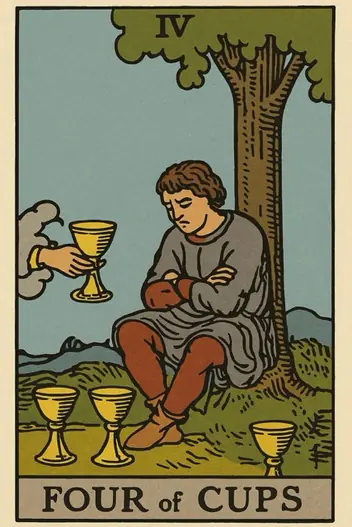

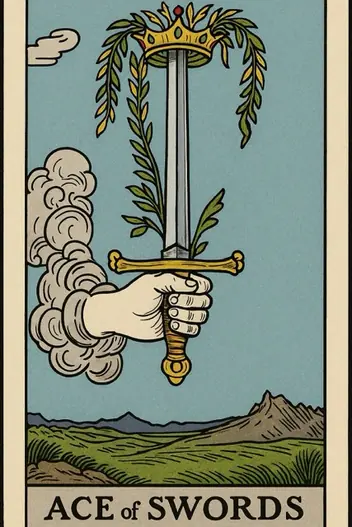
- Arcana
- Four of Cups — Minor Arcana, Cups; Ace of Swords — Minor Arcana, Swords
- Elements
- Four of Cups — Water; Ace of Swords — Air
- Elemental interaction
- Neutral elements — energies coexist without conflict
- Numerology
- 4 + 1 = 5
The Four of Cups represents a state of emotional withdrawal, apathy, and missed opportunities. It is the archetype of the disenchanted dreamer—someone who has become so accustomed to disappointment or routine that they fail to see a new offer right in front of them. The Ace of Swords, by contrast, is the archetype of mental clarity, truth, and decisive action. It cuts through confusion like a scalpel.
When these two cards collide in a reading, the psychological tension is palpable. You are likely feeling stuck or bored, yet the solution is not more emotional stimulation—it is a sharp, objective reevaluation of your current situation. The Ace of Swords demands that you stop wallowing in the Four of Cups’ passive discontent and instead use logic to identify what you are truly refusing to see. This combination forces a confrontation between your emotional stagnation and your rational potential.
Four of Cups and Ace of Swords: How These Energies Interact
The core dynamic here is the clash between emotional inertia and intellectual breakthrough. The Four of Cups often signals a period of depressive realism—you see the flaws in everything, so you stop trying. The Ace of Swords enters as a corrective force, but it is not gentle. It demands that you cut the cord of your own self-pity and look at the situation with brutal honesty.
Psychologically, this is a moment of cognitive restructuring. You may be holding onto a grievance or a sense of entitlement (Four of Cups) that is blinding you to a clear, actionable truth (Ace of Swords). The question is: are you ready to trade your comfortable discontent for a sharp, uncomfortable clarity? The risk is that you use the Ace of Swords’ sharpness to criticize yourself further, turning a tool of liberation into a weapon of self-attack.
In practical terms, this combination suggests that a new idea, perspective, or piece of information is about to break through your apathy. You may receive a blunt message, a direct question, or a sudden realization that makes your previous complaints seem trivial. The key is to receive this clarity without defensiveness. If you can do that, you will move from passive waiting to active problem-solving.
Your pair is already on the table. Ask your question and draw the clarifying card
or simply focus on it
Four of Cups and Ace of Swords in Love and Relationships
If you are single:
This combination warns against dismissing potential partners out of hand. Your current “been there, done that” attitude may be causing you to reject someone who actually offers a different dynamic. Pause before saying “no.”
If you are in a relationship:
Expect a conversation that cuts to the core of a long-standing issue. Your partner may deliver an uncomfortable truth, or you may finally articulate a boundary you have been avoiding.
In relationships, the Four of Cups and Ace of Swords often signal a period of emotional detox. You or your partner may have been coasting on autopilot, ignoring small resentments or unmet needs. The Ace of Swords forces these issues into the open. The healthiest response is to treat this as a problem-solving exercise, not an attack. Use clear, “I” statements and avoid emotional accusations. If you can discuss the issue with the same clinical precision you would use at work, you will resolve it faster.
Key relationship advice in bold:
This is not the time for grand romantic gestures or emotional pleas. It is a time for truth-telling and boundary-setting. If you are in a partnership, ask yourself: “What have I been too comfortable to admit?” If you are single, ask: “Am I confusing boredom with incompatibility?”
Ask your specific question
Don't rely on generic meanings. Get a customized reading tailored specifically to your energies.
Four of Cups and Ace of Swords for Career and Money
Strategic Opportunities:
A new project or role that requires sharp analytical skills. Your current dissatisfaction is a signal that you need a challenge that engages your mind, not just your emotions.
Strategic Opportunities:
Cutting unnecessary costs or processes. The Ace of Swords excels at streamlining. Look at your budget or workflow with a critical eye—there is likely a “sacred cow” you can eliminate.
Calculated Risks:
The risk is acting too hastily on a “brilliant” idea without considering the emotional fallout. A sudden resignation or a blunt email might feel liberating, but ensure you have a logical backup plan.
Professionally, this is a powerful combination for breaking through creative blocks or bureaucratic inertia. If you have been feeling stuck in a dead-end job or a stalled project, the Ace of Swords provides the mental clarity to pivot. Bold important financial warnings or strategic tips: Be wary of a “grass is greener” fallacy. The Four of Cups makes everything look dull, but the Ace of Swords’ clarity should be used to evaluate options objectively, not to justify a rash escape. Use a pros-and-cons list before making any career move.
The Shadow Side of Four of Cups and Ace of Swords
The shadow side of this combination is intellectual arrogance masking emotional avoidance. You may use the Ace of Swords’ sharpness to dissect every option until you find a reason to reject it, thereby remaining stuck in the Four of Cups’ apathy. This is a form of cognitive bias known as “paralysis by analysis.” You cut so finely that you bleed out all potential for action.
Another pitfall is using the truth as a weapon. The Ace of Swords can be wielded cruelly—to win an argument, to shame a partner, or to justify a cold, unfeeling decision. When combined with the Four of Cups’ underlying bitterness, this can lead to a toxic cycle of criticism and withdrawal. You may feel justified in your harshness because you are “right,” but you are ignoring the emotional cost.
Self-sabotage manifests here as perfectionism. You wait for the perfect idea (Ace of Swords) to solve your discontent (Four of Cups), but because no idea is flawless, you remain stuck. Recognize that clarity is a process, not a final state. Take the first logical step, even if it feels incomplete.
Four of Cups and Ace of Swords Reversed: What Changes?
The reversed position of the cards distorts their energy, transforming breakthroughs into chaos and apathy into prolonged suffering.
If the Four of Cups is reversed:
This points to recklessness and an inability to learn from mistakes. Instead of apathy, there is an impulsive pursuit of new sensations that leads to the same disappointments. Advice: you need to stop and analyze why you keep falling into the same traps. The Ace of Swords in this situation may be used to destroy constructive plans.
If the Ace of Swords is reversed:
This indicates internal resistance to the truth. The person knows the truth but refuses to acknowledge it, falling into self-deception. Clarity is replaced by confusion, and decisiveness by passive aggression. Warning: this position often points to harsh words spoken in anger, or to a paralysis of the will, where the "sword" is stuck in its sheath.
If BOTH are reversed:
Complete imbalance. Apathy turns into chaotic self-destruction, and clarity into paranoia and empty arguments. Logical way to correct: return to basic principles. You need to artificially create structure and order (a plan, a schedule, a list of goals) to compensate for the lack of an internal compass. Ignore emotions, focus on facts.
Four of Cups and Ace of Swords: Tarot Advice
How to constructively use this dynamic? The Four of Cups is your barometer of dissatisfaction. Do not try to suppress or ignore it. Instead, use it as a signal to activate the Ace of Swords. Your task is to transform passive longing into active intellectual inquiry. Ask yourself: "What exactly in my current situation causes rejection? What specific fact or decision am I avoiding?"
Strategic advice:
Do not wait for life to strike you with the Ace of Swords. Take the initiative into your own hands. Perform "mental surgery" yourself. Make a list of three things you tolerate but that drain you. Then, for each item, write down one concrete action that will change it. This is the practical application of the Ace of Swords to the apathy of the Four of Cups. You are not just dreaming of change—you are creating a plan for it.
Bottom line: this combination is not about suffering, but about releasing energy through truth. It requires the courage to be honest with yourself and the willingness to accept the consequences of that honesty. The energy of the Four of Cups, channeled into analysis, becomes not apathy, but a strategic pause before the decisive blow. Allow yourself this clarity. It is your most valuable asset right now.
Applying This to Your Situation
The core message of Four of Cups and Ace of Swords is: Your apathy is a symptom of a missing truth. You are not bored because life is boring; you are bored because you have refused to see the one clear option that is already in front of you. The solution is not more emotional input, but a disciplined, honest assessment of what you actually want. Stop waiting for inspiration to feel good—act on the clarity you already have.
While this article gives you the general archetype, the true power of Tarot lies in how it applies to your specific question. The Four of Cups and Ace of Swords will mean something different for a single professional versus a long-term couple. To get a deep, personalized interpretation of this exact combination for your unique situation, use the Fortune Cards app. You can access it on the web or download it to receive a tailored reading that cuts through the noise and gives you the exact clarity you need right now.
Interpretation by the Fortune Cards editorial team, based on the Rider–Waite tradition and Jungian archetypes. About our methodology · Updated: 2026-08-26
Other Combinations with Four of Cups
Other Combinations with Ace of Swords
Explore Individual Card Meanings
Table of Contents
- Four of Cups and Ace of Swords: How These Energies Interact
- Four of Cups and Ace of Swords in Love and Relationships
- Four of Cups and Ace of Swords for Career and Money
- The Shadow Side of Four of Cups and Ace of Swords
- Four of Cups and Ace of Swords Reversed: What Changes?
- Four of Cups and Ace of Swords: Tarot Advice
- Applying This to Your Situation
Ready to find answers to your questions?
Start your first reading now and look at your situation with fresh clarity. The cards are ready to reveal deeper meaning.