Four of Cups and Five of Cups Tarot Combination


- Arcana
- Four of Cups — Minor Arcana, Cups; Five of Cups — Minor Arcana, Cups
- Elements
- Four of Cups — Water; Five of Cups — Water
- Elemental interaction
- Same element — energies intensify each other
- Numerology
- 4 + 5 = 9
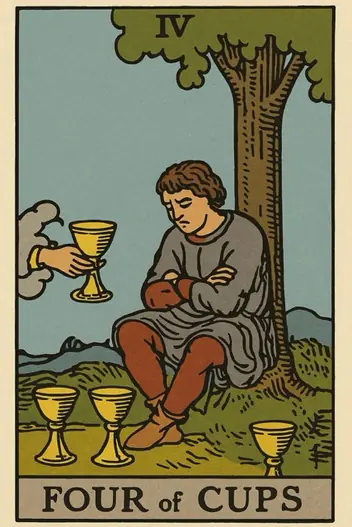
When the Four of Cups—a card of apathy, introspection, and missed opportunities—meets the Five of Cups—a card of grief, loss, and focusing on what’s gone—the result is a powerful psychological trap. This combination often signals a state of emotional paralysis where the seeker is simultaneously rejecting new possibilities and mourning past failures. The core conflict here is between inward withdrawal (Four of Cups) and outward sorrow (Five of Cups), creating a loop of rumination that blocks forward momentum. Pragmatically, this pairing asks: Are you refusing to see the glass half-full because you're too busy staring at the spilled milk? The challenge is to break the cycle of learned helplessness and reframe your perspective from loss to potential.
Four of Cups and Five of Cups Card Meaning Explained
The convergence of these two cards creates a psychological bottleneck. The Four of Cups represents a state of disengagement—you may be bored, dissatisfied, or indifferent to the options presented to you. The Five of Cups, however, adds a layer of acute disappointment or grief over a specific loss (a relationship, a job, a dream). Together, they depict a person who is stuck in a feedback loop: you feel you've lost something valuable (Five), so you withdraw and reject everything else (Four), which only deepens the sense of loss. This is not a time for major decisions, as cognitive biases like the negativity effect—where negative events outweigh positive ones—are likely distorting your judgment. The practical implication is that you are overlooking viable alternatives because you are emotionally anchored to what is no longer available. The key insight here is that this combination often signals a self-fulfilling prophecy: your expectation of disappointment leads you to reject opportunities, which then confirms your belief that nothing good is coming.
Four of Cups and Five of Cups in Career Readings
Strategic Opportunities:
Audit your current projects for hidden value. The Four of Cups warns against dismissing a role or task as "boring" when it may hold long-term stability or networking potential.
Strategic Opportunities:
Use the Five of Cups' grief as a catalyst for pivot. A lost client, failed deal, or missed promotion is a data point, not a verdict. Analyze what went wrong to refine your approach.
Calculated Risks:
Avoid making career changes based on emotional numbness. Do not quit a job or make a major financial move solely because you feel apathetic or disappointed. Wait until you feel a clear pull toward a new opportunity, not just a push away from the current one.
Professionally, this combination signals a dangerous stagnation masked as reflection. The Four of Cups can indicate you are overlooking a viable opportunity because it doesn't match your ideal vision. The Five of Cups adds a layer of professional grief—perhaps you were passed over for a promotion, lost a key client, or your industry is shifting. The pragmatic risk here is decision paralysis. You may be waiting for a "perfect" offer that doesn’t exist, while letting smaller, solid opportunities slip by. Financially, be wary of the sunk cost fallacy: continuing to invest time or money in a failing project because you’ve already lost so much. Instead, conduct a cold-eyed cost-benefit analysis of your current situation. List three concrete actions you can take this week to either improve your current role or actively explore alternatives. The strategic move is to reframe "loss" as "tuition"—you paid a price for a lesson. Now, apply that lesson to your next move.
Your pair is already on the table. Ask your question and draw the clarifying card
or simply focus on it
Four of Cups and Five of Cups Love Outcome
If you are single:
This pairing suggests you may be rejecting potential partners because you are still grieving a past relationship or idealizing an ex. Your apathy is a defense mechanism against further hurt, but it’s also closing the door on genuine connections.
If you are in a relationship:
You or your partner may be emotionally checked out, holding onto resentment over past arguments or unmet expectations. The relationship feels like a hollow shell, with both parties focusing on what’s missing rather than what’s present.
In relationships, this combination signals a dangerous emotional drift. The Four of Cups’ apathy combined with the Five of Cups’ grief creates a dynamic where one or both partners feel isolated and unseen. You may be communicating through silence or passive-aggression, avoiding confrontation while secretly mourning the relationship’s former vitality. The critical strategic move here is to interrupt the cycle of rumination. Instead of dwelling on what was lost, schedule a low-stakes, neutral conversation to express your current emotional state without blame. Use "I" statements: "I feel disconnected," not "You are ignoring me." This combination often appears when unresolved grief (from a previous breakup, a betrayal, or a life transition) is bleeding into the present. Bold action: If you are single, challenge yourself to say "yes" to one social invitation or dating app match you would normally dismiss. The goal is not to force a connection, but to break the pattern of rejection.
The Shadow Side of Four of Cups and Five of Cups
The shadow of this combination is a deep well of self-pity and victimhood. The Four of Cups’ indifference can curdle into entitlement—feeling that the world owes you something better, so you refuse to engage with what’s offered. The Five of Cups’ grief can morph into chronic bitterness, where you wear your disappointment as a badge of honor. This leads to social withdrawal and professional isolation, as you push away people who try to help. The cognitive bias at play here is confirmation bias: you actively seek evidence that reinforces your belief that nothing works out, ignoring any signs of progress or kindness. Beware of the "martyr complex"—using your past losses as a reason to stop trying. This is a self-sabotaging loop where you reject help, then feel abandoned. The most dangerous pitfall is passive resignation: accepting a state of low-grade misery because it feels safer than risking further disappointment.
Your unique Tarot reading
See how these cards interact with your destiny. Start a free personal reading now.
Four of Cups and Five of Cups Reversed: How to Read It
Four of Cups Reversed:
The blockage lifts, but uncontrollably. You stop ignoring opportunities, but grab at everything indiscriminately. This is recklessness born of despair. Advice: Introduce a "one-week filter" for any new proposal to avoid replacing apathy with chaos.
Five of Cups Reversed:
Refusal to process trauma. You suppress grief, pretending that "everything is fine." This leads to internal resistance and passive sabotage. You agree to new projects (the Four), but do so without soul, failing them on a subconscious level. Advice: Allow yourself a ritual of farewell to the past, otherwise it will sabotage your future.
Both Reversed:
Total imbalance. You simultaneously deny your losses and react chaotically to any stimulus. This is a state of "emotional short-circuit." The only logical way to fix this is to introduce rigid structure and time management. Plan every hour to shut down the "emotional brain" and let the rational mind speak. You need external anchors (deadlines, contracts, commitments) to stay on course.
Four of Cups and Five of Cups: The Combined Message
How to constructively harness the energy of this pair? The key lies in redefining the terms. The Four of Cups is not about "rejecting everything," but about "raising your selection standards." The Five of Cups is not about being "fixated on loss," but about "analyzing mistakes for future strategy." Your task is to unite these two processes into a single rational algorithm.
Take a sheet of paper. On one side (the Five of Cups), write down three specific mistakes that led to the loss. Without self-flagellation, like an analyst: "The budget was inflated by 20%," "The partner failed due diligence." On the other side (the Four of Cups), write down three current offers or opportunities you are rejecting. Now conduct a fit audit: check whether you are rejecting opportunity X precisely because of mistake Y. If yes—you are in a trap. If no—your decision is rational.
This method transforms the emotional cycle into a strategic framework. You cease to be a victim of your feelings and become the manager of your own life. Accept the loss as tuition for a lesson, not as a life sentence. Only by acknowledging the reality of the past (the Five) can you soberly evaluate the gifts of the present (the Four). Do not try to "forget" or "forgive"—try to "use" your experience as data for making the right decisions.
Your Next Step: Personal Context Matters
The Four of Cups and Five of Cups combination is a powerful warning against emotional inertia. It asks you to acknowledge your grief without letting it define your future. The core message is that you are not stuck because of external circumstances, but because of an internal refusal to see new possibilities. The path forward requires a conscious shift from focusing on what’s missing to recognizing what’s still available. This is not about toxic positivity; it’s about strategic emotional rebalancing.
Ready to break the cycle? While this analysis provides a solid archetypal framework, the true power of Tarot lies in its application to your unique life. The Fortune Cards app offers a deep, personalized interpretation of this exact combination for your specific question—whether it’s about love, career, or personal growth. Use it on the web or download it now to get a clear, actionable reading that cuts through the noise and shows you exactly where to focus your energy today.
Interpretation by the Fortune Cards editorial team, based on the Rider–Waite tradition and Jungian archetypes. About our methodology · Updated: 2026-08-26
Other Combinations with Four of Cups
Other Combinations with Five of Cups
Explore Individual Card Meanings
Table of Contents
- Four of Cups and Five of Cups Card Meaning Explained
- Four of Cups and Five of Cups in Career Readings
- Four of Cups and Five of Cups Love Outcome
- The Shadow Side of Four of Cups and Five of Cups
- Four of Cups and Five of Cups Reversed: How to Read It
- Four of Cups and Five of Cups: The Combined Message
- Your Next Step: Personal Context Matters
Ready to find answers to your questions?
Start your first reading now and look at your situation with fresh clarity. The cards are ready to reveal deeper meaning.