Four of Cups and Ten of Swords Meaning in Tarot

- Arcana
- Four of Cups — Minor Arcana, Cups; Ten of Swords — Minor Arcana, Swords
- Elements
- Four of Cups — Water; Ten of Swords — Air
- Elemental interaction
- Neutral elements — energies coexist without conflict
- Numerology
- 4 + 10 = 14 → 5
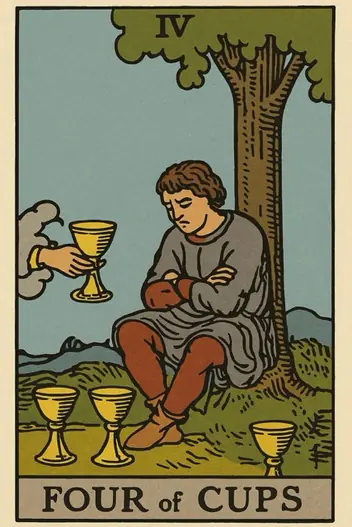
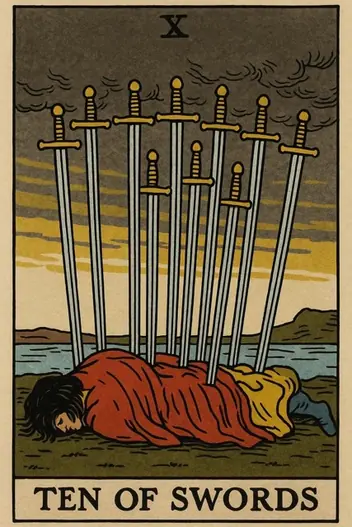
When the Four of Cups (apathy, contemplation, missed opportunities) collides with the Ten of Swords (rock bottom, painful endings, forced clarity), the result is a psychological freeze. This isn’t just a bad day; it’s a state where the mind has surrendered before the fight is over. The seeker feels emotionally numb and mentally pinned down, often mistaking a temporary defeat for a permanent condition. The core question becomes: Are you refusing to see a new option, or are you refusing to get up from a blow that has already passed?
This combination speaks to a critical moment of choice between self-imposed stagnation and a necessary, brutal reset. The Four of Cups provides the emotional withdrawal, while the Ten of Swords provides the catastrophic narrative. Together, they create a feedback loop: “I feel nothing, so everything is over.” In Jungian terms, this is the Shadow of the Recluse—a retreat from life that feels like safety but is actually a prison of unprocessed pain.
Four of Cups and Ten of Swords Card Meaning Explained
The primary dynamic here is learned helplessness. The Ten of Swords represents a final, sharp blow—a betrayal, a failure, or a clear ending. The Four of Cups then steps in not to heal, but to numb the response. The seeker sits amidst the wreckage, arms crossed, refusing the hand of help or the glimpse of a new path because they have already decided the situation is hopeless. This is cognitive closure taken to an extreme: the mind shuts down to protect itself, but in doing so, it blocks the very data needed for recovery.
Psychologically, this pairing highlights a dangerous misattribution of cause and effect. The seeker may believe their apathy is a result of the ending, when in reality, their apathy may have contributed to the ending. The Four of Cups’ refusal to engage can be the unseen cause that led to the Ten of Swords’ final strike. The key insight is this: the pain is real, but the meaning you assign to it is a choice. The Ten of Swords says, “This is over.” The Four of Cups says, “And nothing new can begin.” Both are only true if you stay seated.
Strategically, this combination demands a pause for reality-testing. Ask: Are you mourning a loss, or are you avoiding the effort of rebuilding? The apathy is a false comfort. The real work is to acknowledge the ending without letting it define your entire future. The most practical action is to identify one small, concrete task—not a grand vision, but a single step—that proves you are still capable of moving.
Your pair is already on the table. Ask your question and draw the clarifying card
or simply focus on it
Four of Cups and Ten of Swords: Career and Money
Strategic Opportunities:
Identify the one project or role you have been ignoring. The Four of Cups often hides a valuable opportunity in plain sight. The Ten of Swords clears the deck for a new start—look for the offer you have dismissed as “too small” or “too late.”
Strategic Opportunities:
Use the ending to renegotiate terms. The Ten of Swords can represent a contract termination or a project failure. This is a clean break to demand better conditions, a severance, or a different role without the baggage of the old arrangement.
Calculated Risks:
Avoid making any major financial decisions for 48 hours. The emotional shock of the Ten of Swords and the apathy of the Four of Cups create a perfect storm for poor judgment. You are likely to either overreact (sell low) or underreact (miss a deadline).
Professionally, this combination signals a phase of necessary liquidation. Something has ended—a job, a client relationship, a business venture—and the natural response is to withdraw and brood. However, the Four of Cups warns against letting this withdrawal become a career trap. You may be offered a severance package, a new role, or a pivot opportunity, but your apathy will make you miss it.
The strategic warning is this: do not confuse a career setback with a career death. The Ten of Swords is a specific ending, not a global judgment on your competence. Focus on separating the event from the identity. A project failed; you are not a failure. A job ended; you are not unemployable. The Four of Cups’ temptation is to generalize the loss. Combat this by creating a short, objective list of what is actually over versus what is still available. This is a time for cold, hard data, not emotional narratives.
Uncover hidden insights
Let our advanced Tarot system interpret these archetypes specifically for your personal path.
Four of Cups and Ten of Swords Love Outcome
If you are single:
This pair suggests you are carrying the emotional baggage of a past rejection or disappointment, making you unable to see a genuine new offer. You may be dismissing potential partners before they even have a chance, projecting a past ending onto a new beginning.
If you are in a relationship:
The dynamic points to a power imbalance rooted in emotional withdrawal. One partner (or both) has been “stabbed in the back” by unmet expectations, and the other has retreated into a sullen, silent protest. Communication has been replaced by silent resentment.
In relationships, the Four of Cups and Ten of Swords combination is a red flag for emotional neglect disguised as self-protection. The partner embodying the Four of Cups may feel they have “given up” after a fight, while the partner embodying the Ten of Swords feels deeply wounded and unheard. The result is a gridlock of pain and apathy. The relationship cannot heal because one person is unwilling to look up, and the other is unwilling to stop bleeding.
The critical relationship advice is to separate the story from the sensation. The Ten of Swords’ “ending” may not be the end of the relationship—it may be the end of a specific pattern. To move forward, both parties must name the specific wound (the Ten of Swords) and explicitly reject the narrative of hopelessness (the Four of Cups). This requires a difficult conversation where each person takes responsibility for their role in the collapse. Do not mistake silence for peace; it is often just deferred conflict.
When Four of Cups and Ten of Swords Signal Trouble
The shadow of this pairing is passive nihilism—a quiet, devastating belief that nothing matters and no action is worth taking. The seeker may rationalize their inaction as “acceptance” or “being realistic,” when in truth, they are self-sabotaging through neglect. The cognitive bias at play is the negativity bias: the brain overweights the pain of the Ten of Swords and underweights the potential of any new offer from the Four of Cups.
Another major pitfall is emotional blackmail. The person embodying the Ten of Swords may use their pain to manipulate the Four of Cups person into feeling guilty for their withdrawal. This creates a toxic cycle of blame and silence. Alternatively, the Four of Cups person may use their apathy as a weapon of passive aggression—“I won’t fight, I’ll just stop caring.” This is a form of psychological abandonment that can be more damaging than an open argument.
The most dangerous shadow behavior is refusing to ask for help. The Ten of Swords screams for support, and the Four of Cups whispers that no one can help anyway. This combination is a high-risk indicator for depressive withdrawal. If you or the querent resonate with this energy, the single most important action is to break the isolation by telling one trusted person the truth. Not the story, not the blame, but the simple fact: “I feel stuck and hopeless.” This act alone breaks the spell of the Four of Cups.
Four of Cups and Ten of Swords Reversed: How to Read It
When cards appear in reversed positions, the dynamic becomes less fatal but more confusing.
Reversed Four of Cups:
This is a state of "blocked potential." You have already emerged from apathy, but you don't know how to act. Instead of passivity, you experience chaotic activity. Paired with the Ten of Swords, this indicates that the ending is inevitable, but you can soften the blow if you stop flailing and start acting according to a plan. Advice: focus on one task, not everything at once.
Reversed Ten of Swords:
Internal resistance to accepting loss. The situation has already concluded, but you refuse to acknowledge it. You are trying to "glue a broken cup"—returning to an ex-partner, trying to restore an old job. Warning: this is the most dangerous trap. You are wasting energy on resuscitating a corpse instead of building something new.
Both cards reversed:
Complete imbalance and a postponement of the crisis. You are in an illusory state: apathy (4 of Cups) has transformed into anxiety, and the finale (10 of Swords) is being delayed. This does not mean the problem is gone—it is simply postponed. Logical solution: use this "postponement" to accumulate resources and consult with a psychologist or coach. Do not wait for the situation to explode on its own.
Four of Cups and Ten of Swords: Tarot Advice
How to constructively utilize the energy of this pair? The key principle: The Four of Cups must become a tool for analysis, not for escape. Your task is to realize that your apathy was a defense mechanism that no longer works. The Ten of Swords is not the end of life, but the end of a specific scenario. It grants you permission to feel pain, but also permission for release.
To balance this dynamic, you need to perform a "volitional act." Take responsibility for what you have been ignoring. If it's a relationship — end it with dignity, without playing the silent game. If it's a career — resign on your own terms, preserving your honor. A deep strategic piece of advice: use the energy of the Ten of Swords to "sever" dead connections, and the energy of the Four of Cups to filter future opportunities. Now you know that ignoring problems leads to catastrophe. Your new algorithm: notice a problem (4 of Cups) — solve it immediately (action). This combination teaches us that a painful ending is better than endless apathy. The clarity you will gain after the crisis will become your most valuable asset.
Your Next Step: Personal Context Matters
The core message of Four of Cups and Ten of Swords is that an ending is not a verdict. You are not required to stay seated in the wreckage. The apathy is a symptom, not a solution. The pain is real, but the story you tell yourself about it is optional. The path forward is not about grand reinvention; it is about the small, defiant act of looking up and accepting one new thing—a piece of advice, a helping hand, a forgotten opportunity. The cards show you the trap; your job is to walk out of it.
But this general interpretation is only a map. The real insight comes from how this combination lands on your specific life. Get a personalized reading now in the Fortune Cards app. The app applies these archetypes to your exact question—whether it’s about a relationship, a career crossroads, or a personal crisis. Stop reading about the cards and start using them for your unique situation. Download Fortune Cards on the web or from your app store today and get the clarity you need to move.
Interpretation by the Fortune Cards editorial team, based on the Rider–Waite tradition and Jungian archetypes. About our methodology · Updated: 2026-09-17
Other Combinations with Four of Cups
Other Combinations with Ten of Swords
Explore Individual Card Meanings
Table of Contents
- Four of Cups and Ten of Swords Card Meaning Explained
- Four of Cups and Ten of Swords: Career and Money
- Four of Cups and Ten of Swords Love Outcome
- When Four of Cups and Ten of Swords Signal Trouble
- Four of Cups and Ten of Swords Reversed: How to Read It
- Four of Cups and Ten of Swords: Tarot Advice
- Your Next Step: Personal Context Matters
Ready to find answers to your questions?
Start your first reading now and look at your situation with fresh clarity. The cards are ready to reveal deeper meaning.