Four of Swords and Nine of Swords Tarot Combination
- Arcana
- Four of Swords — Minor Arcana, Swords; Nine of Swords — Minor Arcana, Swords
- Elements
- Four of Swords — Air; Nine of Swords — Air
- Elemental interaction
- Same element — energies intensify each other
- Numerology
- 4 + 9 = 13 → 4
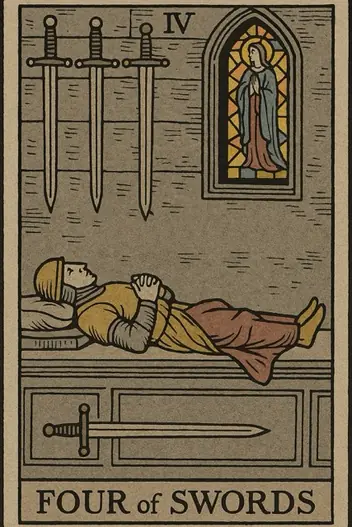
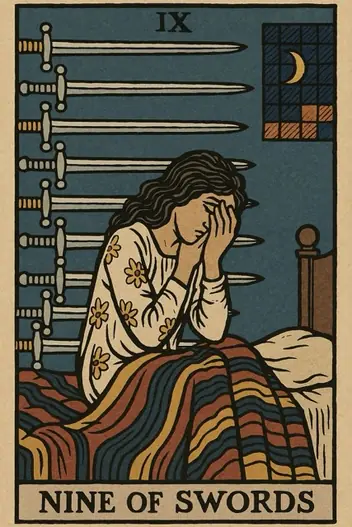
The intersection of the Four of Swords and the Nine of Swords represents a critical psychological turning point. The Four of Swords calls for rest, withdrawal, and mental recuperation, while the Nine of Swords embodies anxiety, insomnia, and the torment of overthinking. When these energies collide, you are likely experiencing a state where your mind is racing with worst-case scenarios, yet your body and spirit are demanding you stop.
This combination often appears when a seeker is trapped in a cycle of rumination—replaying past mistakes or catastrophizing future outcomes—while simultaneously knowing they need to step back. The conflict is not between action and inaction; it is between compulsive worry and deliberate stillness. The pragmatic interpretation here is clear: your mental exhaustion is a signal, not a weakness. The cards are not asking you to fight the anxiety, but to redefine rest as a strategic intervention rather than an escape.
Four of Swords and Nine of Swords: How These Energies Interact
The core dynamic of this pairing is the battle between the conscious mind's fear and the unconscious need for recovery. The Nine of Swords represents the ego's attempt to solve problems through sheer mental force, often leading to sleep deprivation, tunnel vision, and a distorted sense of threat. The Four of Swords counters this by representing the archetype of the wounded healer—someone who must first retreat to gain perspective.
In practical terms, this combination suggests that your current anxiety is not a call to action, but a call to recalibrate. The mind is producing "false alarms" because it is operating on depleted resources. The key insight is that you cannot think your way out of a state of exhaustion. The Four of Swords offers a structured approach: set a specific timeframe for mental disengagement (e.g., 24 hours of no decision-making), use this time to observe your thoughts without judgment, and prepare for a return to action only after rest. This is not passive avoidance; it is active psychological hygiene.
The real-world implication is that you must distinguish between productive worry and futile rumination. If the same anxious thought loops without producing new information or a viable plan, it is time to invoke the Four of Swords. Bold the following: The most strategic action you can take right now is to deliberately stop trying to solve the problem.
Your pair is already on the table. Ask your question and draw the clarifying card
or simply focus on it
Four of Swords and Nine of Swords as Feelings
If you are single:
This combination warns against projecting past relationship trauma onto new connections. Your anxiety about being hurt again may be creating a self-fulfilling prophecy. Take a break from dating apps and social comparisons to reset your baseline expectations.
If you are in a relationship:
This pair often indicates that one partner is carrying the emotional burden of the other's unspoken fears. There may be a pattern of silent resentment where one person is lying awake at night worrying while the other is checked out.
In relationships, the Four of Swords and Nine of Swords together suggest a crisis of emotional safety. The anxious partner (Nine of Swords) may be interpreting their partner's need for space (Four of Swords) as rejection or abandonment. Conversely, the partner seeking rest may feel smothered by the other's constant need for reassurance. The critical relationship advice here is to schedule a "no-conversation" period—a mutually agreed-upon time to be present without discussing problems. This creates a container for the anxiety to settle. Bold this: Do not attempt to resolve conflicts when one partner is sleep-deprived or emotionally flooded. Practical steps include: agreeing on a "pause" signal when conversations become circular, using a journal to externalize worries before bed, and prioritizing physical rest over emotional processing for 48 hours.
Four of Swords and Nine of Swords: Career and Money
Strategic Opportunities:
Use this period to audit your workflow for inefficiencies that are causing mental fatigue. The anxiety may be pointing to a real structural problem (e.g., unclear deadlines, poor delegation) that rest will help you see clearly.
Strategic Opportunities:
Revisit your "why" behind a major career decision. The Nine of Swords often exaggerates the consequences of a mistake. Use the Four of Swords' clarity to separate actual risks from imagined ones.
Calculated Risks:
Avoid making any financial commitments or signing contracts while in this heightened state of anxiety. The risk of overlooking critical details is high. Delay major purchases or investment moves by at least one week.
In the career context, this combination is a powerful warning against "hustle culture" thinking. The Nine of Swords might drive you to work longer hours to compensate for perceived inadequacy, but the Four of Swords reveals that productivity gains from exhaustion are illusory. The pragmatic approach is to treat your mental state as a leading indicator of a flawed system. Ask yourself: What am I avoiding by staying busy? Bold this: The most financially prudent move is to protect your cognitive capital. If you are self-employed, consider outsourcing or automating a task that drains you. If you are an employee, request a deadline extension or use a sick day to break the cycle. The Nine of Swords often represents fear of failure; the Four of Swords reminds you that failure to rest guarantees failure to perform.
Uncover hidden insights
Let our advanced Tarot system interpret these archetypes specifically for your personal path.
When Four of Swords and Nine of Swords Signal Trouble
The shadow side of this combination is catastrophizing paralysis—a state where the seeker becomes so consumed by worst-case scenarios that they cannot take even the smallest step toward recovery. This manifests as insomnia-driven decision-making, where late-night fears are treated as rational truths. A common cognitive bias here is confirmation bias: you only notice evidence that supports your anxiety, ignoring signs of stability. Another pitfall is passive-aggressive withdrawal, where you use the Four of Swords' call for rest as an excuse to avoid necessary confrontations. The danger is that the Nine of Swords' anxiety will fester into resentment or physical illness if not addressed with intention. The shadow also includes self-medication (alcohol, excessive screen time) to quiet the mind, which only deepens the exhaustion. Bold this: The shadow trap is believing that rest means giving up control, when in reality, it is the only way to regain it.
Four of Swords and Nine of Swords Reversed Meaning
1. Four of Swords Reversed. This indicates that the period of forced rest has ended, but you are emerging from it prematurely, without having restored your strength. Warning: you risk committing a reckless act driven not by strength, but by desperation. You can no longer tolerate inaction, but your energy is still at zero. Action taken in this state will lead to collapse.
2. Nine of Swords Reversed. This is one of the most challenging scenarios. The anxiety has not disappeared; it has sunk deeper, into the subconscious. You are denying your fear, appearing outwardly calm, but inside you are being consumed by suppressed panic. Advice: you don't need to "calm down," but to find an eco-friendly way to let off steam. Ignoring the anxiety will lead to psychosomatic issues (headaches, gastrointestinal problems).
3. BOTH Reversed. A complete imbalance: you are simultaneously knocked off balance (Reversed Four) and denying your vulnerability (Reversed Nine). This is a state of chronic crisis, where you are running on broken legs, convincing yourself that everything is fine. The logical way to correct this: an emergency stop. You need not rest, but hospitalization — in a figurative sense. A full digital-detox, a change of scenery, and possibly professional psychological help.
Four of Swords and Nine of Swords: The Combined Message
Constructive use of this dynamic requires strict discipline and a shift in focus. Your task is to use the energy of the Four of Swords (rest) to manage the energy of the Nine of Swords (anxiety), not the other way around. Do not try to "think through" the anxiety—this is impossible. Instead, acknowledge it as a physical symptom, not an intellectual problem.
Strategic Algorithm of Action:
- Structure your rest. Rest must be scheduled. Set aside strict time for "doing nothing" (Four of Swords). During this time, no gadgets, news, or conversations.
- Materialize the anxiety. The Nine of Swords is thoughts. Take them out of your head. Write down your list of fears on paper. Read it aloud. You will see that 90% of them are not real threats, but scenarios.
- Divide responsibility. Separate what you can influence from what is beyond your control. Spend energy only on the former. This will restore your sense of agency.
A deep strategic piece of advice: do not try to get rid of anxiety; use it as fuel for action. Anxiety is energy directed in the wrong place. If you feel fear about a project, do not retreat into rumination (Four of Swords), but take one micro-step (write the first sentence, make one phone call). Action breaks paralysis. Clarity comes not from thinking, but from action.
Where to Go From Here
The Four of Swords and Nine of Swords together deliver a clear message: your anxiety is not a threat to be eliminated, but a signal to be heeded. The path forward requires a disciplined pause—not to escape your problems, but to see them with fresh eyes. The rest you take now is an investment in clearer judgment, better relationships, and smarter career moves. But general interpretations only go so far. Your specific question, your personal history, and the positions of these cards in a spread change everything.
For a deep, personalized interpretation of this exact combination tailored to your unique situation, use the Fortune Cards app. Whether you access it on the web or download it, the app provides a precise, psychologically-informed reading that accounts for your specific context. Stop guessing how these archetypes apply to you—get the clarity you need to move from paralysis to strategic recovery.
Interpretation by the Fortune Cards editorial team, based on the Rider–Waite tradition and Jungian archetypes. About our methodology · Updated: 2026-08-26
Other Combinations with Four of Swords
Other Combinations with Nine of Swords
Explore Individual Card Meanings
Table of Contents
- Four of Swords and Nine of Swords: How These Energies Interact
- Four of Swords and Nine of Swords as Feelings
- Four of Swords and Nine of Swords: Career and Money
- When Four of Swords and Nine of Swords Signal Trouble
- Four of Swords and Nine of Swords Reversed Meaning
- Four of Swords and Nine of Swords: The Combined Message
- Where to Go From Here
Ready to find answers to your questions?
Start your first reading now and look at your situation with fresh clarity. The cards are ready to reveal deeper meaning.