The Hanged Man and Eight of Swords Meaning in Tarot
- Arcana
- The Hanged Man — Major Arcana; Eight of Swords — Minor Arcana, Swords
- Elements
- The Hanged Man — Water; Eight of Swords — Air
- Elemental interaction
- Neutral elements — energies coexist without conflict
- Numerology
- 12 + 8 = 20 → 2
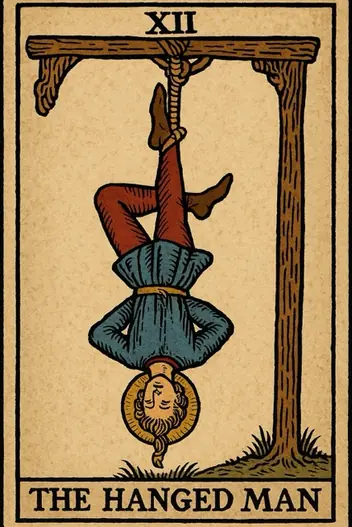
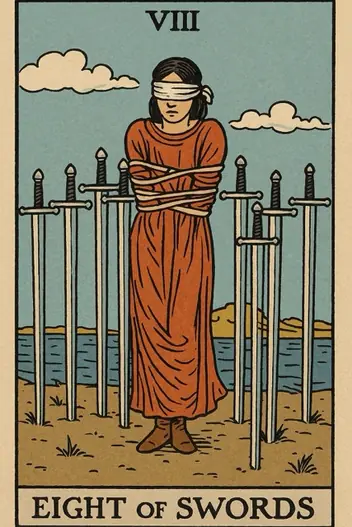
The Hanged Man represents a necessary pause—a suspension of action to gain a new perspective. The Eight of Swords depicts a figure bound and blindfolded, surrounded by swords, symbolizing self-imposed mental traps. When these two cards collide, they create a powerful psychological state: a voluntary sacrifice that has become involuntary imprisonment. The seeker is not just waiting; they are trapped in a cycle of overthinking, where the very act of pausing for clarity has turned into a prison of indecision. This combination asks: Are you patiently awaiting a breakthrough, or are you using analysis paralysis to avoid making a difficult choice?
In practical terms, this pairing reveals a conflict between strategic patience and cognitive entrapment. The Hanged Man’s wisdom lies in surrendering control to see the bigger picture, but the Eight of Swords warns that this surrender can morph into a self-constructed cage of limiting beliefs. The core challenge is distinguishing between a needed period of reflection and a harmful pattern of self-doubt. The key is to recognize when your suspension of judgment stops being a tool and starts being a trap.
The Hanged Man and Eight of Swords Card Meaning Explained
The core dynamic here is a paradox of agency. The Hanged Man suggests you have willingly chosen to pause, perhaps to avoid a rash decision or to gain spiritual insight. However, the Eight of Swords indicates that this pause is now being fueled by fear, guilt, and a distorted sense of helplessness. You may feel you must stay still because you cannot see a way out, but the binding is largely self-created. The blindfold represents the cognitive biases—such as catastrophizing or black-and-white thinking—that prevent you from seeing the simple solution right in front of you.
Psychologically, this combination points to a state of learned helplessness disguised as patience. The seeker may believe they are being noble or spiritual by enduring a difficult situation, but in reality, they are avoiding the responsibility of making a choice. The Hanged Man’s sacrifice is meant to be temporary; the Eight of Swords’ imprisonment is a trap of your own making. The real work is to shift from passive endurance to active introspection. Ask yourself: What am I afraid to see? What truth am I avoiding by staying in this suspended state? The solution often requires a radical shift in perception—not more waiting, but a willingness to remove the blindfold and see the situation for what it truly is.
Your pair is already on the table. Ask your question and draw the clarifying card
or simply focus on it
The Hanged Man and Eight of Swords: Career and Money
Strategic Opportunities:
Re-evaluate your current role or project from a fresh angle. The Hanged Man's perspective can reveal a non-obvious solution to a problem you've been overthinking. Use this time to analyze, not to stagnate.
Strategic Opportunities:
Seek mentorship or feedback. An outside perspective can be the "sword" that cuts through your blindfold. Ask a trusted colleague to review your situation—their objectivity is invaluable.
Calculated Risks:
Avoid making any major financial commitments or career changes until you have clarity. The Eight of Swords warns against acting from a place of panic or perceived scarcity. Do not quit your job or invest money based on a fear-driven fantasy.
In career and finances, this combination is a red flag for analysis paralysis. You may be stuck in a job or project that feels like a sacrifice (Hanged Man), but you are also convincing yourself that you have no other options (Eight of Swords). This is a classic cognitive distortion: the "sunk cost fallacy." You believe you have invested too much time or energy to leave, so you stay, feeling increasingly trapped. The practical advice is to conduct a ruthless audit of your options. Write down the three best and three worst outcomes of staying versus leaving. The Hanged Man's energy is useful for strategic pause, but only if you are actively seeking clarity, not passively waiting for rescue. Financially, this card pair suggests a need to rethink your relationship with scarcity. Are you holding onto money out of fear? Or are you overspending to escape feelings of restriction? The key is to move from a reactive to a proactive mindset.
Get a personalized interpretation
Unlock the combined meaning of your cards in the context of your unique question — for free.
The Hanged Man and Eight of Swords in Love and Relationships
If you are single:
This pair suggests you are hesitating to pursue a connection because of imaginary barriers. You may feel "stuck" in a pattern of waiting for the "perfect" person, but the real issue is your own fear of vulnerability. The pause is a defense mechanism, not a strategy.
If you are in a relationship:
You and your partner may be in a stalemate, where one or both of you feel trapped by unspoken expectations. The relationship may feel like a sacrifice, but the bonds are largely self-imposed. Honest communication is the only way to cut through the mental fog.
In relationships, the Hanged Man and Eight of Swords combination often signals a power dynamic where one person is sacrificing their needs while the other remains unaware or indifferent. This is not a healthy martyrdom; it is a quiet crisis of boundaries. The seeker may believe they are being patient and understanding, but they are actually withholding their truth out of fear of conflict or rejection. The boldest act of love here is to speak your mind. Remove the blindfold of "I don't want to hurt them" and acknowledge that silence is a form of dishonesty. For singles, this card pair warns against idealizing a connection from a distance. You are not waiting for a sign; you are avoiding the risk of rejection. Take one small, concrete action—send a message, ask a question—to break the paralysis.
The Hanged Man and Eight of Swords Reversed Meaning
When cards appear in reversed positions, the dynamic becomes more chaotic, yet also more fluid.
The Hanged Man Reversed:
This is a state of reckless impatience. The person refuses to take a necessary pause, tearing themselves from the "cross" before receiving the answer. Instead of wise sacrifice, there are impulsive actions that destroy what could still have been saved. Advice: Stop immediately. If you feel you "can't wait any longer," this is precisely the moment when waiting is vital.
Eight of Swords Reversed:
Here, internal resistance is lifted. The person begins to see exits that were previously hidden. However, this can be an illusion. The reversed Eight often indicates that you have removed the blindfold but are standing on the edge of an abyss. Warning: Do not confuse insight with panic. Just because you see a "hole in the fence" doesn't mean you need to jump through it.
BOTH Reversed:
This is complete imbalance. You are simultaneously impatient (Hanged Man reversed) and blind to real risks (Eight reversed). The most dangerous scenario — you begin active actions without understanding either their cost or their goal. How to correct it: Return to basics. Take a 48-hour digital detox. Turn off notifications, your phone, and social media. Only silence can restore your focus.
When The Hanged Man and Eight of Swords Signal Trouble
The shadow side of this combination is toxic passivity and self-victimization. The seeker may unconsciously enjoy the role of the martyr, gaining a sense of moral superiority from their "sacrifice." This is a form of emotional manipulation—by appearing helpless, they avoid responsibility for their own choices. The cognitive bias at play is learned helplessness, where repeated failures (or perceived failures) lead the person to believe they have no control, even when they do. The biggest pitfall is mistaking inaction for wisdom. You may tell yourself you are "waiting for a sign," but the real sign is that you are avoiding the discomfort of making a decision. Self-sabotage is also a risk: you might unconsciously create obstacles (e.g., picking a fight, missing a deadline) to justify your paralysis. The antidote is radical accountability. Recognize that your bindings are self-imposed, and the only way out is to take one small, deliberate action—even if it feels risky.
The Hanged Man and Eight of Swords: The Combined Message
How can the energy of this pair be used constructively? The answer lies in redefining the concept of "sacrifice." The Hanged One teaches us that sacrifice is not a loss, but an investment. You give up comfort or a habitual way of acting in order to gain access to a new level of awareness. The Eight of Swords, in turn, demands that you stop confusing real limitations with imaginary ones.
Your strategic plan for the near future is active inaction. You must stop fighting the "cage" and begin studying its structure. Ask yourself three questions:
- Which specific belief is keeping me in place? (Eight of Swords)
- What outcome am I willing to give up right now in order to gain clarity? (The Hanged One)
- What new opportunity am I missing because I am staring at a single point?
Deep advice:
use the "Reverse Course" technique. If you feel stuck, instead of looking for a way out, begin to intensify your "stuckness." Sit down and intentionally spend an hour in complete stillness, contemplating your situation. Often, it is precisely at the moment of fully accepting the limitation that it disappears. You will not be freed until you stop fighting for freedom.
Your Next Step: Personal Context Matters
The core message of The Hanged Man and Eight of Swords is clear: You are not trapped by fate, but by your own perception. The pause is a gift, but only if you use it to actively seek a new perspective, not to wallow in indecision. The swords around you are not weapons; they are the sharp ideas and truths you are refusing to see. Your next step is to remove the blindfold and ask yourself one honest question: What am I afraid to admit?
This general interpretation provides a powerful framework, but the true power of Tarot lies in its application to your unique life. Your specific situation—your career, your relationship, your personal history—will shift the meaning of these cards in subtle but critical ways. To get a deep, personalized interpretation of The Hanged Man and Eight of Swords for your exact question, use the Fortune Cards app. Available on the web and for download, it offers a bespoke reading that considers your unique context. Stop waiting for clarity—take the first step toward it today.
Interpretation by the Fortune Cards editorial team, based on the Rider–Waite tradition and Jungian archetypes. About our methodology · Updated: 2026-08-26
Other Combinations with The Hanged Man
Other Combinations with Eight of Swords
Explore Individual Card Meanings
Table of Contents
- The Hanged Man and Eight of Swords Card Meaning Explained
- The Hanged Man and Eight of Swords: Career and Money
- The Hanged Man and Eight of Swords in Love and Relationships
- The Hanged Man and Eight of Swords Reversed Meaning
- When The Hanged Man and Eight of Swords Signal Trouble
- The Hanged Man and Eight of Swords: The Combined Message
- Your Next Step: Personal Context Matters
Ready to find answers to your questions?
Start your first reading now and look at your situation with fresh clarity. The cards are ready to reveal deeper meaning.