The Hermit and Five of Cups Together in Tarot
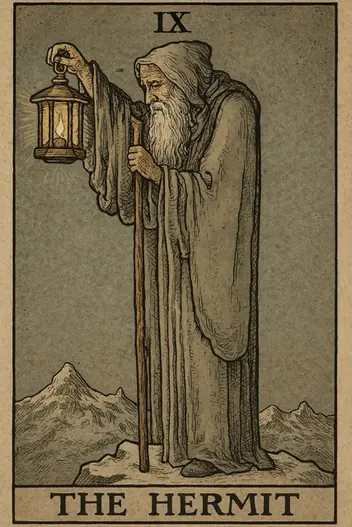

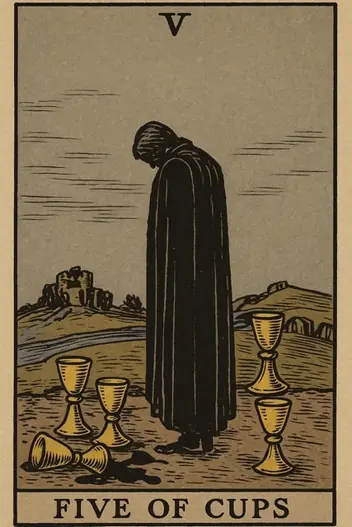
- Arcana
- The Hermit — Major Arcana; Five of Cups — Minor Arcana, Cups
- Elements
- The Hermit — Earth; Five of Cups — Water
- Elemental interaction
- Friendly elements — energies support each other
- Numerology
- 9 + 5 = 14 → 5
This combination represents a powerful psychological crossroads: the need to withdraw for self-discovery collides with the visceral pain of recent loss. The Hermit’s light of inner wisdom is meant to guide, but here it only illuminates the spilled cups of the past. This is not a time for action, but for conscious grief and strategic recalibration. The core conflict is between the desire to isolate and heal, and the risk of becoming trapped in a narrative of regret that prevents any forward movement.
When the Hermit and Five of Cups appear together, the seeker is often standing at the edge of a personal wasteland. They have lost something significant—a relationship, a job, an identity—and the natural instinct is to retreat. However, this retreat must be purposeful, not escapist. The psychological task is to distinguish between a healthy, temporary withdrawal for reflection, and a chronic state of rumination that turns the past into a prison.
The Hermit and Five of Cups Combination Meaning
The core dynamic is a feedback loop of withdrawal and disappointment. The Five of Cups provides the emotional fuel—a sense of deep loss, regret, and a focus on what has been taken away. The Hermit then provides the behavioral response: a retreat from the world to analyze this pain. The risk here is that the seeker uses the Hermit’s “wisdom-seeking” as a justification for avoiding the messy work of emotional integration.
Psychologically, this pair activates the "puer aeternus" (eternal child) shadow, where the individual clings to a fantasy of what could have been, rather than accepting the reality of what is. The Hermit’s lantern, in this context, must be used to illuminate the specific cognitive distortions fueling the grief. Is the loss being catastrophized? Is the past being idealized? The strategic action is not to stop feeling the loss, but to use the isolation to map out the exact lessons the loss is trying to teach. The goal is to transform self-pity into self-knowledge.
This combination demands a temporary suspension of hope. You cannot force optimism here. Instead, you must allow the mourning to run its course, but with a clear boundary: you will not let the grief define your entire identity. The Hermit’s discipline is the key. Your task is to journal, meditate, and analyze the loss as if you were a scientist studying a failed experiment. What variables led to the spill? What can you control next time? This is not coldness; it is emotional risk management.
Career Meaning of The Hermit and Five of Cups
Strategic Opportunities:
Deep skill refinement. This is the perfect time to take a course, get a certification, or master a niche area of your expertise. The withdrawal is a chance to become an expert.
Strategic Opportunities:
Rebranding and strategic planning. Use this quiet period to analyze past professional failures. What projects failed? Why? Map out a new, more resilient strategy based on those lessons.
Calculated Risks:
Do not make major financial decisions while grieving. Avoid selling assets in a panic, quitting a job impulsively, or making large investments driven by a desire to "fix" a past loss. The biggest risk is acting out of emotional desperation.
In your career, The Hermit and Five of Cups often appear after a professional setback: a failed promotion, a lost client, a project that collapsed. The natural response is to withdraw and lick your wounds. This is actually strategically sound for a limited period. You need space to analyze what went wrong without the pressure of immediate performance.
Frame this as a period of professional post-mortem. Do not blame yourself or your team universally. Instead, isolate the specific variables that caused the failure. Was it poor market research? A miscommunication? A lack of resources? The Hermit’s analytical energy is your greatest asset here. Financially, adopt a defensive posture. Build your cash reserves. Cut unnecessary expenses. Do not try to "make back" lost money quickly. The financial warning is clear: patience is not cowardice; it is risk management. When you re-enter the market, you will do so with a sharper, more informed strategy.
Your pair is already on the table. Ask your question and draw the clarifying card
or simply focus on it
Love and Relationships
If you are single:
This combination suggests you are currently evaluating new connections through the lens of a past wound. You are not ready for a new relationship until you process the old loss. The person you meet will likely trigger feelings of inadequacy or fear of abandonment. Advice: Do not date to heal. Date only when you have already done the internal work.
If you are in a relationship:
You and your partner are likely in a period of emotional distance following a specific betrayal or disappointment. One of you (or both) has retreated into a shell of silent resentment. The dynamic is one of passive-aggressive withdrawal rather than open conflict.
In relationships, this pair signals a crisis of emotional investment. The Five of Cups indicates that one partner feels the relationship has failed to meet a core expectation, leading to a sense of profound disappointment. The Hermit then creates a communication vacuum where the wounded partner isolates instead of explaining their pain. The other partner may feel shut out and confused, leading to a cycle of mutual misunderstanding.
The key relationship advice is to break the silence with a structured, non-blaming conversation. You must name the specific loss you are grieving. For example, "I am grieving the loss of the spontaneity we used to have," rather than "You never make me happy anymore." Use the Hermit’s clarity to articulate, not to accuse. The goal is to transform the isolation into a shared, conscious mourning of what the relationship has lost, so you can both decide if you want to rebuild. If you cannot do this, the relationship will die from emotional starvation.
Shadow Side & Pitfalls
The shadow of this combination is pathological rumination and learned helplessness. The seeker becomes addicted to the pain of the past, using the Hermit’s isolation as a cave to hide in, rather than a temple to find wisdom in. The cognitive bias at play is "hindsight bias" —the belief that the loss was inevitable and that you are fundamentally flawed for not preventing it. This leads to a self-fulfilling prophecy of failure where you stop trying because you already assume the outcome will be negative.
Another dangerous shadow is spiritual bypassing. The seeker may use the Hermit’s spiritual connotations to avoid the gritty emotional work of grief. They might say, "I am just releasing this energy," or "This was meant to be," as a way to avoid feeling the actual pain. This is a form of psychological avoidance that prevents genuine healing. The pitfall is mistaking intellectual analysis for emotional processing. You can understand why you lost something and still feel the sting of its absence. True integration requires both.
Deepen your understanding
Find out exactly what this reading means for your current life situation with our oracle.
Reversed Positions: What Changes?
The Hermit Reversed:
Potential is blocked by impulsivity. The person is unwilling or unable to withdraw for analysis. They rush out of the "cave" into social activity, trying to drown out the pain of the Five of Cups with new connections or projects. Result: superficial solutions and repeating old mistakes. Advice: forcibly implement a 3-day "information detox" (no social media or news).
Five of Cups Reversed:
Internal resistance to accepting loss. The person is stuck in denial ("it didn't happen," "it can still be fixed") or, conversely, has fallen into apathy, refusing to acknowledge their grief. Weakness: false optimism or emotional suppression. Advice: start keeping a "Loss Journal" — write down the specific facts of what has ended. This will reduce tension and restore control.
BOTH Reversed:
Complete imbalance and chaos. Energy is unstructured. This is a state of acute crisis, where there is neither the ability to step back nor the desire to process emotions. High risk of psychosomatic issues and impulsive destructive actions. Method of correction: crisis management. Find one "anchor" person (friend, psychologist, mentor) who will act as your external Hermit — ask structuring questions and prevent you from descending into chaos. Do not try to cope alone.
Synthesis: Strategic Conclusion
How can this union be used constructively? Your strategic task is to transform The Hermit from a "monk-hermit" into a "scholar-researcher", and the Five of Cups from "weeping" into a "card of losses". A rigorous audit is necessary: what exactly have you lost? Was this loss inevitable? What lesson do you extract from this experience for future decisions?
The key tool is the "Two Cups" method. Take a sheet of paper. Draw three overturned cups (what is lost) and two standing cups (what remains). Next to each cup, write a concrete fact, not an emotion. For example, instead of "I lost love," write "A relationship ended with a person who did not share my values." Instead of "I have nothing left," write "I have professional skill X and the support of friend Y." This exercise translates emotional chaos into structured data.
A deep strategic counsel: use this combination for a "life inventory." The Hermit provides you with light; the Five of Cups focuses on what needs replacement. Your goal is not to avoid pain, but to minimize the time spent experiencing it. Set a time limit for the "grieving phase" (e.g., 7 days). Upon its expiration, you are obligated to take one specific action based on your analysis. This could be a letter, a phone call, the start of a new project, or the closure of an old one. Discipline transforms suffering into experience, and experience into strength.
Applying This to Your Situation
The core message of The Hermit and Five Of Cups is to honor your grief without letting it become your identity. You have lost something real, and you need time to process it. But this is not the end of your story; it is the necessary pause before the next chapter. The light you find in this darkness will be a guide for your future choices, but only if you use the isolation to learn, not to languish.
While this article provides a general map of this archetypal terrain, the true power of Tarot lies in its application to your unique life. Your specific question—about a particular person, a job, or a decision—changes the nuance of this reading dramatically. Get a deep, personalized interpretation of this exact combination for your specific situation. Use the Fortune Cards app on the web or download it now to unlock the precise message the cards have for you, right now. Your insight is just a click away.
Interpretation by the Fortune Cards editorial team, based on the Rider–Waite tradition and Jungian archetypes. About our methodology · Updated: 2026-08-26
Other Combinations with The Hermit
Other Combinations with Five of Cups
Explore Individual Card Meanings
Ready to find answers to your questions?
Start your first reading now and look at your situation with fresh clarity. The cards are ready to reveal deeper meaning.