The Hermit and Ten of Wands Reversed in Tarot
- Arcana
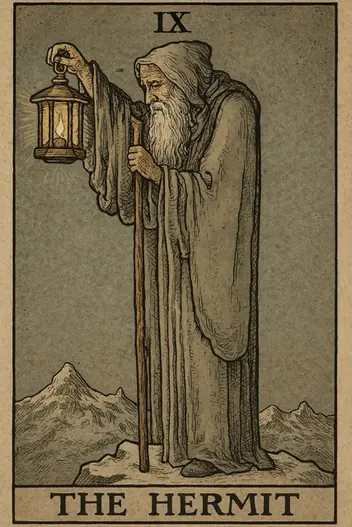
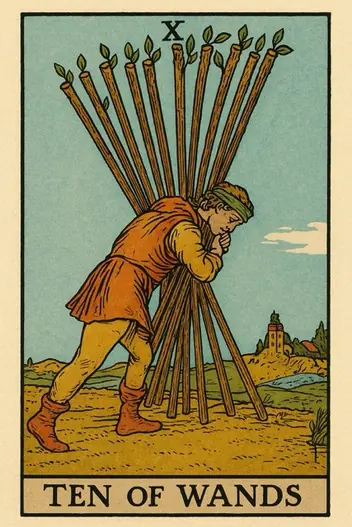
- The Hermit — Major Arcana; Ten of Wands — Minor Arcana, Wands
- Elements
- The Hermit — Earth; Ten of Wands — Fire
- Elemental interaction
- Neutral elements — energies coexist without conflict
- Numerology
- 9 + 10 = 19 → 1
When The Hermit—the archetype of introspection and inner truth—collides with the Ten of Wands—the card of overwhelming responsibility and burnout—we see a psychological paradox. The seeker is carrying a heavy load, yet feels compelled to retreat into isolation to figure it out alone. This is not a call for more solitude, but a strategic signal that your current method of problem-solving is unsustainable.
The core tension here lies between self-reliance and resource exhaustion. The Hermit’s lantern illuminates the path, but the Ten of Wands reminds us that you cannot see clearly when you are hunched over under a pile of obligations. Pragmatically, this combination demands a reassessment of what truly needs your attention and what can be delegated, postponed, or discarded.
The Hermit and Ten of Wands: How These Energies Interact
The psychological state created by The Hermit and Ten of Wands is one of overwhelmed introspection. You are not just busy; you are busy thinking about being busy. The mind loops through tasks, worries, and perceived failures, yet the body is frozen in a state of analysis paralysis. This is the shadow of the "lone wolf" mentality—a belief that you must solve every problem in isolation, even when the burden is crushing you.
The key insight is that the Ten of Wands represents a choice, not a sentence. The Hermit’s wisdom is to ask: “Which of these burdens are mine to carry, and which have I taken on out of fear, guilt, or ego?” The answer will not come from more effort, but from strategic withdrawal to prioritize. In practical terms, this means scheduling a "retreat day" to audit your commitments, not to escape them.
When these energies merge, the risk is self-imposed martyrdom. You may feel that no one else can do the job as well as you, or that asking for help is a sign of weakness. The reality is that this card pair is a warning against perfectionism disguised as diligence. The lantern of The Hermit shows that the most efficient path forward is to put down the extra wands, not to carry them faster.
The Hermit and Ten of Wands as Feelings
If you are single:
This combination suggests you are overthinking a potential partner. You may be analyzing every text or interaction to the point of exhaustion. The advice is to stop trying to figure them out alone—ask a trusted friend for an outside perspective, or simply let the connection breathe.
If you are in a relationship:
You or your partner are carrying an uneven emotional or logistical load. One person is retreating into silence (The Hermit) while the other is overwhelmed by responsibilities (Ten of Wands). This is a recipe for resentment.
In relationships, The Hermit and Ten of Wands often signal a power imbalance in emotional labor. One partner may be the "fixer" or the "planner," while the other withdraws into introspection, leaving the first person to shoulder all the practical and emotional burdens. The critical communication advice is to schedule a non-confrontational check-in where you both list what you are carrying. Do not assume the other person knows you are overwhelmed. Use "I" statements like "I feel like I am handling all the logistics alone, and I need help rebalancing this." The goal is to transform the burden from a solo project into a shared responsibility.
Your pair is already on the table. Ask your question and draw the clarifying card
or simply focus on it
The Hermit and Ten of Wands: Career and Money
Strategic Opportunities:
Audit your current projects. Identify the one task that, if removed, would reduce your stress by 50%. Delegate or eliminate it this week.
Strategic Opportunities:
Leverage your expertise. The Hermit’s mastery is valuable—consider consulting, mentoring, or writing a guide that systematizes your knowledge, so you don’t have to be the only one who can do the work.
Calculated Risks:
Avoid taking on new clients or projects until you finish or drop two existing ones. The risk of burnout is high, and your judgment is clouded by fatigue.
Professionally, this combination is a red flag for the "indispensable employee" or solo entrepreneur who refuses to build a team. Financially, the Ten of Wands warns of hidden costs of overwork: health bills, missed opportunities due to exhaustion, and poor negotiation because you are too tired to advocate for yourself. The strategic move is to automate or outsource repetitive tasks—even if it costs short-term money, it pays off in long-term clarity. Do not sign any contracts or make major financial decisions while in this state; The Hermit’s clarity requires distance from the noise. Instead, use this period to renegotiate terms on existing commitments, not to expand.
The Hermit and Ten of Wands Reversed Meaning
If The Hermit is reversed:
You are ignoring obvious signals that you need to stop. Reckless stubbornness drives you to run faster, even though the road leads to an abyss. Advice: forcibly take a 24-hour timeout from all obligations.
If the Ten of Wands is reversed:
You have shed the burden, but have not learned new behavioral patterns. Inner resistance manifests as procrastination and guilt about rest. You fear that without the burden, you will lose your sense of purpose. Advice: create a new ritual that replaces "heroic suffering" with "conscious productivity."
If BOTH are reversed:
Complete imbalance: you are simultaneously overloaded and refuse to acknowledge it. Identity crisis — you don't know who you are without your problems. Method for correction: start small — give up one micro-obligation (e.g., checking email after 8:00 PM) and track how this affects your state.
Ask your specific question
Don't rely on generic meanings. Get a customized reading tailored specifically to your energies.
Negative Meaning of The Hermit and Ten of Wands
The shadow of this combination is paralyzing perfectionism masked as wisdom. The seeker may believe they are being "strategic" by retreating to analyze, but in reality, they are avoiding the painful decision of letting go. Cognitive biases at play include the sunk cost fallacy ("I’ve already put in so much work, I can’t stop now") and the Dunning-Kruger effect (overestimating one’s ability to handle the load alone). Self-sabotage manifests as procrastination through over-analysis: you spend hours planning the perfect solution instead of taking one imperfect but effective action. The most dangerous pitfall is resentment toward others for not helping, when you never clearly communicated the need for assistance.
Overall Meaning of The Hermit and Ten of Wands
Constructive use of this energy requires a paradoxical action: you must stop in order to move faster. The Hermit gives you a tool—the capacity for deep reflection. The Ten of Wands is the fuel you are burning incorrectly. Your task is to transform a "heavy burden" into "conscious responsibility."
The first step is taking inventory of your commitments. Take a sheet of paper and divide it into three columns: "My Tasks," "Others' Tasks," and "Illusory Tasks." In the first column, place only what directly impacts your goals. In the second, everything you do for others. In the third, tasks that hold no significance yet consume your time. Eliminate columns 2 and 3.
The second step is shifting your paradigm from "porter" to "architect." Instead of hauling the load, design a system that distributes it. Here, the Hermit is your strategist, not a reclusive hermit. Use solitude for planning, not for escape.
The third step is dosed reflection. Do not try to solve all problems in a single session of introspection. Set aside 15 minutes a day for "silence" and record only one insight. This will prevent overload and allow the Ten of Wands to become not an enemy, but a resource—you will carry only what you have chosen to carry consciously.
Your Next Step: Personal Context Matters
The core message of The Hermit and Ten of Wands is that mastery requires both solitude and surrender. You must stop carrying everything alone to see clearly, and you must stop hiding in analysis to actually act. The path forward is not more work or more isolation—it is a deliberate, uncomfortable pause to drop the excess weight.
While this article provides the general archetype, the true magic happens when Tarot is applied to your unique situation. Your specific question, your personal history, and the surrounding cards in your spread will shift the meaning dramatically. To get a deep, personalized interpretation of this exact combination for your specific question, use the Fortune Cards app—available on the web or as a download. It’s the fastest way to turn these insights into actionable clarity right now.
Interpretation by the Fortune Cards editorial team, based on the Rider–Waite tradition and Jungian archetypes. About our methodology · Updated: 2026-08-26
Other Combinations with The Hermit
Other Combinations with Ten of Wands
Explore Individual Card Meanings
Table of Contents
- The Hermit and Ten of Wands: How These Energies Interact
- The Hermit and Ten of Wands as Feelings
- The Hermit and Ten of Wands: Career and Money
- The Hermit and Ten of Wands Reversed Meaning
- Negative Meaning of The Hermit and Ten of Wands
- Overall Meaning of The Hermit and Ten of Wands
- Your Next Step: Personal Context Matters
Ready to find answers to your questions?
Start your first reading now and look at your situation with fresh clarity. The cards are ready to reveal deeper meaning.