The Hermit and Three of Swords Meaning in Tarot
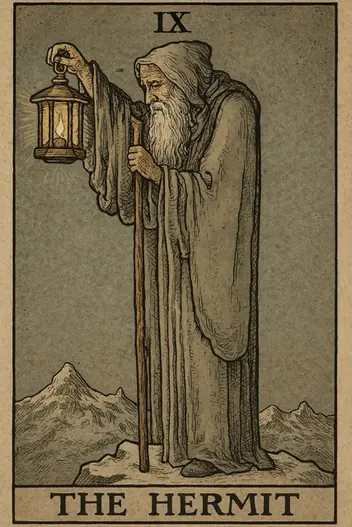

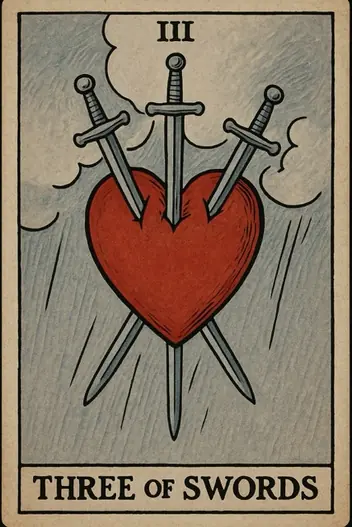
- Arcana
- The Hermit — Major Arcana; Three of Swords — Minor Arcana, Swords
- Elements
- The Hermit — Earth; Three of Swords — Air
- Elemental interaction
- Opposing elements — energies create tension
- Numerology
- 9 + 3 = 12 → 3
This combination represents a psychological bottleneck where solitary introspection meets acute emotional pain. The Hermit, the archetype of deliberate withdrawal and inner seeking, collides with the Three of Swords, the card of heartbreak, betrayal, and piercing truth. In real life, this manifests as a period where you are forced to be alone with a painful realization—a truth that cuts deeply but also illuminates. The core dynamic is not about avoiding the pain, but about using isolation as a crucible for cognitive restructuring and emotional release. This is not a passive suffering; it is an active, strategic withdrawal to process a wound that can no longer be ignored.
The Hermit and Three of Swords Card Meaning Explained
When The Hermit and Three of Swords appear together, the psychological state is one of necessary grief and deliberate analysis. You are not merely sad; you are strategically sad. The Hermit provides the mental framework to dissect the source of the pain without distraction. This is the moment to ask: What belief system just shattered? What illusion about myself or another person must I now discard? The Three of Swords delivers the raw data—the betrayal, the loss, the sharp truth—while The Hermit insists you sit with it, examine it, and extract its lesson.
The real-world implication is a high-stakes period of cognitive dissonance. You may feel a deep urge to isolate, not from depression, but from a need to protect the integrity of your analysis. The mind is processing a significant paradigm shift. The key insight here is that this is not a time for external validation. Seeking comfort from others will likely delay the necessary inner work. Instead, treat this as a research project on your own psyche: document the pain, identify the trigger, and map out the new boundaries required. The combination demands you become the scientist of your own suffering.
Your pair is already on the table. Ask your question and draw the clarifying card
or simply focus on it
The Hermit and Three of Swords for Career and Money
Strategic Opportunities:
This is an optimal time to conduct a post-mortem on a failed project or missed promotion. The solitude allows for ruthless honesty about your performance without office politics.
Strategic Opportunities:
Use this period to research a pivot. The Hermit’s deep dive can uncover a niche market or a skill gap you need to fill, turning the pain of a rejection into a strategic advantage.
Calculated Risks:
Do not make major financial decisions while emotionally raw. The Three of Swords can skew your risk assessment. Wait until the initial sting has subsided and you have a written plan.
For career and finances, this combination demands analytical detachment from emotional fallout. If you were passed over for a promotion, laid off, or had a business deal fall through, the natural reaction is to feel betrayed or undervalued. The strategic action is to schedule a one-week "no-contact" period with the situation. During that time, create a SWOT analysis (Strengths, Weaknesses, Opportunities, Threats) of your current position. The financial warning here is clear: do not burn bridges or resign in a fit of righteous anger. The Hermit’s wisdom is that the best revenge is a well-executed plan. Use the pain as fuel to update your resume, learn a new skill, or network quietly. The Three of Swords pierces the bubble of false security—use that clarity to cut out unprofitable ventures or toxic colleagues.
Your unique Tarot reading
See how these cards interact with your destiny. Start a free personal reading now.
The Hermit and Three of Swords as Feelings
If you are single:
This pair suggests you are currently evaluating a new connection through the lens of a past wound. Do not project old betrayals onto a new person. Instead, use the solitude to clarify what you actually need in a partner, not just what you fear.
If you are in a relationship:
A painful truth has surfaced or is about to surface. Withdraw to assess the damage objectively, not to punish your partner. The relationship may require a temporary cooling-off period to process a breach of trust.
In relationships, this combination signals a critical juncture for emotional intelligence. The Hermit’s energy prevents you from making impulsive accusations or seeking revenge, while the Three of Swords forces you to feel the full weight of the situation. The key relationship advice here is to distinguish between the pain of the truth and the pain of the ego. The truth might be that the relationship has run its course, or that a specific boundary was crossed. The ego’s pain might be about feeling foolish or rejected. Use the Hermit’s solitude to separate these two. Establish clear, time-bound space for reflection. Do not ghost; communicate that you need time to process. The goal is to return to the conversation with a clear head and a list of non-negotiable terms, not with a bleeding heart.
Negative Meaning of The Hermit and Three of Swords
The shadow manifestation of this combination is rumination disguised as introspection. You may convince yourself you are "processing" when you are actually rehearsing grievances and replaying the hurt on a loop. This is a cognitive bias known as the "narrative fallacy" —building a story around the pain that casts you as the perpetual victim. The pitfall is that the Three of Swords’ sharp energy can turn inward, leading to self-flagellation and harsh internal criticism. You might judge yourself for "not seeing it coming" or for being "too trusting." Another common trap is using the Hermit’s withdrawal as a weapon, giving someone the silent treatment under the guise of needing space. This is not introspection; it is passive-aggressive control. The poor judgment here lies in assuming that all pain must be processed alone. If the isolation leads to a spiral of despair rather than clarity, you have crossed from healthy analysis into self-sabotage.
The Hermit and Three of Swords Reversed Meaning
When cards appear reversed, the dynamic of pain and isolation becomes distorted, often transitioning into neurotic forms.
- The Hermit Reversed, Three of Swords Upright. The core issue is "blocked healing." You are aware of the pain (Three of Swords), but you refuse solitude and analysis. You seek comfort externally—in alcohol, shopping, casual encounters, or endless complaints to friends. This is a path to prolonged depression. Advice: Acknowledge your inability to cope alone and seek a professional psychologist. The Hermit reversed is the fear of being alone with one's shadow.
- The Hermit Upright, Three of Swords Reversed. The "internal resistance" scenario. The pain exists, but you deny, suppress, or rationalize it. You retreat into isolation (The Hermit), not for analysis, but to hide from your feelings. This is the most dangerous scenario for the psyche—a "frozen trauma." It will not disappear but will manifest as psychosomatic symptoms or sudden outbursts of anger. Advice: Find a way to "cry out" this pain. Journaling, art therapy, or bodywork can help release the blockage.
- BOTH Reversed. Complete imbalance and chaos. This is a state where a person can neither withdraw into themselves to think nor adequately process the pain. They oscillate between attempts to reclaim the past and panic attacks. The logical way to correct this is to return the cards to their upright positions. This means forcibly organizing a "ritual of solitude" (The Hermit upright) and giving yourself permission to experience the pain (Three of Swords upright). Without this, you risk making a fatal mistake in relationships or business.
The Hermit and Three of Swords: Tarot Advice
Constructive use of this pair's energy requires iron discipline and intellectual honesty. Your task is to use the light of the Hermit's lantern to perform a surgical operation (Three of Swords) on your psyche. You must excise from your worldview all illusions, false hopes, and toxic attachments. This is not destruction, but deconstruction.
Strategic advice: divide the process into two clear stages. The first stage is "Autopsy" (under the influence of the Three of Swords). For 1-3 days, allow yourself to fully immerse in the pain. Cry, rage, write angry letters (without sending them). Let the emotions out. The second stage is "Reflection" (under the influence of the Hermit). After the emotional peak, retreat into solitude for a week to coldly analyze what happened. Ask yourself: "What pattern led me to this pain?", "What lie was I telling myself?", "What new truth is now my foundation?"
Deep insight: The Three of Swords is not a sentence, but a diagnosis. The Hermit is not an escape, but a treatment. Together, they give you a chance not just to heal the wound, but to become stronger at the site of the scar. You cannot return to your former "self," but you can build a new, more resilient and conscious "self" that will not repeat these mistakes. Accept the pain as the price for wisdom, and solitude as the space for its crystallization.
Your Next Step: Personal Context Matters
The core message of The Hermit and Three of Swords is that clarity is born from confronting pain head-on, in solitude. This is not a time to numb or distract. It is a time to sit with the sharp truth, dissect it, and let it reshape your inner landscape. The strategic payoff is a stronger, more defined sense of self and boundaries.
While this article provides the archetypal blueprint, your situation is unique. The true power of Tarot lies in applying these energies to your specific question. That is why you should use the Fortune Cards app. Whether on the web or by downloading it, you can get a deep, personalized interpretation of this exact combination for your relationship, career, or personal query right now. Stop guessing—get the clarity you need.
Interpretation by the Fortune Cards editorial team, based on the Rider–Waite tradition and Jungian archetypes. About our methodology · Updated: 2026-08-26
Other Combinations with The Hermit
Other Combinations with Three of Swords
Explore Individual Card Meanings
Table of Contents
- The Hermit and Three of Swords Card Meaning Explained
- The Hermit and Three of Swords for Career and Money
- The Hermit and Three of Swords as Feelings
- Negative Meaning of The Hermit and Three of Swords
- The Hermit and Three of Swords Reversed Meaning
- The Hermit and Three of Swords: Tarot Advice
- Your Next Step: Personal Context Matters
Ready to find answers to your questions?
Start your first reading now and look at your situation with fresh clarity. The cards are ready to reveal deeper meaning.