Judgement and Six of Swords Meaning in Tarot
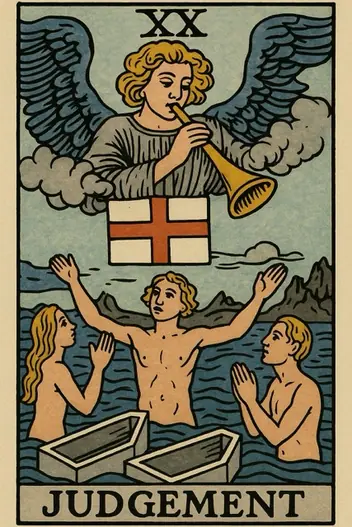
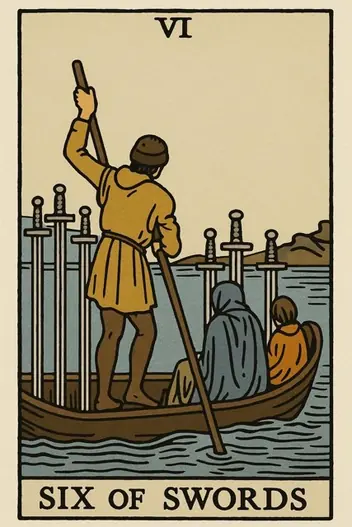
- Arcana
- Judgement — Major Arcana; Six of Swords — Minor Arcana, Swords
- Elements
- Judgement — Fire; Six of Swords — Air
- Elemental interaction
- Friendly elements — energies support each other
- Numerology
- 20 + 6 = 26 → 8
Judgement calls for a final reckoning—a moment of absolute truth where a past cycle must be closed. The Six of Swords offers the only logical path forward: a necessary, often painful, transition to calmer waters. When these two cards appear together, they signal that a definitive decision has been forced upon you, and the only sane response is to move on, even if the destination is uncertain. This is not a time for hesitation; it is a time for strategic departure.
Psychologically, this pairing represents the collision of the "Call to Awaken" (Judgement) with the "Retreat to Safety" (Six of Swords). You are being asked to objectively evaluate what has died in your life—a relationship, a job, an identity—and then to execute a disciplined exit plan. The core message is clear: you cannot heal in the same environment that broke you. The Judgement card provides the clarity; the Six of Swords provides the vessel.
Judgement and Six of Swords: How These Energies Interact
The core dynamic here is the transition from crisis to strategy. Judgement shatters denial, forcing you to see a situation for what it truly is. It exposes the cognitive dissonance you may have been living with—the gap between how things appear and how they actually function. The Six of Swords then steps in as the pragmatic response: you must now navigate away from the source of your pain using logic, planning, and emotional detachment.
This combination creates a high-risk, high-reward psychological state. You are leaving behind a known problem for an unknown solution. The risk is that you may feel numb or disconnected during the transition. The reward is that this is the most efficient path to genuine psychological resolution. The seeker is not running away; they are executing a calculated withdrawal from a situation that has already been judged as unsustainable. The key insight: this is not about forgiveness or redemption yet. This is about survival and strategic repositioning.
In practice, this card pair demands that you trust your judgment without needing external validation. The Six of Swords is a solitary journey. You may feel isolated, but this isolation is necessary for the integration of the truth that Judgement has revealed. Focus on the logistics of your departure, not the emotions of what you leave behind.
Your pair is already on the table. Ask your question and draw the clarifying card
or simply focus on it
Judgement and Six of Swords in Career Readings
Strategic Opportunities:
Exit gracefully from a toxic work environment. Use your judgment to identify the exact moment to resign or pivot.
Strategic Opportunities:
Invest in education or training for a new field. The "crossing over" energy supports career pivots.
Calculated Risks:
Avoid burning bridges. The Six of Swords warns against public confrontations. Your exit must be professional and silent to protect your future reputation.
Professionally, this is a transitional and evaluative period. Judgement indicates that a performance review, a project failure, or a major ethical dilemma has brought a clear verdict: your current path is no longer viable. The Six of Swords advises you to plan your departure meticulously. This is not the time for impulsive resignations. Instead, create a 30-60 day exit strategy that allows you to leave with your network intact and your finances stable.
A critical financial warning:
Do not make major investments during this transition. The Six of Swords is about moving light. Liquidate assets if necessary, but do not commit to long-term financial obligations until you have reached calmer waters. Your greatest asset right now is your mobility and your clear judgment. Use this period to reassess your career values. What kind of work environment actually supports your psychological health? The answer from this card pair is often: one that is quieter, more structured, and less dramatic.
Judgement and Six of Swords as Feelings
If you are single:
This combination suggests you are emerging from a period of emotional turmoil or a dead-end connection. Do not rush into a new relationship. Instead, focus on the internal reckoning of what you truly need. The right next step is to travel—literally or metaphorically—to a new emotional landscape alone.
If you are in a relationship:
You and your partner are facing a critical juncture. A major truth has surfaced that cannot be ignored. The relationship may be undergoing a fundamental restructuring, or it may be ending. The healthiest action is to agree on a clear, respectful transition plan rather than prolonging the conflict.
In love readings, Judgement and Six of Swords together often signify the end of a karmic cycle. This is not a casual breakup; it is a psychological divorce from a pattern of relating that no longer serves your growth. The most important relationship advice here is to avoid blame. Judgement is about personal accountability. The Six of Swords is about peaceful departure. Boldly state your truth, then withdraw with dignity. If you are staying together, this card pair indicates a need for radical honesty and a complete reboot of the relationship's operating system. Old agreements must be dissolved and new ones written.
Ask your specific question
Don't rely on generic meanings. Get a customized reading tailored specifically to your energies.
Judgement and Six of Swords Reversed: How to Read It
If Judgment is reversed, it indicates blocked potential and reckless denial. You hear the call for change but refuse to get off the couch. Psychologically, this is like recurring nightmares where you run but stay in place. Advice: acknowledge that your resistance is a form of self-deception. Find a psychologist or mentor who can play the role of an "external judge."
If the Six of Swords is reversed, it signifies internal resistance to movement. You already know what needs to be done, but the fear of the unknown paralyzes your will. This is not weakness, but a cognitive trap: you overestimate the risks of transition and underestimate the cost of staying in the swamp. Advice: break the "move" into micro-steps. Today – gather documents, tomorrow – send out the first resume.
If BOTH cards are reversed, you are facing a complete imbalance of dynamics. You are stuck at a crossroads, unable to either accept the verdict or move from the spot. This is a state of chronic crisis that leads to depression. A logical way to fix it: artificially create an external deadline. Give yourself an ultimatum: "If I haven't done X by the 1st, I will hire a lawyer / file an application / cut off communication." Shock therapy is the only way to break this vicious cycle.
Negative Meaning of Judgement and Six of Swords
The shadow of this combination manifests as emotional paralysis or false martyrdom. The seeker may interpret the Judgement card as a sign to punish themselves or others, rather than to simply see the truth. They may use the Six of Swords as an excuse for passive-aggressive withdrawal—leaving without communicating why, or fleeing from a situation that could actually be healed.
A major pitfall is cognitive bias known as "sunk cost fallacy." The Judgement card shows the truth, but the ego may resist, thinking, "I’ve invested too much to leave now." This leads to stagnation. Alternatively, the seeker might rush the crossing without proper planning, leading to financial or emotional shipwreck. The shadow also includes a tendency toward emotional numbness. You may detach so effectively that you fail to process the grief of what you are leaving behind, which will resurface later. To avoid these pitfalls, balance the clarity of Judgement with the patience of the Six of Swords. Move, but move with a map.
Judgement and Six of Swords: Tarot Advice
Constructive use of this combination requires paradoxical discipline: to accept the verdict without being broken by it. The energy of Judgment should be directed not at self-flagellation, but at a rational inventory of the past. Make a list: what exactly led to this moment? Which of your decisions were mistaken? Write them down and burn the paper — this is a symbolic act of farewell to the illusion of control over the past.
Then, activate the Six of Swords through the "two-column" method in real life. Take a sheet of paper and divide it into two columns: "What I leave behind" and "What I take with me." In the first column — people, habits, debts, projects that have been condemned by Judgment. In the second — skills, capital, health, values. Your task is to lighten the boat as much as possible, leaving only what is necessary for survival on the new shore.
A strategic tip for arming yourself with clarity: use the "10-10-10" principle. Ask yourself: how will this decision affect my life in 10 minutes, 10 months, and 10 years? If in 10 years you will be grateful for the harshness of today's choice — act without hesitation. The Six of Swords does not promise an easy road, but it guarantees that movement, even painful, is better than standing still. Your task is not to avoid the storm, but to learn how to steer the boat through it.
Your Next Step: Personal Context Matters
The Judgement and Six of Swords combination delivers a powerful, singular message: you know what needs to end, and you know you must move on. The general archetype is clear—it is time for a strategic, honest departure to a new emotional or professional shore. However, the specific timing, the right direction, and the hidden resistance can only be understood when Tarot is applied to your unique life context.
This is where the Fortune Cards app becomes your most valuable tool. While this article provides the universal psychology of these two cards, the app uses your exact question and situation to generate a deeply personalized interpretation. It accounts for your specific relationship dynamics, career pressures, and personal history. Stop guessing and start navigating. Use the Fortune Cards app on the web or download it now to get a precise, actionable reading for this exact combination, tailored to your life. Your next step is just a click away.
Interpretation by the Fortune Cards editorial team, based on the Rider–Waite tradition and Jungian archetypes. About our methodology · Updated: 2026-08-26
Other Combinations with Judgement
Other Combinations with Six of Swords
Explore Individual Card Meanings
Table of Contents
- Judgement and Six of Swords: How These Energies Interact
- Judgement and Six of Swords in Career Readings
- Judgement and Six of Swords as Feelings
- Judgement and Six of Swords Reversed: How to Read It
- Negative Meaning of Judgement and Six of Swords
- Judgement and Six of Swords: Tarot Advice
- Your Next Step: Personal Context Matters
Ready to find answers to your questions?
Start your first reading now and look at your situation with fresh clarity. The cards are ready to reveal deeper meaning.