Seven of Swords and Eight of Swords Reversed in Tarot
- Arcana
- Seven of Swords — Minor Arcana, Swords; Eight of Swords — Minor Arcana, Swords
- Elements
- Seven of Swords — Air; Eight of Swords — Air
- Elemental interaction
- Same element — energies intensify each other
- Numerology
- 7 + 8 = 15 → 6
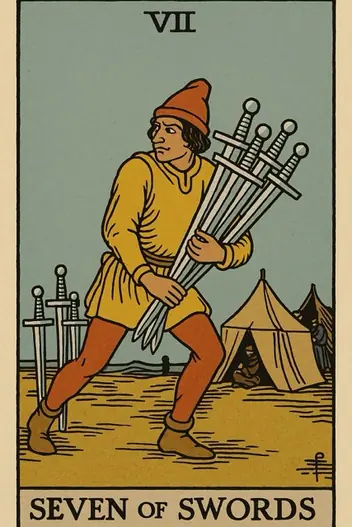
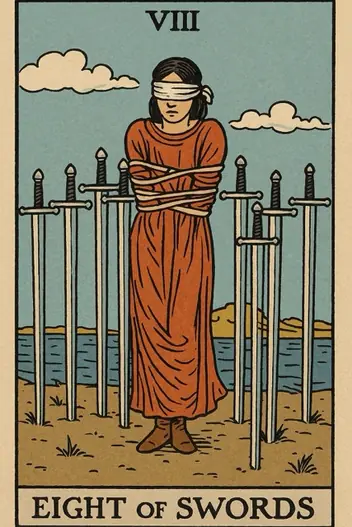
When the Seven of Swords—the card of stealth, strategy, and self-preservation—meets the Eight of Swords—the card of mental imprisonment, self-imposed limitations, and anxious paralysis—the result is a powerful psychological paradox. You are simultaneously plotting an escape while feeling trapped by your own thoughts. This combination reveals a person who knows they need to act but is caught between the fear of getting caught and the fear of staying stuck.
In real-world terms, this pairing often surfaces when someone is weighing the cost of a clever move against the weight of their own self-doubt. The Seven of Swords urges you to be resourceful and discreet; the Eight of Swords warns that your biggest obstacle may not be external, but internal. Together, they demand a hard look at whether your perceived constraints are real or manufactured by your own mind.
Seven of Swords and Eight of Swords Together: Meaning
The core dynamic here is a tension between action and paralysis. The Seven of Swords represents a calculated, sometimes deceptive, approach to problem-solving. You may be tempted to take a shortcut, hide information, or maneuver around a conflict to avoid direct confrontation. The Eight of Swords, however, introduces a layer of cognitive distortion—you feel blindfolded, bound, and unable to see a clear way out. This creates a feedback loop: the more you scheme, the more trapped you feel; the more trapped you feel, the more desperate your schemes become.
Psychologically, this combination points to a defense mechanism of avoidance. You are using cleverness (Seven of Swords) to protect yourself from the vulnerability of facing your fears (Eight of Swords). The key insight is that your escape plan may be unnecessary if you first untie the mental knots holding you back. The Eight of Swords is often a self-constructed prison—the blindfold is your own refusal to see options. The Seven of Swords, then, becomes a tool to either break free or to dig yourself deeper into a web of half-truths.
The most important takeaway is that you must distinguish between genuine threats and perceived threats. Are you hiding because someone is actually dangerous, or because you fear judgment? Are you plotting because you have no other choice, or because you refuse to ask for help? This card pair asks you to pause your strategy and examine your reality with brutal honesty.
Seven of Swords and Eight of Swords: Career and Money
Strategic Opportunities:
Leverage your analytical skills to identify hidden gaps in the market or internal inefficiencies. Your ability to see what others miss (Seven of Swords) is an asset—use it ethically to outmaneuver competition, not to deceive colleagues.
Strategic Opportunities:
Use this time to quietly gather information before making a major move. The Eight of Swords warns against impulsive decisions based on fear. Research thoroughly, then act with precision.
Calculated Risks:
Avoid any temptation to cut corners, hide financial losses, or engage in office politics that could backfire. The Eight of Swords suggests that your current feeling of being stuck may be temporary—a rash "escape" could create worse problems.
In a professional context, this card pair signals a critical decision point. You may feel trapped in a job, a project, or a financial situation, and the Seven of Swords energy tempts you to find a clever way out—perhaps by applying for jobs in secret, manipulating data, or withholding information from a partner. Bold financial warning: Do not confuse a strategic retreat with dishonest escape. The Eight of Swords reminds you that many of your limitations are perceptual. Before scheming, ask yourself if the trap is real or imagined.
Practical advice for career: Create a pros-and-cons list of staying vs. leaving, but include one column for "fears" and one for "facts." This forces you to separate objective reality from subjective anxiety. For finances, audit your budget and debts with ruthless clarity—the Seven of Swords' cunning is best applied to finding savings or revenue streams, not hiding losses. The smartest move is to consult a trusted mentor or financial advisor who can see the blind spots you cannot.
Your pair is already on the table. Ask your question and draw the clarifying card
or simply focus on it
Seven of Swords and Eight of Swords Love Outcome
If you are single:
This combination suggests you may be attracted to someone who seems intriguing but potentially unreliable. Beware of projecting mystery onto someone who is simply withholding. Your own fear of rejection could be causing you to play games or rationalize red flags.
If you are in a relationship:
A pattern of avoidance and secrecy may be eroding trust. You or your partner might be retreating into silence or small deceptions rather than addressing underlying issues. The relationship feels like a trap, but the cage is built from unspoken fears.
In relationships, the Seven of Swords and Eight of Swords together often indicate a power imbalance rooted in fear. One partner may feel the need to hide their true feelings (Seven of Swords) to avoid conflict, while the other feels trapped by the resulting emotional distance (Eight of Swords). The solution lies in radical transparency. Bold key relationship advice: Stop strategizing around each other and start communicating directly. The escape you seek (Seven of Swords) is not through deception but through vulnerability. The freedom you crave (Eight of Swords) comes not from removing external obstacles but from voicing your internal ones.
Emotional intelligence here means recognizing that your partner is not your enemy. The Eight of Swords' blindfold is your own unwillingness to see their perspective. The Seven of Swords' stealth is your own refusal to be honest. The most practical step is to schedule a calm, uninterrupted conversation where both parties agree to speak without judgment. This breaks the cycle of mental imprisonment and secretive maneuvering.
Get a personalized interpretation
Unlock the combined meaning of your cards in the context of your unique question — for free.
The Shadow Side of Seven of Swords and Eight of Swords
The shadow side of this combination is active self-sabotage through calculated deception. When the Seven of Swords is ungrounded, it becomes manipulation and theft of trust. When the Eight of Swords is unexamined, it becomes victimhood and helplessness. Together, they can manifest as a person who blames external circumstances for their own avoidant behavior. Cognitive biases like the "illusion of control" (thinking you can outsmart everyone) and "learned helplessness" (believing there is no way out) collide.
Common pitfalls include: lying to yourself about the severity of a situation, using "strategy" as an excuse for dishonesty, or remaining passive while secretly resenting others. The Eight of Swords' blindfold can make you miss obvious solutions, while the Seven of Swords' stealth can make you miss the damage you are causing. The greatest risk is that you become so focused on your escape plan that you fail to notice the door was unlocked all along. Poor judgment here often stems from a refusal to ask for help—pride (Seven of Swords) meets fear (Eight of Swords) to create a perfect storm of isolation.
Seven of Swords and Eight of Swords Reversed: How to Read It
When cards appear in a reversed position, the dynamic becomes distorted, but does not disappear.
Reversed Seven of Swords:
Your plan has failed, or you have been caught by your own cunning. The energy has devolved into recklessness. Now you are not the manipulator, but the victim of someone else's trap. Advice: Acknowledge your vulnerability. Do not try to "get even"—this will lead to even greater losses. Focus on minimizing the damage.
Reversed Eight of Swords:
Fear begins to release its grip, but you are still in confusion. The blindfold is falling from your eyes, but you do not know where to run. Advice: Do not wait for complete clarity. Start with a small action—even a wrong step is better than standing still. This will shatter the illusion of total isolation.
Both Reversed:
Complete imbalance: you are acting chaotically and feel cornered by your own mistakes. You are simultaneously the aggressor and the victim. Advice: Stop. Any active action now will worsen the situation. Take a 24-48 hour pause to separate real threats from the products of your imagination.
Seven of Swords and Eight of Swords: The Combined Message
Constructive use of this pair requires paradoxical thinking. You must simultaneously embrace your capacity for cunning (Seven) and honestly acknowledge your fears (Eight). The strategy is not to flee from fear, but to use it as a source of information. Ask yourself: "What exactly am I afraid of? Loss of control? Judgment? Financial ruin?" Once the fear is named, it ceases to be a vague threat and becomes a concrete task.
Your next step is the integration of the rational and the irrational. The Seven of Swords offers a "Plan B," while the Eight suggests that "Plan A" is too risky. Instead of choosing between them, create a "Plan C" that takes both warnings into account. For example: "I will take this risky step, but only after I have created a safety net (a financial cushion, an escape route, public support)." Your strength lies in the ability to act without one hundred percent guarantees. Embrace uncertainty as the price of freedom.
Where to Go From Here
The core message of Seven of Swords and Eight of Swords is: Your mind is both your greatest weapon and your most confining prison. You have the intelligence to navigate complex situations, but that same intelligence can trap you in loops of overthinking and secrecy. The path forward requires discernment—knowing when to be strategic and when to be transparent. The freedom you seek is not found in a clever trick, but in the courage to see your situation clearly and act with integrity.
To truly understand what this combination means for your unique life, you need a reading that factors in your specific question, other cards, and your personal context. The Fortune Cards app offers exactly that. Whether you use it on the web or download it, you can get a deep, personalized interpretation of this exact combination for your specific question right now. Stop guessing—let the cards speak directly to your situation.
Interpretation by the Fortune Cards editorial team, based on the Rider–Waite tradition and Jungian archetypes. About our methodology · Updated: 2026-09-17
Other Combinations with Seven of Swords
Other Combinations with Eight of Swords
Explore Individual Card Meanings
Table of Contents
- Seven of Swords and Eight of Swords Together: Meaning
- Seven of Swords and Eight of Swords: Career and Money
- Seven of Swords and Eight of Swords Love Outcome
- The Shadow Side of Seven of Swords and Eight of Swords
- Seven of Swords and Eight of Swords Reversed: How to Read It
- Seven of Swords and Eight of Swords: The Combined Message
- Where to Go From Here
Ready to find answers to your questions?
Start your first reading now and look at your situation with fresh clarity. The cards are ready to reveal deeper meaning.