Seven of Wands and Eight of Cups Meaning in Tarot
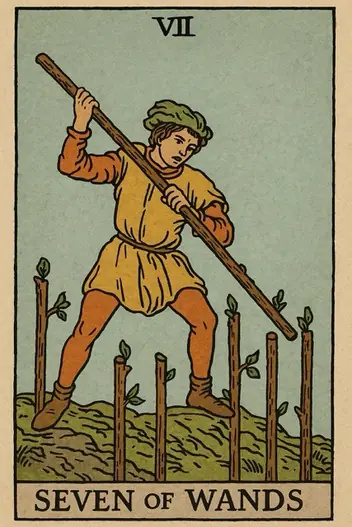

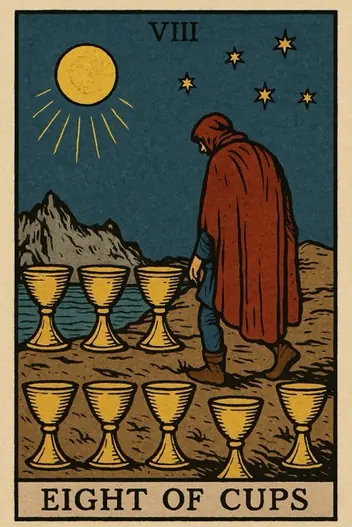
- Arcana
- Seven of Wands — Minor Arcana, Wands; Eight of Cups — Minor Arcana, Cups
- Elements
- Seven of Wands — Fire; Eight of Cups — Water
- Elemental interaction
- Opposing elements — energies create tension
- Numerology
- 7 + 8 = 15 → 6
The collision of the Seven of Wands and the Eight of Cups creates a powerful psychological tension: the drive to defend your position versus the urge to walk away entirely. In practical terms, this card pair represents a critical decision point where you must assess whether your current struggle is a noble stand worth fighting for—or a draining commitment that is quietly eroding your resources and self-respect.
Jungian psychology frames this as a confrontation between the Warrior archetype (holding the line) and the Wanderer archetype (seeking new horizons). The key insight is that both impulses can be valid, but only one will serve your long-term psychological health. The Seven of Wands demands you ask: "Am I defending a value or just my ego?" The Eight of Cups asks: "Am I leaving a toxic situation or simply avoiding discomfort?" The answer lies in honest self-assessment of your motivations, not in the surface-level drama of the conflict.
Seven of Wands and Eight of Cups Card Meaning Explained
When these two cards appear together, the core dynamic is a defensive posture that has become unsustainable. You are likely in a situation where you have been fighting to maintain control—whether over a project, a relationship, or a personal boundary—but the effort required is now outweighing the rewards. The Seven of Wands energy keeps you standing your ground, but the Eight of Cups whispers that the ground itself may not be worth holding.
This combination often surfaces when you are defending a position that no longer aligns with your deeper values. The psychological state here is one of ambivalent exhaustion: you know you could keep fighting, but you are beginning to question why you should. The Eight of Cups does not represent failure; it represents strategic withdrawal to preserve your energy for something more meaningful. The real challenge is distinguishing between a temporary setback that requires persistence and a fundamental misalignment that requires departure.
A pragmatic interpretation demands that you audit your current battles. Ask yourself: Is this conflict about a core principle I cannot abandon, or is it about a preference I have mistaken for a necessity? The Seven of Wands can become a trap of false pride—continuing to fight simply to avoid admitting you chose poorly. The Eight of Cups can become a trap of premature surrender—leaving before you have extracted the learning or leverage you need. The wisest path is to hold your position just long enough to secure a graceful exit, not to win a war you no longer believe in.
Your pair is already on the table. Ask your question and draw the clarifying card
or simply focus on it
Seven of Wands and Eight of Cups as Feelings
If you are single:
This combination warns against defending a connection that has already shown its limits. You may be fighting to keep someone interested who is already emotionally checked out. Evaluate whether your persistence is genuine passion or just fear of being alone.
If you are in a relationship:
You are likely in a power struggle where one partner is defending their autonomy while the other is emotionally withdrawing. The risk is a cold standoff where neither feels heard, and the relationship slowly starves.
In relationships, the Seven of Wands and Eight of Cups signals a critical inflection point where the emotional cost of staying may exceed the benefits. The defensive partner (Seven of Wands) is likely protecting their ego or their version of the relationship, while the withdrawing partner (Eight of Cups) is silently calculating whether the effort is worth it. Bold relationship advice: Do not mistake silence for peace. The Eight of Cups often indicates emotional abandonment before physical separation occurs. If you are the defender, ask directly what your partner needs instead of assuming you already know. If you are the one considering leaving, communicate your reasons clearly before you walk away—otherwise, you risk repeating the same pattern in your next relationship.
Key insight: This pair often appears when one partner has been fighting for the relationship alone. The Seven of Wands energy is sustainable only if both people are equally committed. If you feel like you are the only one holding the line, the Eight of Cups is not a betrayal—it is a necessary reality check. The healthiest outcome is either a renewed mutual commitment or a clean, respectful separation that allows both partners to heal.
Seven of Wands and Eight of Cups for Career and Money
Strategic Opportunities:
Exit gracefully from a project that is draining your resources—this frees capital and attention for higher-yield opportunities. Use your defensive skills to negotiate a better severance or transition package before you leave.
Strategic Opportunities:
Pivot your career focus toward roles that align with your core values—the Eight of Cups energy is a compass pointing you toward more meaningful work, even if it means a temporary pay cut.
Calculated Risks:
Avoid burning bridges—the Seven of Wands can make you fight dirty when you feel cornered, which destroys future references. Do not leave without a financial buffer—the Eight of Cups can lead to impulsive resignation without a safety net.
In the professional realm, this card combination is a clear signal to reassess your current position with cold objectivity. You may be defending a job, a client relationship, or a business strategy that is no longer serving your long-term goals. The Seven of Wands energy can keep you fighting for a promotion or a project that has become a sunk cost—you have invested so much time and energy that you cannot see the exit. However, the Eight of Cups demands you calculate the opportunity cost of staying.
Bold financial warning: Do not let loyalty to past effort blind you to present losses. If you are spending more energy defending your position than you are gaining in compensation or growth, it is time to plan your departure. This is not about quitting impulsively; it is about strategically redirecting your efforts toward a path with better returns. Practical advice: Update your resume, network quietly, and set a three-month exit timeline if conditions do not improve. The Eight of Cups does not mean immediate flight—it means beginning the mental and logistical preparation to leave.
Uncover hidden insights
Let our advanced Tarot system interpret these archetypes specifically for your personal path.
Negative Meaning of Seven of Wands and Eight of Cups
The shadow of this combination is cognitive dissonance—believing you are fighting for a just cause when you are actually fighting to avoid admitting a mistake. The Seven of Wands shadow manifests as aggressive defensiveness: you become argumentative, rigid, and unwilling to consider alternative perspectives. The Eight of Cups shadow manifests as emotional avoidance: you walk away without closure, leaving unresolved issues that will resurface later.
Another common pitfall is misidentifying the source of the conflict. You may blame external circumstances (a difficult boss, an unsupportive partner) when the real issue is your own unclear boundaries or unrealistic expectations. The self-sabotage pattern here is fighting battles you cannot win, then leaving just before you could have learned a valuable lesson. This creates a cycle of defeat and withdrawal that prevents genuine growth.
Bold warning: Beware of the "martyr complex" —the belief that your suffering is noble and that leaving would be a betrayal of your values. Sometimes the most courageous act is not to hold the line, but to admit the line was drawn in the wrong place. Similarly, do not romanticize the Eight of Cups as a "spiritual journey" when it is actually emotional cowardice. The shadow path is either fighting until you are destroyed or leaving before you have truly tried.
Seven of Wands and Eight of Cups Reversed Meaning
When the Seven of Wands is reversed, the defense becomes chaotic or passive. You are not repelling attacks; you are simply absorbing blows, hoping the opponent will tire. This is blocked potential — you are not using your aggression for defense, leading to a rapid loss of ground. Advice: stop waiting for the problem to resolve itself and take an active, even if uncomfortable, stance.
If the Eight of Cups is reversed, the departure becomes impossible. You are stuck in a swamp you wish to leave, but internal resistance (fear, inertia, guilt) prevents you from taking a step. This is a trap of apathy. Instead of leaving gracefully, you stay and slowly destroy everything around you. Advice: acknowledge that staying is also a choice, and it requires responsibility.
When BOTH cards are reversed, a complete imbalance arises. You can neither defend nor leave. This is a state of paralysis of the will, where a person endures humiliation, lacking the strength to either fight back or walk away. This requires immediate intervention: restoring the basic right to choose. Start small — make one decision that returns a sense of control (for example, turn off notifications from a toxic person).
Seven of Wands and Eight of Cups: Tarot Advice
How to constructively use the energy of these cards? The key lies in integrating defense and withdrawal into a single strategy. The Eight of Cups is not about escape, but about movement toward something new. The Seven of Wands is not about aggression, but about protecting your values. Your task is to understand what you are defending and where you truly want to go.
Strategic advice: use the Eight of Cups as a compass and the Seven of Wands as a shield. First, determine the direction of your withdrawal (what you want to build or find), then use defense to protect that path. Do not defend the ruins of the past—defend the road to the future.
Practical action algorithm:
Diagnosis:
Honestly answer—are you defending what you love, or what you fear to lose?Planning:
Write an "evacuation" plan—concrete steps for exiting the situation.Defense:
Use the energy of the Seven of Wands only to protect this plan, not to prove you were right in the past.
Deep conclusion:
The strongest defense is not the one that holds positions, but the one that allows you to safely retreat and regroup. Do not be afraid to leave the battlefield if the battle is already lost. Your strength lies not in stubbornness, but in the ability to change strategy in time.
Your Next Step: Personal Context Matters
The Seven of Wands and Eight of Cups together deliver a single, urgent message: you are at a crossroads where pride and practicality must be weighed against each other. The wisest course is to defend your core values but abandon your attachment to outcomes. Hold your ground only as long as it serves your deeper purpose, then walk away with dignity when the cost exceeds the benefit. The goal is not to win every battle, but to preserve your energy for the battles that truly matter.
While this article provides the general psychological archetype of this card combination, the true power of Tarot lies in its application to your specific situation. The meaning of Seven of Wands and Eight of Cups shifts dramatically depending on whether you are asking about a toxic relationship, a dead-end job, or a creative project that has lost its spark. Do not rely on generic interpretations alone. Use the Fortune Cards app to get a deep, personalized reading of this exact combination for your unique question. Whether you access it on the web or download it, the app applies Jungian psychology and targeted Tarot analysis to your specific context—giving you the clarity to make your next move with confidence.
Interpretation by the Fortune Cards editorial team, based on the Rider–Waite tradition and Jungian archetypes. About our methodology · Updated: 2026-08-26
Other Combinations with Seven of Wands
Other Combinations with Eight of Cups
Explore Individual Card Meanings
Table of Contents
- Seven of Wands and Eight of Cups Card Meaning Explained
- Seven of Wands and Eight of Cups as Feelings
- Seven of Wands and Eight of Cups for Career and Money
- Negative Meaning of Seven of Wands and Eight of Cups
- Seven of Wands and Eight of Cups Reversed Meaning
- Seven of Wands and Eight of Cups: Tarot Advice
- Your Next Step: Personal Context Matters
Ready to find answers to your questions?
Start your first reading now and look at your situation with fresh clarity. The cards are ready to reveal deeper meaning.