Love Tarot: Seven of Wands and Eight of Swords
- Arcana
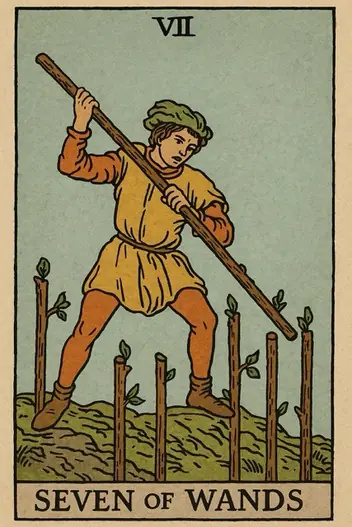
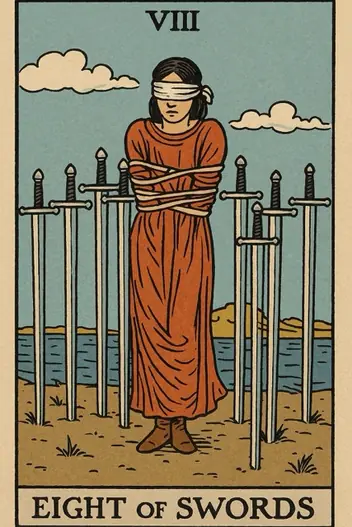
- Seven of Wands — Minor Arcana, Wands; Eight of Swords — Minor Arcana, Swords
- Elements
- Seven of Wands — Fire; Eight of Swords — Air
- Elemental interaction
- Friendly elements — energies support each other
- Numerology
- 7 + 8 = 15 → 6
The intersection of the Seven of Wands and the Eight of Swords creates a powerful psychological paradox. The Seven of Wands represents a defensive posture—standing your ground against external challenges, often with courage and grit. The Eight of Swords, by contrast, depicts internal bondage: a feeling of being trapped, blinded, and powerless, often by one’s own thoughts. Together, they reveal a dynamic where external pressure triggers an internal crisis of self-doubt.
This combination is not about a literal physical battle. It is about the moment when a fight for your position (Seven of Wands) collides with a mental prison (Eight of Swords). The seeker may feel they are fighting alone, but the real adversary is the limiting belief that they are outnumbered, outsmarted, or already defeated. Understanding this interplay is key to strategic action and psychological liberation.
Seven of Wands and Eight of Swords Combination Meaning
When the defensive energy of the Seven of Wands meets the restrictive mindset of the Eight of Swords, the result is a state of high alert mixed with cognitive paralysis. The seeker is likely aware of a threat or challenge (Seven of Wands) but feels unable to act effectively because they are blinded by fear, guilt, or self-imposed rules (Eight of Swords). This is not a time for passive waiting; it is a call to identify the difference between a real enemy and a phantom fear.
The psychological core here is projection and internal conflict. The seeker may be projecting their own insecurities onto an external situation, believing that others are attacking them when, in fact, they are their own harshest critic. Alternatively, they may be fighting for a position that is no longer viable, trapped by the fear of change. The key insight is that the perceived "swords" (obstacles) are often mental constructs, not physical realities. The Seven of Wands’ energy must be redirected from fighting the world to fighting the inner narrative of helplessness.
To break this cycle, the seeker must first acknowledge their own agency. The Eight of Swords’ blindfold is self-imposed; removing it begins with a single, honest question: "What am I afraid to see?" The Seven of Wands then becomes a tool for setting firm boundaries against negative self-talk, not just against external opponents. This combination demands a strategic pause: assess the battlefield, distinguish real threats from imagined ones, and then choose a single, focused action to regain momentum.
Your pair is already on the table. Ask your question and draw the clarifying card
or simply focus on it
Career Meaning of Seven of Wands and Eight of Swords
Strategic Opportunities:
This is a powerful time to redefine your professional boundaries. You may be fighting for a project or position that is draining you. The opportunity lies in stepping back to see if the fight is worth your energy.
Strategic Opportunities:
Use the Eight of Swords’ reflective energy to identify a hidden skill or resource you have overlooked. Your feeling of being trapped may be a sign that you need to delegate, automate, or seek mentorship.
Calculated Risks:
Avoid making hasty, defensive decisions in negotiations or financial matters. Do not sign contracts or make major commitments while feeling pressured or cornered. The biggest risk is acting from a scarcity mindset, believing you have no options when, in fact, you do.
In your career, the Seven of Wands and Eight of Swords combination points to a professional stalemate. You may be working hard to defend your reputation, workload, or position, but you feel mentally constrained by office politics, unclear expectations, or a lack of resources. The solution is strategic disengagement from unproductive battles. Instead of fighting every small fire, focus on one clear, high-impact goal. Financially, this is a warning against "defensive spending"—using money to soothe anxiety or to prove a point. Bold move: create a 30-day "no new commitments" rule to break the cycle of reacting to pressure. Use this time to gather information and clarify your true priorities. The feeling of being trapped is a signal to redesign your approach, not to double down on a failing strategy.
Ask your specific question
Don't rely on generic meanings. Get a customized reading tailored specifically to your energies.
Seven of Wands and Eight of Swords in Love Tarot
If you are single:
This combination suggests you may be defending yourself against the idea of vulnerability, fearing judgment or rejection before it even occurs. Your "battle" is not with others but with your own perfectionism or past trauma. Consider whether you are using defensiveness to avoid the risk of intimacy.
If you are in a relationship:
You and your partner may be stuck in a power struggle where both feel trapped and misunderstood. One or both of you is likely defending a position while feeling victimized by the other’s perspective. The real issue is not the argument itself, but the lack of clear communication and mutual empathy.
In relationships, this pairing often signals a toxic cycle of defensiveness and resentment. The Seven of Wands partner feels attacked and digs in, while the Eight of Swords partner feels silenced and helpless. The path forward requires a radical shift from "winning" to "understanding." Both partners must acknowledge that their "swords" are often self-inflicted—assumptions, unspoken expectations, or past hurts that are being projected onto the present. Practical advice: schedule a "no-blame" conversation where each person speaks only about their own feelings of being trapped, without accusing the other. This breaks the defensive loop and opens the door to genuine connection.
Reversed Positions: What Changes?
If the Seven of Wands is reversed (and the Eight of Swords is upright):
You have given up without a fight. The defense mechanism is broken, and you fall into passive victimhood. You not only feel trapped (Eight of Swords), but you also make no attempt to escape. The risk of depression and loss of will to act is extremely high. Advice: start with a small action to break the cycle of paralysis.
If the Eight of Swords is reversed (and the Seven of Wands is upright):
You begin to see a way out, but your reaction is aggression. You lash out at those trying to help you, confusing aid with a threat. You are no longer locked in, but you keep swinging your sword. The risk is ruining relationships with those who extend a helping hand. Advice: realize that your battle is over.
If BOTH are reversed:
Complete imbalance — chaotic aggression mixed with total disorientation. You don't know who to fight or why. This is a state of inner chaos where a person creates problems out of thin air just to feel alive. Correction strategy: total information detox and a complete halt of all activity for 48 hours. It is necessary to reset the cognitive noise.
Seven of Wands and Eight of Swords: Warning Signs
The shadow of this combination is paranoid defensiveness and learned helplessness. The seeker may become hypervigilant, interpreting every minor setback as a major attack, while simultaneously feeling unable to take any effective action. This leads to a state of chronic stress and burnout, where the individual exhausts themselves fighting imaginary battles. The cognitive bias at play is confirmation bias: the seeker only notices evidence that supports their feeling of being trapped, ignoring opportunities for escape. Another pitfall is victim identity—using the Eight of Swords’ imagery of helplessness to avoid taking responsibility for one’s own choices. The shadow warns against using past trauma as a permanent excuse for inaction. The true danger is not the external challenge, but the internal narrative that says "I cannot" when reality says "I choose not to."
Synthesis: Strategic Conclusion
Constructive use of this energy requires a radical shift of focus from the external enemy to the internal map. Your task is to use the momentum of the Seven of Wands not for defense, but for "demining" your own consciousness. Imagine you are a general who has realized the war was a mistake, and now your main task is to withdraw your troops from the battlefield without losses.
The first step is threat verification. Make a list of what you are fighting against. Next to each item, write objective evidence that this threat is real. With 90% probability, you will see that the list consists of assumptions. The second step is changing tactics from defense to reconnaissance. Instead of fortifying the walls, begin exploring the terrain. What opportunities are you ignoring while standing guard?
The third, most important step is acknowledging your vulnerability. The Seven of Wands demands a show of strength, but true strength in this situation is admitting that you are tired and confused. Strategic advice: voluntarily surrender one position. Give up defending something you don't actually need. You will see that the world hasn't collapsed, and the freed-up energy will finally allow you to see the real way out of the labyrinth you built for yourself.
Your Next Step: Personal Context Matters
The core message of the Seven of Wands and Eight of Swords is that your greatest obstacle is often the story you tell yourself about your limitations. You have the strength to defend what matters, but first you must see clearly. The battle is not against the world, but against the blindfold of fear and self-doubt. Take off the blindfold, identify one real threat, and take one small, decisive action.
While this article provides a general map of these archetypes, the true power of Tarot lies in its application to your unique life. Your specific question, relationship history, and career context will change the nuance of this reading completely. Get a deep, personalized interpretation of this exact combination for your specific situation right now by using the Fortune Cards app. Available on the web and for download, the app uses your precise question to unlock the most relevant psychological and strategic insights for your journey. Don’t fight your own mind alone—let the cards guide you to clarity.
Interpretation by the Fortune Cards editorial team, based on the Rider–Waite tradition and Jungian archetypes. About our methodology · Updated: 2026-08-26
Other Combinations with Seven of Wands
Other Combinations with Eight of Swords
Explore Individual Card Meanings
Table of Contents
- Seven of Wands and Eight of Swords Combination Meaning
- Career Meaning of Seven of Wands and Eight of Swords
- Seven of Wands and Eight of Swords in Love Tarot
- Reversed Positions: What Changes?
- Seven of Wands and Eight of Swords: Warning Signs
- Synthesis: Strategic Conclusion
- Your Next Step: Personal Context Matters
Ready to find answers to your questions?
Start your first reading now and look at your situation with fresh clarity. The cards are ready to reveal deeper meaning.