Seven of Wands and Ten of Swords Tarot as Feelings
- Arcana
- Seven of Wands — Minor Arcana, Wands; Ten of Swords — Minor Arcana, Swords
- Elements
- Seven of Wands — Fire; Ten of Swords — Air
- Elemental interaction
- Friendly elements — energies support each other
- Numerology
- 7 + 10 = 17 → 8
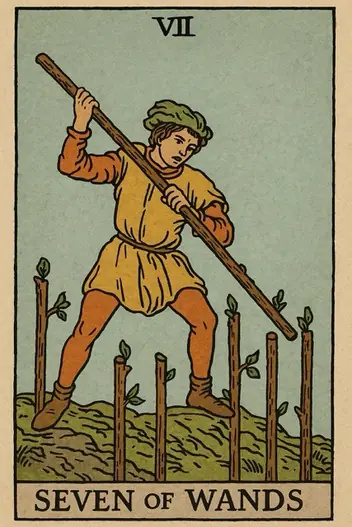
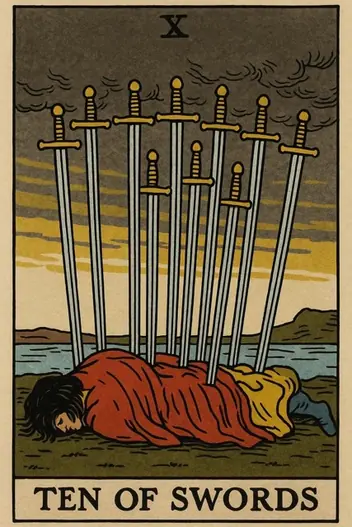
When the Seven of Wands—the card of defensive struggle and holding your ground—collides with the Ten of Swords—the archetype of rock-bottom endings and painful clarity—the result is a stark, pragmatic snapshot of a turning point. This isn't about mystical fate; it's about a psychological crossroads where your fight for control meets an undeniable reality check. The Seven of Wands represents the ego’s refusal to yield, while the Ten of Swords signals that the conflict has reached its natural, often brutal, conclusion. Together, they force a question: Are you fighting to protect something valuable, or are you merely prolonging a necessary collapse?
Psychologically, this pairing highlights the tension between resilience and acceptance. The Seven of Wands energy can be a healthy boundary or a stubborn defense mechanism. The Ten of Swords energy is the painful but liberating truth that some battles are lost—or must be surrendered—for growth to occur. The strategic key is to distinguish between a worthy defense and a self-destructive last stand. This combination asks you to assess your resources, your ego, and the actual cost of continuing the fight. The most pragmatic move is often to let the swords fall, absorb the lesson, and use the clarity of the ending to plan your next move.
Core Dynamics & Interpretation
The core dynamic here is a psychological confrontation between defensive action and inevitable conclusion. The Seven of Wands archetype embodies the fighter’s mindset: you are on higher ground, outnumbered, but fiercely committed to defending your position. This can represent a boundary you’re protecting—a creative project, a relationship boundary, or a career stance. However, the Ten of Swords archetype reveals that the battle has already taken a heavy toll. The swords represent overwhelming mental pressure, betrayal of expectations, or a conclusion that feels like defeat.
In practical terms, this combination often appears when a person is refusing to accept the end of a cycle. They are still swinging, still arguing, still defending a position that has already been critically wounded. The psychological insight here is the cognitive bias of sunk cost: the belief that because you have invested so much—emotionally, financially, or energetically—you must see it through. The Ten of Swords forces a reality check: persistence without strategic adjustment is not courage; it is self-sabotage. The most important takeaway is to distinguish between a necessary defense of your values and a futile defense of a losing position. The path forward requires you to stop fighting the ending and start planning the recovery.
What Do Seven of Wands and Ten of Swords Say About Love?
If you are single:
This pair suggests you may be defending a romantic ideal or a past hurt that is preventing you from seeing a new connection clearly. Let go of the defensive narrative and allow yourself to experience the ending of that old story.
If you are in a relationship:
You are likely in a cycle of conflict where one partner is fighting to be heard (Seven of Wands) while the other feels the relationship has reached a breaking point (Ten of Swords). Honest, vulnerable communication is non-negotiable.
In relationships, this combination often signals a power struggle that has escalated beyond healthy conflict. The Seven of Wands partner may be defending their autonomy, a decision, or a past grievance, while the Ten of Swords partner feels emotionally exhausted, betrayed, or convinced the relationship is over. The psychological trap is mutual defensiveness: each person is so focused on their own pain that they cannot see the other’s. The key is to differentiate between a boundary that protects the relationship and a wall that destroys it. If you are the one feeling like the "victim" (Ten of Swords), ask yourself: Are you truly being attacked, or are you avoiding accountability by playing the martyr? If you are the defender (Seven of Wands), ask: Is your fight about respect, or is it about control? The healthiest outcome is to let the argument die, not the relationship. This requires both partners to acknowledge the ending of a specific conflict pattern and consciously choose to rebuild from a place of mutual respect.
Your pair is already on the table. Ask your question and draw the clarifying card
or simply focus on it
Career and Finances
Strategic Opportunities:
Use the clarity of the Ten of Swords to identify exactly what went wrong in a project or job role. This is your data for a smarter pivot.
Strategic Opportunities:
The Seven of Wands energy can be channeled into protecting your core professional values—your intellectual property, your reputation, or a key client relationship—without fighting every minor battle.
Calculated Risks:
Avoid escalating a conflict with a superior or a competitor when the outcome is already clear. Do not throw good resources after bad.
In a career context, this combination is a red flag for burnout and strategic blindness. The Seven of Wands suggests you are fighting to maintain your position—perhaps against office politics, a budget cut, or a demanding client. The Ten of Swords warns that this fight may be costing you more than it’s worth. Financially, this is a warning against doubling down on a losing investment or business strategy. The pragmatic approach is to conduct a ruthless audit of your resources: time, energy, capital, and relationships. Ask: Is this battle worth the psychological toll? The Ten of Swords offers a painful but valuable lesson—it forces you to see the failure clearly so you can cut your losses and redirect your efforts. The most strategic move is to surrender the fight, not the goal. You can still achieve your career ambitions, but you must first accept that the current path is dead. Bold action tip: Write down the "swords" (the specific problems) and then cross out the ones you cannot control. Focus your defensive energy (Seven of Wands) only on the factors you can influence.
Ask your specific question
Don't rely on generic meanings. Get a customized reading tailored specifically to your energies.
Reversed Seven of Wands and Ten of Swords Explained
If the Seven of Wands is Reversed:
This indicates a blocked will or reckless aggression. You are either unable to defend your boundaries (passivity) or do so chaotically, provoking unnecessary conflicts. Advice: focus on one, most important goal instead of spreading yourself thin.
If the Ten of Swords is Reversed:
This is a state of internal resistance and weakness. You have already been defeated but refuse to acknowledge it, clinging to an illusion of control. Warning: this is a path to prolonged depression. Accept the loss as a fact to make room for something new.
If BOTH are Reversed:
Complete imbalance. You are simultaneously unable to defend yourself and unwilling to let go of the situation. This is a chronic victim state, where you blame circumstances but change nothing. Logical method for correction: take a pause. Completely cease any activity for 24-48 hours. This will break the cycle of reactive behavior and allow you to see reality without distortions.
Seven of Wands and Ten of Swords: Warning Signs
The shadow side of this combination is a toxic cycle of victimhood and aggression. When the energy is blocked, the Seven of Wands can manifest as paranoid defensiveness—seeing threats where none exist and attacking allies. The Ten of Swords, in its shadow form, becomes chronic martyrdom—the seeker may adopt a "woe is me" attitude, using past pain as an excuse to avoid accountability or change. This is a classic cognitive distortion known as "mental filtering": focusing only on the negative (the swords) while ignoring the possibility of a new beginning. The most dangerous pitfall is confusing endurance with wisdom. Just because you can survive a brutal fight doesn't mean you should. The shadow warns against letting your identity become defined by your struggle—"I am the one who always has to fight" or "I am the one who always gets betrayed." This mindset prevents you from seeing the strategic opportunity in surrender. To avoid this trap, practice radical self-inquiry: Am I fighting because I am strong, or because I am afraid of what comes next?
Seven of Wands and Ten of Swords Combined Message
How to constructively use the energy of the Seven of Wands to balance the Ten of Swords? The first step is to acknowledge defeat as a strategic maneuver. The Ten of Swords is not the end of the world, but the end of a specific phase. The Seven of Wands must defend not an old position, but your right to begin anew. The paradox is that total surrender (the Ten) grants you the legitimacy for a new defense (the Seven). You surrender in order to regroup.
The second step is to change the object of defense. Stop defending your ego, reputation, or past decisions. Begin to defend your future, your time, and your resources. The Seven of Wands in a healthy state is not a "fight against the whole world," but a clear delineation of boundaries for a new start. The Ten of Swords, lived through consciously, becomes not a trauma, but a lesson that clears the space for a new cycle.
The third, most important step is the integration of pain into strength. The Ten of Swords is the archetype of completion. If you stop fighting it and accept its lesson, you gain crystal-clear vision of what does not work. The Seven of Wands then transforms into a tool that does not waste energy resisting the wind, but builds a sturdy shelter for new sowing. Your decision is not to win at any cost, but to choose the battle worth winning.
Where to Go From Here
The Seven of Wands and Ten of Swords together deliver a stark, pragmatic message: Know when to fight and when to fall. The strength of the Wands is real, but it must be directed by the wisdom of the Swords. Your next step is to stop fighting the ending and start planning the recovery. Accept the lesson of the Ten of Swords—the clarity that comes from a painful conclusion—and use the resilience of the Seven of Wands to protect what truly matters as you rebuild. The general archetype is clear, but your specific situation—your history, your goals, your fears—determines the exact meaning.
Ready for a reading that understands your story? The Fortune Cards app provides a deep, personalized interpretation of this exact combination for your unique question. Whether you're navigating a relationship crisis, a career pivot, or a personal crossroads, the app applies these archetypes to your context with precision. Use it on the web or download it now to get the clarity you need to make your next move with confidence.
Interpretation by the Fortune Cards editorial team, based on the Rider–Waite tradition and Jungian archetypes. About our methodology · Updated: 2026-09-24
Other Combinations with Seven of Wands
Other Combinations with Ten of Swords
Explore Individual Card Meanings
Table of Contents
Ready to find answers to your questions?
Start your first reading now and look at your situation with fresh clarity. The cards are ready to reveal deeper meaning.