Six of Cups Paired with Seven of Pentacles — Tarot Combination Explained

- Arcana
- Six of Cups — Minor Arcana, Cups; Seven of Pentacles — Minor Arcana, Pentacles
- Elements
- Six of Cups — Water; Seven of Pentacles — Earth
- Elemental interaction
- Friendly elements — energies support each other
- Numerology
- 6 + 7 = 13 → 4
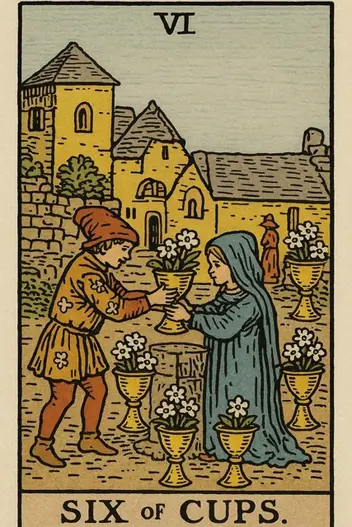
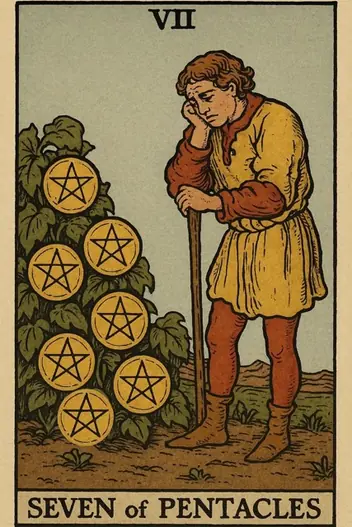
When the Six of Cups—the card of sweet memories, innocence, and emotional gifts—meets the Seven of Pentacles—the card of patient assessment, delayed rewards, and strategic re-evaluation—a compelling tension arises. This is not a quick, impulsive pairing. Instead, it describes a psychological state where you are drawing on past emotional experiences or relationships to inform a long-term, practical decision. The core question becomes: Are you investing your emotional energy wisely, or are you clinging to a memory that has no future?
This combination demands a pragmatic blend of heart and head. The Six of Cups offers the emotional blueprint—what felt good, what was nurturing, what you miss. The Seven of Pentacles insists you pause, look at the results of your current efforts, and ask whether that blueprint is still viable. It is a powerful archetype for anyone facing a crossroads between sentimental attachment and sustainable growth. The key insight is that nostalgia can be a compass, but it should not be a cage.
What Do Six of Cups and Seven of Pentacles Mean Together?
The psychological interplay here is one of evaluating emotional investments. The Six of Cups represents a reservoir of positive past experiences—relationships, childhood joys, or a simpler time. The Seven of Pentacles represents the farmer surveying his field, checking for growth, and deciding whether to prune, fertilize, or abandon the crop. Together, they create a mindset where you are reviewing the "return on investment" of your emotional history.
This is not about living in the past; it is about using the past as data. You may find yourself revisiting an old hobby, reconnecting with a friend from long ago, or considering a career path that once brought you joy. The Seven of Pentacles energy forces you to ask: Is this effort yielding the results I want? The danger is cognitive bias towards the "good old days", where you overvalue past comfort and undervalue present reality. The mature response is to honor the memory, extract the lesson, and then make a cold-eyed assessment of whether repeating that pattern is actually productive.
In practical terms, this combination often appears when you are waiting for a payoff from a relationship or project that has roots in the past. You might feel a mix of hopeful nostalgia and frustrating impatience. The strategic move is to acknowledge the emotional value of what came before, but to set clear, measurable criteria for what you need to see in the next cycle. Patience is required, but so is honest self-appraisal.
Ask your question and flip the cards
or simply focus on it
Love and Relationships
If you are single:
This pairing suggests you are comparing new potential partners to an idealized past relationship. Focus on whether the current connection offers genuine, sustainable compatibility, not just a familiar emotional echo. Do not let nostalgia for an ex blind you to a present opportunity.
If you are in a relationship:
You and your partner may be in a phase of reviewing the history of your bond. Are you both investing equally in its future? One partner may be clinging to "how things used to be," while the other is focused on practical growth. Honest communication about shared goals is critical.
The relationship dynamic here is deeply about emotional accounting. The Six of Cups brings a desire to recreate a past feeling of safety, innocence, or unconditional acceptance. The Seven of Pentacles asks, "What have we actually built together, and is it growing?" This can manifest as a couple debating whether to move to a new city, have children, or simply change their routines. The shadow is passive-aggressive resentment—one partner feels they are doing all the work (Seven of Pentacles) while the other lives in pleasant memories (Six of Cups). The solution is a joint strategic review: list what you each value from your shared past, then co-create a plan for the next season. Bold move: schedule a "relationship audit" where you discuss what's working, what's not, and what needs to be reinvested in.
Your unique Tarot reading
See how these cards interact with your destiny. Start a free personal reading now.
Six of Cups and Seven of Pentacles: Career and Money
Strategic Opportunities:
Reconnect with a former mentor, client, or colleague who provided emotional or professional support in the past. This network could yield a slow-burn opportunity.
Strategic Opportunities:
Revisit an old business idea or skill set that you abandoned. The Seven of Pentacles suggests that with patient cultivation, it could now bear fruit.
Calculated Risks:
Avoid over-investing in a project purely because of sentimental attachment. Just because you started it years ago doesn't mean it's viable now. Objectively audit your time and money.
In the professional realm, this combination is a signal to conduct a performance review of your own history. Are you trading current growth for the comfort of a familiar role? The Six of Cups can represent a "golden handcuffs" situation—a job that feels safe because it reminds you of a simpler time, but which is stagnating your income or skill development. The Seven of Pentacles urges you to map your efforts against actual results. If you've been in the same position for years with no promotion, the nostalgia for "how good it used to be" is a trap.
Financially, this is a conservative but hopeful pairing. It suggests reviewing old investments or savings plans with fresh eyes. Perhaps a small, long-held asset (like a vintage item or a modest stock) is finally showing value. The warning is clear: do not throw good money after bad. If a project or investment is not showing measurable growth after a reasonable period, cut your losses and redirect your resources. The strategic advice is to create a "portfolio of patience"—allocate a small percentage of your capital to long-term, low-risk ventures that have emotional resonance, but keep the majority in liquid, high-growth assets.
What If Six of Cups or Seven of Pentacles Appears Reversed?
When cards appear in a reversed position, the dynamics become sharper and more conflicted.
Six of Cups Reversed:
This is blocked potential or recklessness. The person rejects lessons from the past, repeating the same mistakes, or conversely, gets stuck in a traumatic experience, unable to let it go. In combination with the Seven of Pentacles, this points to irrational spending — an attempt to "buy off" the past or prove something to a non-existent offender. Advice: stop trying to rewrite history.
Seven of Pentacles Reversed:
This is internal resistance or weakness. The person sees that their investments are not paying off but is afraid to admit it and change their strategy. A paralysis of will sets in. Paired with the Six of Cups, this manifests as "the sunk cost fallacy": you know you need to move on, but you cling to the past out of fear of the unknown. Advice: start small — close one unpromising project today.
BOTH Reversed:
Complete imbalance. This is a crisis of identity and resources. The person is simultaneously cut off from their past (doesn't understand where they came from) and sees no results in the present (a feeling that all efforts are in vain). This is a state of deep frustration. Method for correction: an urgent "digital detox" and a complete audit of all areas of life. It is necessary to artificially create structure: record every action and its result for a week to see an objective picture.
Shadow Side & Pitfalls
The shadow of this combination is sentimental paralysis. The seeker may become so attached to the memory of a past success, relationship, or identity that they refuse to see present decline. This manifests as the sunk cost fallacy—continuing to invest time, money, or emotion into a dead-end situation because "we've come this far." The Six of Cups can also trigger regressive behavior: acting like a child or a victim to get the nurturing you once received, rather than building adult resilience.
Another pitfall is passive waiting. The Seven of Pentacles can encourage a "just sit and watch it grow" mentality, but when combined with the Six of Cups' nostalgia, it can become lazy romanticism. You might wait for a relationship to magically return to its "golden age" without doing the work to change the present dynamics. Cognitive bias alert: the "rosy retrospection" bias will make the past seem far better than it was, leading to poor decisions in the present. The mature response is to grieve what was lost, learn the lesson, and then take one concrete action to move forward.
Six of Cups and Seven of Pentacles: The Combined Message
To constructively harness the energy of this pair, it is essential to translate nostalgia into strategy. The Six of Cups is your emotional capital and experience. The Seven of Pentacles is the tool for capitalizing on it. Do not reject the past, but do not live in it either. Your task is to take the best lessons, the best skills, and the best connections from the past, and then apply them to build a sustainable future.
Strategic advice: perform a "farewell to the past" ritual. Write down on a sheet of paper everything you hold onto "for memory's sake" or "out of a sense of duty"—old projects, toxic connections, outdated beliefs. Then, evaluate each item on a scale of 1 to 10 according to two criteria: "Emotional Value" and "Practical Benefit." If "Benefit" is below 5 and "Value" is above 7—you are in a trap. Make a decision: either invest resources into transforming this item, or let it go forever. There is no third option.
Where to Go From Here
The core message of the Six of Cups and Seven of Pentacles is that your past is a resource, not a residence. Honor the emotional gifts and lessons of your history, but apply them with the strategic patience of a farmer who knows when to harvest and when to let a field lie fallow. The key is to balance emotional warmth with cold analysis—ask yourself what you truly want to grow, and whether your current actions are aligned with that vision.
Ready to apply this archetype to your specific situation? The Fortune Cards app can provide a deep, personalized interpretation of this exact combination for your unique question. Whether you're navigating a career pivot, a relationship decision, or a financial review, the app uses your personal context to cut through the general advice and give you a tailored, actionable reading. Download it now or use it on the web to get your precise answer today.
Interpretation by the Fortune Cards editorial team, based on the Rider–Waite tradition and Jungian archetypes. About our methodology · Updated: 2026-08-01
Other Combinations with Six of Cups
Other Combinations with Seven of Pentacles
Explore Individual Card Meanings
Table of Contents
Ready to Discover Your Path?
Join thousands of seekers who have found clarity and guidance through our platform. Your cosmic journey awaits.