Ten of Swords and Four of Pentacles Reversed in Tarot
- Arcana
- Ten of Swords — Minor Arcana, Swords; Four of Pentacles — Minor Arcana, Pentacles
- Elements
- Ten of Swords — Air; Four of Pentacles — Earth
- Elemental interaction
- Opposing elements — energies create tension
- Numerology
- 10 + 4 = 14 → 5
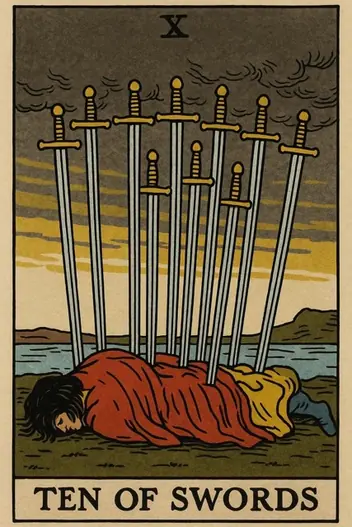
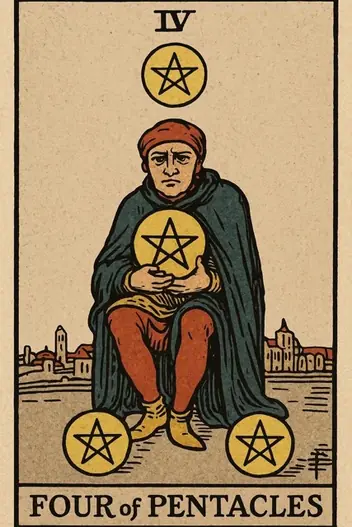
The Ten of Swords represents a definitive, often painful ending—the final blow that leaves no room for denial. It is the archetype of crisis, betrayal, or hitting rock bottom. In contrast, the Four of Pentacles symbolizes control, hoarding, and rigid boundaries—the psychological fortress built to prevent loss. When these two cards appear together, we witness a collision between the need to surrender to a painful truth and the desperate compulsion to cling to what remains.
This combination often emerges when a person has experienced a significant loss—whether of status, relationship, or identity—and responds by tightening their grip on material or emotional security. The result is a paradoxical state: you are lying in the emotional wreckage of the Ten of Swords, yet refusing to let go of the very patterns that led there. The key insight here is that true recovery requires releasing control, not reinforcing it.
Ten of Swords and Four of Pentacles Together: Meaning
The psychological state created by this pairing is one of defensive paralysis. The Ten of Swords forces a confrontation with reality—a relationship has ended, a career path has collapsed, or a core belief has shattered. The Four of Pentacles then kicks in as a survival mechanism: the ego attempts to control what it can (finances, routines, possessions) to compensate for the chaos it cannot control. This is a classic cognitive bias known as the "illusion of control" —you overvalue the areas where you still have agency while denying the magnitude of the loss.
In practical terms, this combination suggests a person who is grieving but not processing. They may be holding onto a job that no longer fits, a savings account that cannot replace lost purpose, or a relationship dynamic that has already died. The Four of Pentacles here is a shield made of glass—it offers the illusion of safety but shatters under any real pressure. The challenge is to recognize that clinging to the past's debris prevents you from building a new foundation.
The real-world implications are stark: financial conservatism after a major loss can be wise, but emotional conservatism after a trauma is self-sabotage. This card pair asks you to distinguish between prudent risk management and fear-driven hoarding. The path forward requires a deliberate act of letting go—not of all resources, but of the rigid identity that ties your worth to what you possess or control.
Ten of Swords and Four of Pentacles in Career Readings
Strategic Opportunities:
Use the clarity from a recent failure to reevaluate your core priorities. A job loss or project collapse can force you to focus on what truly matters—skills, relationships, or a pivot to a more aligned path.
Strategic Opportunities:
Reassess your financial safety net without hoarding. The Four of Pentacles can be channeled into building a realistic emergency fund (3-6 months of expenses) rather than stockpiling out of anxiety.
Calculated Risks:
Avoid doubling down on a failing strategy out of fear of starting over. The Ten of Swords is a clear signal to stop throwing good money or effort after bad. Do not mistake stubbornness for resilience.
Professionally, this combination often appears after a significant career setback—a layoff, a failed business, a public mistake. The Four of Pentacles response is to become hyper-conservative: refusing to invest in new training, avoiding networking, or clinging to a safe but unfulfilling role. The practical danger here is that you are protecting yourself from further loss at the cost of future growth. The most effective strategy is to differentiate between "saving" and "stagnating." Save your resources, yes, but invest in your adaptability—update your resume, learn a new skill, or consult with a mentor. The real financial risk is not the cost of change, but the cost of staying still.
Your pair is already on the table. Ask your question and draw the clarifying card
or simply focus on it
Ten of Swords and Four of Pentacles Love Outcome
If you are single:
This combination warns against guarding your heart so tightly that you miss genuine connection. You may be projecting past betrayals onto new prospects, interpreting caution as wisdom when it is actually fear. Evaluate new connections based on current behavior, not past wounds.
If you are in a relationship:
The dynamic here often involves one partner feeling "stabbed in the back" (Ten of Swords) while the other clings to control (Four of Pentacles) . This can manifest as financial control, emotional withdrawal, or refusal to discuss painful issues. The relationship is stuck in a power struggle over who gets to define the narrative of the "ending."
In relationships, this pair signals a crisis of trust and territory. The Ten of Swords suggests that a betrayal or painful truth has surfaced—perhaps infidelity, a broken promise, or a fundamental incompatibility. The Four of Pentacles response is to tighten boundaries, withhold affection, or control finances as a form of punishment or protection. This creates a toxic loop: the more one partner tries to control, the more the other feels isolated and defensive. The key relationship advice here is to recognize that control is not intimacy. You cannot repair trust by building higher walls. Instead, focus on transparent communication about fears of loss—what are you actually afraid of losing? Your partner, your image, your financial security? Naming the specific fear allows you to address it, rather than acting it out through rigid behavior.
Your unique Tarot reading
See how these cards interact with your destiny. Start a free personal reading now.
Ten of Swords and Four of Pentacles Reversed Meaning
Reversed cards soften the fatalism of the Ten of Swords and weaken the grip of the Four of Pentacles, but they create new risks.
Ten of Swords Reversed (Four of Pentacles Upright):
You are resisting an inevitable end. You haven't survived a collapse; you've merely postponed it. This is a state of "frozen conflict," where you cling to dying projects or relationships, wasting energy. Warning: postponing the verdict does not mean acquittal.
Four of Pentacles Reversed (Ten of Swords Upright):
You have endured a blow, but your reaction is not defense, but recklessness. You are squandering your last resources, trying to buy comfort or prove you don't care. This is "gambler's last-ditch syndrome." Advice: stop before you lose your last foothold.
BOTH Reversed:
Complete imbalance. You are simultaneously experiencing a collapse and unable to find a foothold. This is a state of "chaotic recovery," where the fear of loss has given way to apathy. The best strategy is a complete time-out. Disconnect from all financial decisions and social contacts for 48 hours to allow your nervous system to reset.
The Shadow Side of Ten of Swords and Four of Pentacles
The shadow side of this pairing is self-sabotage disguised as self-protection. The Ten of Swords can represent a victim identity—you may unconsciously replay the narrative of being betrayed or defeated, using it as an excuse to avoid taking risks. The Four of Pentacles then feeds this by hoarding emotional energy and material resources, creating a prison of your own making. Cognitive biases at play include the "sunk cost fallacy" (clinging to a failing investment because you've already lost so much) and "catastrophizing" (assuming any new attempt will end in disaster). The most dangerous pitfall is confusing control with safety: you may feel secure with your walls up, but you are actually starving yourself of the connections and opportunities needed to heal.
Overall Meaning of Ten of Swords and Four of Pentacles
Constructive use of this dynamic requires paradoxical action: you must accept the loss in order to make room for something new. The Ten of Swords is not the end of life—it is the end of a specific chapter. Its energy is purification. The Four of Pentacles must transform from a "cage" into a "foundation." Instead of clinging to resources with a death grip, use them to create basic security that allows you to take risks.
Strategic advice: conduct a "fear audit." Write down exactly what you are afraid of losing (money, status, relationships). Then, next to each item, write: "What will I gain if I let this go?" You will see that behind the fear of loss lies the possibility of liberation. The Ten of Swords gives you the right to start anew, and the Four of Pentacles is the resource for that start—if you stop hiding it.
Your task is to stop being a victim of circumstances and become a strategist. Use the energy of the Four for planning, and the energy of the Ten for decisively letting go of everything that holds you back. True security lies not in holding on, but in the ability to survive after loss.
Your Next Step: Personal Context Matters
The Ten of Swords and Four of Pentacles together deliver a powerful message: you cannot hold onto the wreckage and build a new ship at the same time. The pain of the past is real, but the solution is not to freeze in a defensive posture. The path forward requires acknowledging the loss, releasing the need to control the uncontrollable, and making deliberate, small investments in your future. This is not about reckless abandon—it's about strategic surrender.
While this analysis provides a deep understanding of the archetypes, your specific situation is unique. The meaning of this combination shifts dramatically depending on whether you are the one who was betrayed, the one who ended things, or the one watching from the sidelines. To get a personalized, detailed interpretation of how the Ten of Swords and Four of Pentacles apply to your exact question—whether about a relationship, career decision, or personal crossroads—use the Fortune Cards app. You can access it on the web or download it to your device. Enter your specific question, draw these cards, and receive a tailored reading that addresses your unique context, timing, and psychological blocks. Don't settle for general advice when your life is specific.
Interpretation by the Fortune Cards editorial team, based on the Rider–Waite tradition and Jungian archetypes. About our methodology · Updated: 2026-10-01
Other Combinations with Ten of Swords
Other Combinations with Four of Pentacles
Explore Individual Card Meanings
Table of Contents
- Ten of Swords and Four of Pentacles Together: Meaning
- Ten of Swords and Four of Pentacles in Career Readings
- Ten of Swords and Four of Pentacles Love Outcome
- Ten of Swords and Four of Pentacles Reversed Meaning
- The Shadow Side of Ten of Swords and Four of Pentacles
- Overall Meaning of Ten of Swords and Four of Pentacles
- Your Next Step: Personal Context Matters
Ready to find answers to your questions?
Start your first reading now and look at your situation with fresh clarity. The cards are ready to reveal deeper meaning.