Ten of Wands and Eight of Cups Meaning in Tarot
- Arcana
- Ten of Wands — Minor Arcana, Wands; Eight of Cups — Minor Arcana, Cups
- Elements
- Ten of Wands — Fire; Eight of Cups — Water
- Elemental interaction
- Opposing elements — energies create tension
- Numerology
- 10 + 8 = 18 → 9
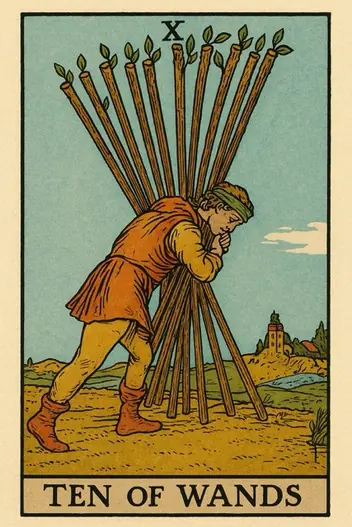
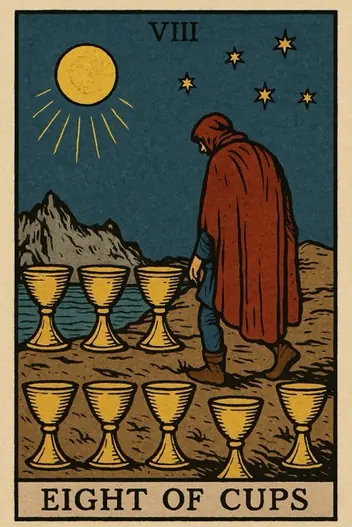
The Ten of Wands depicts a figure burdened by a heavy load, straining under the weight of accumulated responsibilities. The Eight of Cups shows a figure walking away from a stack of cups, leaving behind emotional investments that no longer serve them. When these two cards appear together, they signal a critical psychological crossroads: the moment when the cost of carrying too much finally outweighs the fear of leaving something unfinished.
This combination represents the tension between duty and self-preservation. The Ten of Wands embodies the archetype of the "burdened achiever"—someone who has taken on more than their fair share, often out of obligation, guilt, or a misplaced sense of control. The Eight of Cups embodies the "sovereign quitter"—the part of us that recognizes when persistence becomes self-destruction. Together, they ask a pragmatic question: Are you holding onto responsibilities out of genuine commitment, or are you simply afraid of the emptiness that follows letting go?
Ten of Wands and Eight of Cups Card Meaning Explained
The psychological state created by this pairing is one of exhaustion mixed with clarity. The Ten of Wands represents the physical and mental toll of overextension—late nights, missed boundaries, and a growing resentment toward tasks you once accepted willingly. The Eight of Cups introduces the painful but necessary act of selective abandonment. This is not about failure; it is about strategic withdrawal from situations that drain more energy than they return.
The key insight here is that carrying a burden does not automatically make it meaningful. The Ten of Wands often stems from a cognitive bias known as the "sunk cost fallacy"—the belief that because you have invested so much time, effort, or emotion into something, you must continue, even when the return has diminished. The Eight of Cups challenges this by asking you to distinguish between loyalty and masochism. When these cards combine, the healthiest response is to audit your commitments ruthlessly. Which tasks are truly yours? Which are you holding because no one else will? The answer will guide your next move.
From a Jungian perspective, this combination reflects the tension between the Persona (the social mask that says "I can handle it all") and the Shadow (the repressed desire to simply walk away). The Eight of Cups represents the integration of the "shadow quitter"—acknowledging that leaving is sometimes the most mature, responsible choice. The burden is not a badge of honor; it is a signal that your resources are mismatched with your environment.
Your pair is already on the table. Ask your question and draw the clarifying card
or simply focus on it
Ten of Wands and Eight of Cups for Career and Money
Strategic Opportunities:
Delegate or automate at least 30% of your current workload. The Ten of Wands indicates you are doing too much alone. Identify tasks that others can handle, even if you think you do them better.
Strategic Opportunities:
Re-negotiate terms with your employer or clients. This combination favors honesty over silent suffering. Ask for a deadline extension, a pay raise, or a redistribution of tasks.
Calculated Risks:
Resist the urge to quit impulsively. The Eight of Cups can indicate a desire to walk away entirely, but the Ten of Wands warns against abandoning a role without a clear next step. Leave only when you have a plan, not just when you are tired.
In a professional context, this pairing signals systemic overwork. You may be in a role where the expectations exceed the resources provided—too many projects, too little support, and an unspoken expectation that you will "figure it out." The Ten of Wands represents the physical manifestation of this imbalance (long hours, burnout, declining health). The Eight of Cups represents the psychological realization that this is unsustainable.
The strategic approach here is to shift from "doing more" to "doing what matters". Identify the 20% of your tasks that generate 80% of the value, and let the rest drop or be delegated. Financially, this combination warns against "golden handcuffs"—staying in a high-paying but soul-crushing job because you fear losing income. Bold important financial warnings or strategic tips: The cost of burnout is higher than the cost of a temporary pay cut. If your health or relationships are suffering, the Eight of Cups recommends a strategic exit, not a dramatic one.
Your unique Tarot reading
See how these cards interact with your destiny. Start a free personal reading now.
Ten of Wands and Eight of Cups Love Outcome
If you are single:
This combination suggests you may be carrying emotional baggage from past relationships that is preventing you from seeing new connections clearly. Stop trying to fix old patterns while expecting new results. The Eight of Cups advises a clean break from lingering attachments before pursuing someone new.
If you are in a relationship:
You or your partner may feel overburdened by the emotional labor in the relationship. This is a sign that one person is giving significantly more than the other, and resentment is building. The Eight of Cups warns that if this imbalance continues, one party may walk away without warning.
In relationships, the Ten of Wands and Eight of Cups together point to a power dynamic where one partner has become the "emotional mule". They carry the weight of arguments, apologies, planning, and emotional support, while the other remains passive. The Eight of Cups suggests that the burdened partner is nearing their threshold. They are not acting out of spite; they are acting out of survival. The pragmatic advice here is to initiate a direct, non-accusatory conversation about division of labor—both practical and emotional. If the other partner is unwilling to shoulder their share, the Eight of Cups validates the decision to walk away with dignity rather than collapse under the load.
Key relationship advice in bold:
Do not mistake endurance for love. If you are constantly exhausted by the relationship, it is not a sign of devotion; it is a sign of imbalance. The Eight of Cups is not about abandonment; it is about reclaiming your energy for relationships that are reciprocal.
Ten of Wands and Eight of Cups Reversed: What Changes?
When cards are reversed, the dynamic becomes distorted, turning into a trap.
Ten of Wands reversed:
This indicates blocked potential or reckless resistance. You know you are overloaded but refuse to admit it. Instead of setting down the burden, you take on even more, proving your "strength." Warning: such behavior leads to physical exhaustion and a nervous breakdown. Your task is to acknowledge your vulnerability.
Eight of Cups reversed:
This is inner resistance to change. You understand that you need to leave, but fear, guilt, or false hope keep you in place. You are stuck in a toxic environment because you fear the unknown. Advice: you need an external trigger (a mentor, a crisis) to get unstuck. Stop making excuses for inaction.
BOTH reversed:
Complete imbalance and chaos. You are simultaneously overloaded and unable to leave. This is a state of paralysis of the will. You know you need to change everything, but you do nothing. A logical way to fix it: start small. Don't try to leave entirely—give up one minor but irritating obligation. This will set the process in motion.
When Ten of Wands and Eight of Cups Signal Trouble
The shadow manifestation of this combination is self-martyrdom masked as responsibility. The Ten of Wands can lead to a victim mentality—where you take on extra work not because you must, but because you derive identity from being the "suffering savior." The Eight of Cups, in its shadow form, becomes escapism disguised as growth—walking away from commitments prematurely, blaming others for your burnout, or using "self-care" as an excuse to avoid difficult conversations.
Cognitive biases to watch for include the "just one more" fallacy (believing that completing one more task will finally bring relief) and "all-or-nothing thinking" (the belief that you must either carry everything or abandon everything). The healthiest path is not between these extremes, but a third option: strategic reduction. You do not need to drop all your cups; you simply need to carry fewer of them. Avoid the trap of making your suffering your identity. The Eight of Cups is not about running away; it is about choosing what to leave behind with intention.
Overall Meaning of Ten of Wands and Eight of Cups
How to constructively use the energy of this pair? The first step is to acknowledge that you are not obligated to carry what you did not choose. The Ten of Wands often arises from an inability to say "no." Your task is to audit all your commitments. Divide them into three categories: "Mine," "Someone else's, but I can delegate," and "Someone else's, and I refuse." Discard the last category without regret.
The second step is to transform the Eight of Cups from an escape into a strategy. The departure should not be a reaction to pain, but an action based on a clear goal. Ask yourself: "Where am I going? What am I seeking?" If the answer is "just far away from here," you risk jumping from the frying pan into the fire. Formulate a specific criterion for what you want to find (e.g., "a job with a flexible schedule" or "a relationship without enmeshment").
A deep strategic advice: use the energy of the Ten of Wands as fuel for your departure. Do not try to leave quietly and discreetly, fearing to offend. Your overload is your argument. In negotiations with a boss or partner, you can honestly say: "I am at my limit. If nothing changes, I will leave." This will give you strength and clarity. The combination of these cards teaches us that true strength lies not in enduring, but in knowing when to stop and go where you are awaited, not used.
Where to Go From Here
The Ten of Wands and Eight of Cups together deliver a clear message: You have been carrying too much, and the only way forward is to put some of it down. This is not a call to quit everything, but to audit your commitments with ruthless honesty and decide which ones are truly yours. The burden you feel is not a character flaw; it is a signal that your current strategy is no longer working. The courage to leave is not weakness; it is wisdom.
While this article provides the general archetype of this card combination, the true magic happens when Tarot is applied to your unique situation. The Fortune Cards app allows you to input your specific question—about a relationship, a career decision, or a personal dilemma—and receive a deep, personalized interpretation of this exact combination right now. You can use it on the web or download it to get the clarity you need to make your next move with confidence.
Interpretation by the Fortune Cards editorial team, based on the Rider–Waite tradition and Jungian archetypes. About our methodology · Updated: 2026-08-26
Other Combinations with Ten of Wands
Other Combinations with Eight of Cups
Explore Individual Card Meanings
Table of Contents
- Ten of Wands and Eight of Cups Card Meaning Explained
- Ten of Wands and Eight of Cups for Career and Money
- Ten of Wands and Eight of Cups Love Outcome
- Ten of Wands and Eight of Cups Reversed: What Changes?
- When Ten of Wands and Eight of Cups Signal Trouble
- Overall Meaning of Ten of Wands and Eight of Cups
- Where to Go From Here
Ready to find answers to your questions?
Start your first reading now and look at your situation with fresh clarity. The cards are ready to reveal deeper meaning.