The Hierophant and Five of Swords Together in Tarot
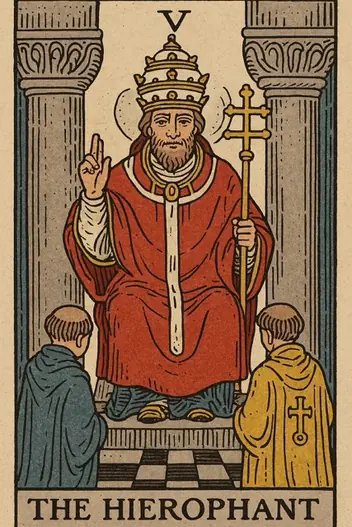

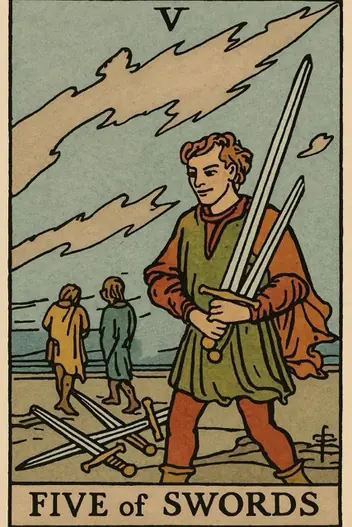
- Arcana
- The Hierophant — Major Arcana; Five of Swords — Minor Arcana, Swords
- Elements
- The Hierophant — Earth; Five of Swords — Air
- Elemental interaction
- Opposing elements — energies create tension
- Numerology
- 5 + 5 = 10 → 1
When The Hierophant—the card of tradition, institutions, and shared belief systems—collides with The Five of Swords—the card of hollow victory, conflict, and cutting losses—you get a psychological landscape where authority is challenged through ruthless pragmatism. This pairing often signals a moment when someone uses established rules or moral high ground as a weapon, or when a person must choose between loyalty to a system and their own strategic survival.
The core tension here is between conformity and self-preservation. The Hierophant represents the comfort of the known: marriage, corporate hierarchy, religious dogma, or academic credentials. The Five of Swords represents the cost of winning: isolation, guilt, or a pyrrhic victory. Together, they ask: Are you fighting for the right reasons, or just to prove you can win within someone else’s game?
What Do The Hierophant and Five of Swords Mean Together?
The psychological dynamic created by The Hierophant and Five of Swords is one of calculated rebellion within a structured environment. You are not breaking the rules—you are using them selectively to your advantage. This can manifest as a person who twists institutional policy to justify a personal vendetta, or as a leader who sacrifices a subordinate to protect the system’s reputation. The core mindset is defensive pragmatism: you believe you must win at all costs because the alternative is losing your place in the hierarchy.
This combination often appears when a power struggle is underway, but it is masked as a matter of principle. For example, a manager may fire an underperformer not because it is fair, but because it upholds a performance metric that protects their own job. The psychological cost is cognitive dissonance: you know your victory came at someone else’s expense, but you justify it by appealing to higher authority or tradition. The key insight here is that this energy works best for short-term survival, but it erodes trust and long-term relationships.
The real-world implication is that you must decide whether you are defending a system you genuinely believe in, or simply using it as a shield for selfish gain. The Five of Swords warns that even if you win this battle, you may lose the war—especially if your allies see you as a ruthless opportunist rather than a principled leader.
Career Meaning of The Hierophant and Five of Swords
Strategic Opportunities:
Use established protocols or mentorship to navigate a conflict with a competitor or colleague. Leverage your knowledge of the system to outmaneuver someone who is playing dirty.
Strategic Opportunities:
If you are in a leadership role, this combination can help you enforce necessary discipline without emotional attachment. Use clear policies to justify a difficult decision (e.g., termination, budget cuts).
Calculated Risks:
Avoid making enemies in the process of winning. The Five of Swords warns that a short-term victory may cost you long-term allies or reputation. Do not gloat or humiliate others.
In a professional context, The Hierophant and Five of Swords suggest a high-stakes negotiation or a competitive environment where rules are both a shield and a sword. You may be dealing with a boss or client who uses corporate policy to stonewall you, or you may be the one using compliance as a weapon. The most strategic move is to focus on objective facts rather than personal attacks. If you are being challenged, document everything and appeal to higher authority (HR, industry standards, legal precedent). If you are the challenger, ensure your victory is clean—no one should be able to accuse you of unethical behavior.
Financially, this combination warns against “winning” a settlement or deal that leaves you isolated. For example, winning a lawsuit but destroying a partnership, or getting a promotion by undermining a colleague. The best financial advice here is to prioritize sustainable success over immediate gain. Ask: Will this victory make me more secure, or just more alone?
Your pair is already on the table. Ask your question and draw the clarifying card
or simply focus on it
What Do The Hierophant and Five of Swords Say About Love?
If you are single:
This pairing suggests you may be attracted to someone who represents stability or authority (a mentor, a boss, an older figure), but the dynamic could become competitive or manipulative. Be wary of using “traditional values” as a reason to pressure someone into a commitment.
If you are in a relationship:
You or your partner may be using shared beliefs (religion, family expectations, financial goals) as leverage in an argument. The fight may be about who is “right” rather than what is healthy for the relationship.
In relationships, The Hierophant and Five of Swords indicate a power struggle disguised as a moral disagreement. One partner may feel they have the “right” way to do things (finances, parenting, social roles) and use that as a weapon to dominate the other. The Five of Swords warns that even if you “win” the argument, you will damage intimacy. The key relationship advice here is to distinguish between shared values and personal control. Ask yourself: Are you fighting for the relationship’s integrity, or for your ego’s need to be right?
Emotional intelligence is critical in this dynamic. The person who holds The Hierophant energy often feels righteous; the person embodying Five of Swords feels resentful. To break the cycle, both parties must agree to a truce based on mutual respect, not on who has the most authority. If you are the one wielding the rules, consider whether your partner’s dissent is a sign of independence or a genuine threat. If you are the one losing, ask if the relationship’s structure is worth the cost of your self-respect.
What If The Hierophant or Five of Swords Appears Reversed?
If The Hierophant is Reversed:
The potential to use tradition as a resource is blocked. The person may rebel against rules without any strategy behind it. Advice: Do not deny rules for the sake of denial. First, figure out which ones are actually hindering you and which ones are protecting you.
If the Five of Swords is Reversed:
Aggression turns inward, transforming into passive aggression or internal resistance. Instead of open struggle — sabotage, gossip, and "behind-the-scenes games." Warning: This position is more dangerous than a direct attack, as it destroys the system from within, leaving no room for dialogue.
If BOTH are Reversed:
Complete imbalance. The person simultaneously despises authority and fears conflict. This leads to chaos and an inability to defend one's boundaries. Method of Correction: It is necessary to find a "third force" — a neutral arbiter or mentor who is not part of the conflict — and begin building relationships from scratch based on clear, voluntarily accepted rules.
Get a personalized interpretation
Unlock the combined meaning of your cards in the context of your unique question — for free.
What Are the Risks of The Hierophant and Five of Swords?
The shadow manifestation of The Hierophant and Five of Swords is authoritarian manipulation. This is the energy of a cult leader, a corrupt bureaucrat, or a partner who uses “tradition” to justify abuse. The seeker may suffer from confirmation bias, only seeing evidence that supports their position while ignoring the human cost. Alternatively, they may engage in moral licensing, believing that because they are “following the rules,” their ruthless behavior is justified.
Cognitive biases to watch for:
The sunk cost fallacy (continuing a harmful fight because you’ve already invested so much), authority bias (blindly trusting a system or person because of their title), and self-serving bias (attributing your own win to skill and others’ losses to their flaws). If you feel a sense of grim satisfaction after a conflict, check whether you are actually proud of your actions or just relieved to have survived.
Self-sabotage occurs when the seeker becomes so attached to being “right” that they alienate everyone around them. The Five of Swords often leaves the winner standing alone on the battlefield. If you see this combination, ask yourself: Am I willing to lose relationships to win an argument? If the answer is yes, you may be in your shadow.
What Is the Overall Message of The Hierophant and Five of Swords?
Constructive use of this pair's energy requires mental discipline. The Hierophant provides you with structure and an understanding of the "rules of the game," while the Five of Swords offers analytical sharpness and the ability to see weak points. Your task is not to attack the system, but to improve it from within. Use your knowledge of traditions (The Hierophant) to find the most effective and least costly way to implement changes.
The Five of Swords is not a tool for war, but a scalpel for surgery. Apply its sharpness to remove what has outlived its usefulness, but do so with respect for the structure. The strategic advice: turn conflict into negotiation. Instead of proving that old methods are bad, propose a new interpretation of old principles that will satisfy everyone. Your strength lies in synthesis: you respect the past, but are not afraid to criticize it for the sake of the future. Clarity comes when you understand that your main battle is not with people, but with outdated ideas.
Your Next Step: Personal Context Matters
The Hierophant and Five of Swords together deliver a stark message: You can win by the rules, but you may lose your peace. This combination is not inherently negative—it can help you enforce boundaries or exit a toxic institution—but it demands honesty about your motives. The core question is: Are you defending a principle, or just your pride? The answer depends entirely on your personal situation, your history, and the specific question you asked.
To truly understand what this combination means for you, context is everything. The general archetypes here are powerful, but they become transformative when applied to your unique circumstances. That is why I recommend using the Fortune Cards app for a personalized reading. Whether you access it on the web or download it, the app can analyze your exact question, your relationship history, or your career dilemma, and give you a tailored interpretation of The Hierophant and Five of Swords. Stop guessing—get the clarity you need to make your next move with confidence.
Interpretation by the Fortune Cards editorial team, based on the Rider–Waite tradition and Jungian archetypes. About our methodology · Updated: 2026-08-26
Other Combinations with The Hierophant
Other Combinations with Five of Swords
Explore Individual Card Meanings
Table of Contents
- What Do The Hierophant and Five of Swords Mean Together?
- Career Meaning of The Hierophant and Five of Swords
- What Do The Hierophant and Five of Swords Say About Love?
- What If The Hierophant or Five of Swords Appears Reversed?
- What Are the Risks of The Hierophant and Five of Swords?
- What Is the Overall Message of The Hierophant and Five of Swords?
- Your Next Step: Personal Context Matters
Ready to find answers to your questions?
Start your first reading now and look at your situation with fresh clarity. The cards are ready to reveal deeper meaning.